



Skip to content
DataHub
Get a Demo
Product Overview

Product Overview

AI-powered discovery, governance, and observability unify across your data estate to deliver data quality, compliance, and AI readiness.

Learn more

Platform

  • Discovery
  • Observability
  • Governance
  • Lineage
  • AI
  • Context Management New

Explore

  • The ROI of DataHub Cloud
  • DataHub Cloud vs Core
  • Integrations
  • Product Demos
Join the Community

Join the Community

Get help, share ideas, and connect with the DataHub community on Slack.

Learn more

Engage

  • Join the Community
  • Town Halls
  • Docs
  • Champions

Connect

  • Slack
  • Youtube
  • Office Hours
Pinterest Powers its #1 AI Agent with DataHub Context

Pinterest Powers its #1 AI Agent with DataHub Context

Modern data discovery goes beyond search. Learn how DataHub connects your data estate end-to-end.

Learn more
Resources
  • Blog
  • Guides
  • Events
  • Customer Stories
  • Webinars

Support

  • Docs
  • Get Support
  • Live Group Demo
Context Management for Enterprise AI

Context Management for Enterprise AI

The complete resource hub for context management: foundational concepts, architecture guides, implementation patterns, and comparisons.

Learn More

Hubs

  • Context Management
  • Data Lineage Coming Soon
Careers

Careers

Data is powering AI. But without context, even the best models fall short. Join us.

Learn more

Company

  • About us
  • Careers
  • News
Partners
  • AWS
  • Google Cloud
  • Snowflake
  • Databricks
DataHub
  • Platform

    • Discovery
    • Observability
    • Governance
    • Lineage
    • AI
    • Context Management New

    Explore

    • The ROI of DataHub Cloud
    • DataHub Cloud vs Core
    • Integrations
    • Product Demos
    Product Overview

    Product Overview

    AI-powered discovery, governance, and observability unify across your data estate to deliver data quality, compliance, and AI readiness.

    Learn more
  • Engage

    • Join the Community
    • Town Halls
    • Docs
    • Champions

    Connect

    • Slack
    • Youtube
    • Office Hours
    Join the Community

    Join the Community

    Get help, share ideas, and connect with the DataHub community on Slack.

    Learn more
  • Resources
    • Blog
    • Guides
    • Events
    • Customer Stories
    • Webinars

    Support

    • Docs
    • Get Support
    • Live Group Demo
    Pinterest Powers its #1 AI Agent with DataHub Context

    Pinterest Powers its #1 AI Agent with DataHub Context

    Modern data discovery goes beyond search. Learn how DataHub connects your data estate end-to-end.

    Learn more
  • Hubs

    • Context Management
    • Data Lineage Coming Soon
    Context Management for Enterprise AI

    Context Management for Enterprise AI

    The complete resource hub for context management: foundational concepts, architecture guides, implementation patterns, and comparisons.

    Learn More
  • Company

    • About us
    • Careers
    • News
    Partners
    • AWS
    • Google Cloud
    • Snowflake
    • Databricks
    Careers

    Careers

    Data is powering AI. But without context, even the best models fall short. Join us.

    Learn more
Get a Demo

The 3 Must-Haves of Metadata Management — Part 2

By: Maggie Hays

10.29.22

Contents

    I’m back with another post on metadata must-haves. Last time, I spoke about Metadata 360 and how it combines logical and technical metadata to manage and use metadata effectively. As the field evolves, metadata management trends are shaping how teams approach governance and impact. Today, I’m going to focus on a metadata management principle that I’m personally very, very enthusiastic about: Shift Left.

    In principle, Shift Left refers to the practice of declaring and emitting metadata at the source, i.e., where the data is generated. This means that instead of treating metadata as an afterthought (all too often the case!) and annotating it later, we emit metadata right where the code is managed and maintained.

    This is important for two reasons:

    1) It helps us meet developers or teams where they are — instead of forcing new processes or workflows upon them for the sake of documentation.
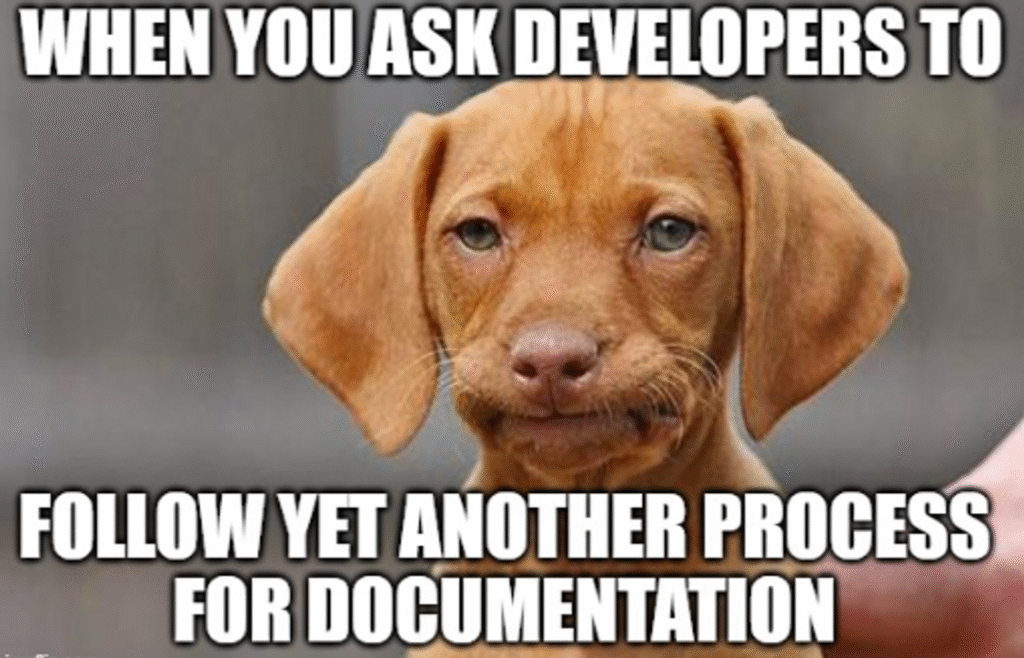
    Developer Meme

    2) It has a significant role to play in understanding the downstream implications of any changes or identifying breaking changes.

    Developer Meme

    We’re also exploring how automating data propagations can streamline metadata changes across downstream systems.

    DataHub and Shift Left

    To understand this, let’s go back to the example of our friends at Long Tail Companions (LTC) that we spoke about in Part 1. (Missed it? Read it here: The 3 Must-Haves of Metadata Management — Part 1). For practical applications and field-tested techniques, see our piece on metadata in action.
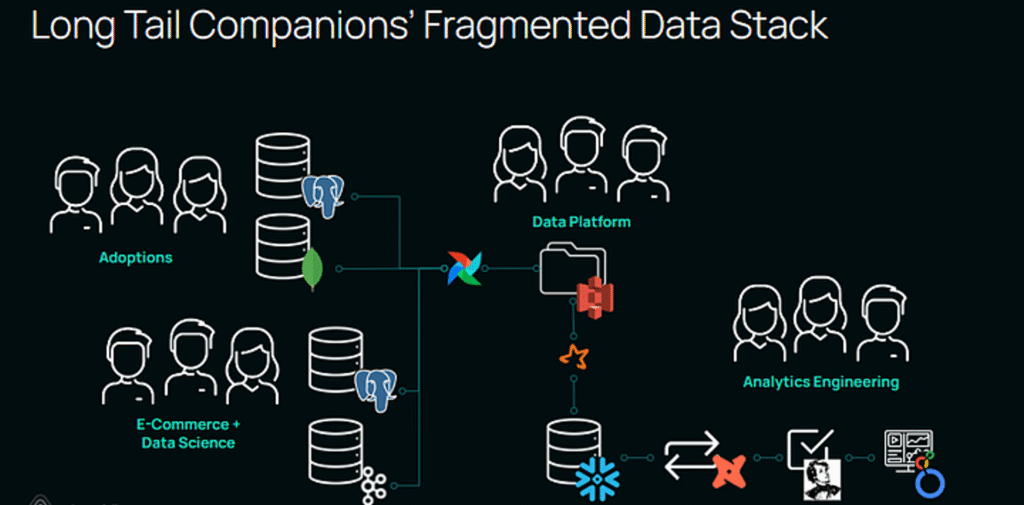
    Long Tail Companions' Fragmented Data Stack

    Shift Left: Metadata in Code

    The LTC Team can use meta blocks within the schema YAML for their dbt model to define metadata at source, as shown below.

    With this, the LTC Team can define a fully customizable meta block to capture the most critical metadata next to the code that generates the data, assigning:

    • asset ownership
    • model maturity status (Production or Development, for instance)
    • PII status
    • domain (common in organizations that are adopting Data Mesh)
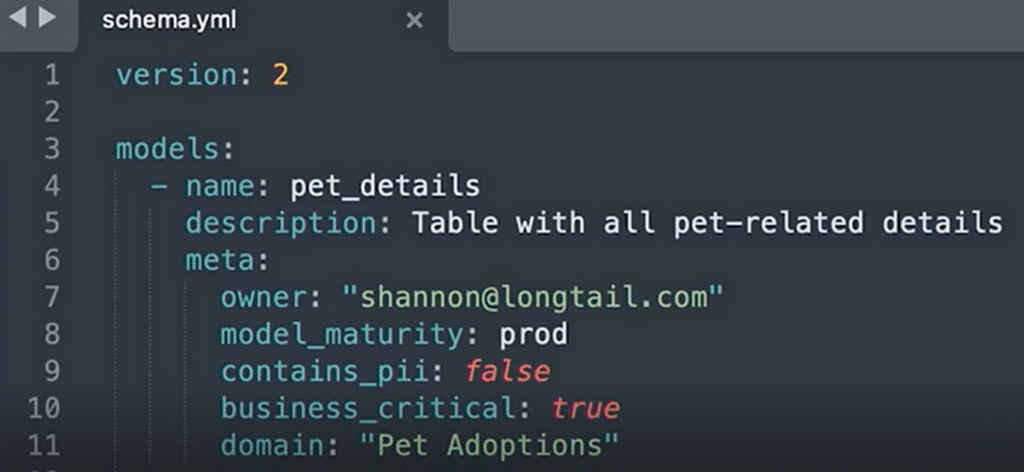
    schema.yml

    This way, the owner of a dbt model, can focus on building out the model, assigning it to different domains, and assigning tags to it — all within code.

    And the data catalog — DataHub in this example — can bubble it all up with all the associated context. For teams, an AI data catalog powered by knowledge graphs accelerates metadata discovery and governance.
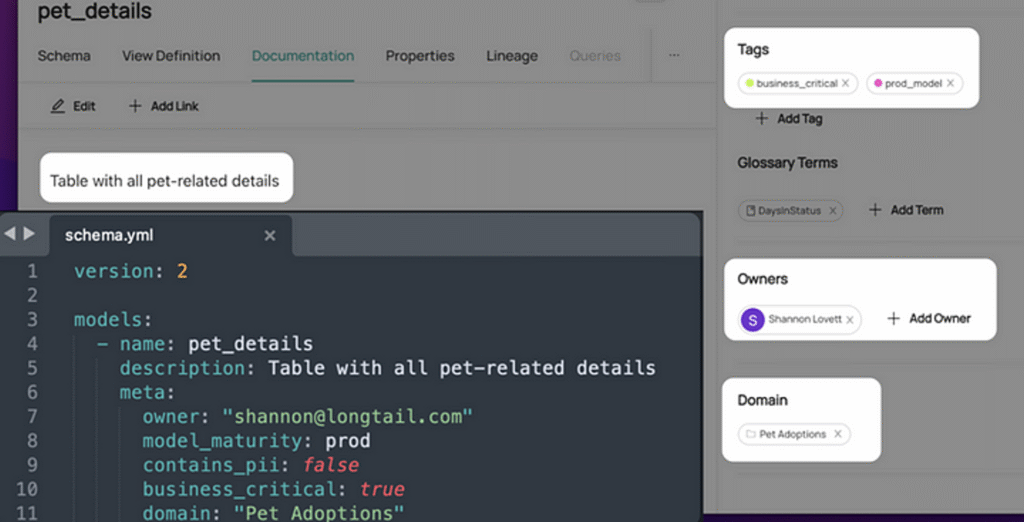
    How DataHub surfaces metadata added at source in its UI

    How DataHub surfaces metadata added at source in its UI

    Let’s also look at another application of Shift Left — this time, with LTC’s Ecommerce team that works with Kafka and Protobuf.

    The team can simply annotate their schema while adding it to their datasets (or topics as they are called in Kafka).
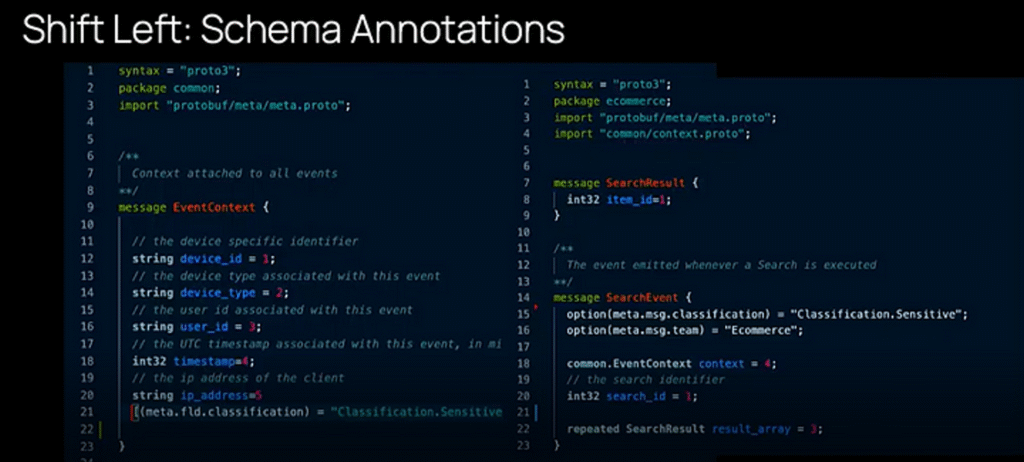
    Shift Left: Schema Annotations

    In the example of the Kafka Search Event above, you can see a few additional annotations marked as options, such as the

    • classification option (Classification.Sensitive)
    • team option (Ecommerce)
    • IP address field with a sensitive classification

    This approach ensures that schema annotations live alongside Protobuf schemas — putting business context and business metadata in line with their schemas.
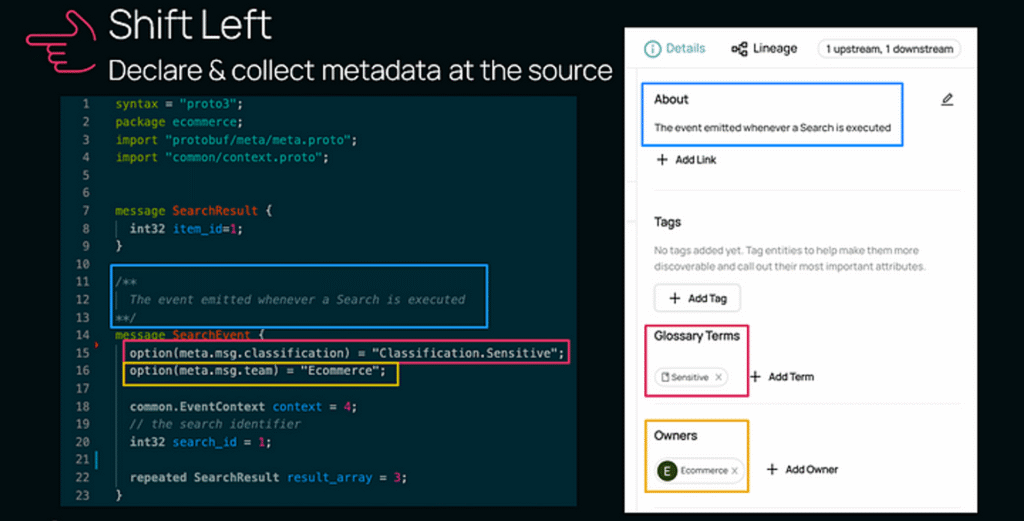
    Shift Left: declare & collect metadata at the source

    And on DataHub, searching for the Search Event surfaces individual elements from those schemas directly mapped into tags, terms, or documentation.

    Additionally, the team can use schema linters to validate if the schema has the required annotations before pushing metadata artifacts to DataHub via their CI/CD pipelines.

    I hope these examples using dbt and Kafka explain how the Shift Left principle can be tailored to different teams’ tools and development patterns — while ensuring the same discovery/surface experience within DataHub.

    Shift Left for Impact analysis

    Another important aspect of shifting left is moving focus leftwards towards production systems to understand the downstream impact.

    And here’s why emitting metadata at source helps: it ensures that you have a robust knowledge graph with a reliable view of interdependencies and how different components work together. The correct data catalog can help you use this rich metadata for impact analysis.

    DataHub’s Lineage Impact Analysis feature offers the ability to get a snapshot view of all the resources so individuals can proactively reach out to folks for conversations around breaking changes.
    Dependency Impact Analysis in DataHub

    Dependency Impact Analysis in DataHub

    You can look at the lineage, understand dependencies, and even export all this information in a CSV.

    Need any help understanding how you can use impact analysis in DataHub? Ask us on our Slack channel or check out the DataHub Lineage Impact Analysis feature guide.

    Our ongoing exploration of metadata management can be enriched by a modern take on metadata customization that adapts to how data is ingested and transformed.

    That’s it from me for now…oh, and one last thing before I go, do check out Shirshanka’s excellent blog post on Shifting Left on Governance.
    Curious to see DataHub in action?

    DataHub transforms enterprise metadata management with AI-powered discovery, intelligent observability, and automated governance.

    Meet with us

    See how DataHub Cloud can support enterprise needs and accelerate your journey toward context-rich, AI-ready data.

    Book a Demo DataHub Cloud

    Join our open source community

    Explore the project, contribute ideas, and connect with thousands of practitioners.

    Join the Slack community slack

    Recommended next reads

    View All Blogs
    Netflix Reimagines Discovery and Governance at Scale
    CUSTOMER STORY03.20.26

    Netflix Reimagines Discovery and Governance at Scale

    With DataHub, Netflix empowers teams to define and manage metadata through self-serve workflows, improving flexibility and governance.

    Introducing DataHub Cloud v0.3.17
    PRODUCT UPDATES03.24.26

    Introducing DataHub Cloud v0.3.17

    DataHub Cloud v0.3.17 brings native Microsoft Fabric connectors for cross-platform lineage, Ask DataHub Plugins for multi-tool context, and smarter data quality monitoring.

    The State of Context Management in 2026
    CONTEXT MANAGEMENT03.09.26

    The State of Context Management in 2026

    Survey data from 250 IT and data leaders exposes the gap between AI confidence and the context management infrastructure production-scale agentic AI demands.

    Product

    • Product Overview
    • Discovery
    • Observability
    • Governance
    • Lineage
    • AI Data Management
    • Context Management
    • The ROI of DataHub Cloud
    • Product Demos

    Community

    • Join the Community
    • Docs
    • Champions
    • Town Halls
    • Office Hours
    • Slack
    • Youtube

    Resources

    • Customer Stories
    • Blog
    • Guides
    • Articles
    • Webinars
    • Get Support

    Company

    • About Us
    • Leadership
    • News
    • Careers

    © 2026 Acryl Data, Inc.

    Privacy Policy Terms of Service Security