



Meet the Winners of Build with DataHub: The Agent Hackathon
Build with DataHub: The Agent Hackathon ran from July 6 to August 10, 2026, and asked one question: what can an agent do when it has real context about your data?
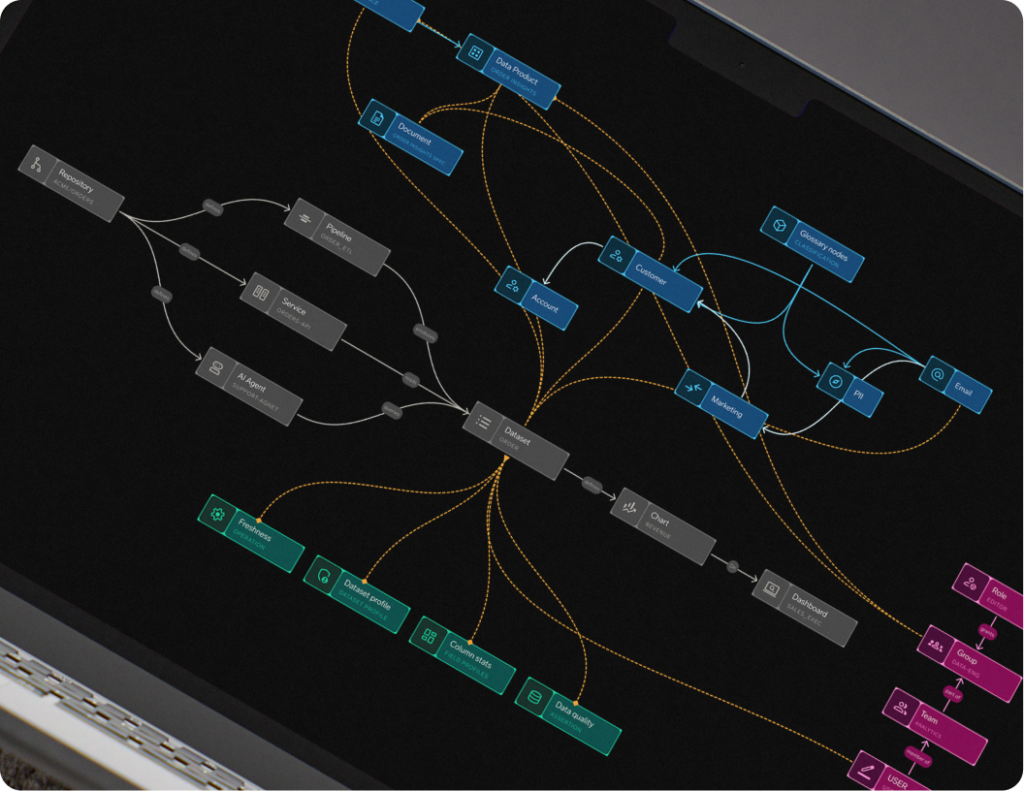
Not a mocked catalog. Not a hand-written schema in a prompt. Actual lineage, ownership, schemas, ML metadata, and governance signals, read from a running instance of the open-source context platform, acted on, and written back so the next person or agent inherits what the last one learned.
More than 600 projects were submitted across four challenge tracks. Seven of them shared the $20,500 prize pool, and every one of them is worth a look.
Here they are.
Grand prize: Project Blackbox
Alex Velazquez · View on Devpost
The worst data incidents do not crash anything. A payment provider quietly starts reporting amounts in cents instead of dollars, every schema still validates, every job stays green, and the executive revenue dashboard is wrong by two orders of magnitude until somebody notices.
Blackbox takes one plain-English sentence, “revenue just jumped, is this real?”, and works backwards. It reads DataHub lineage to localize the change, proves the root cause against a machine-enforced evidence gate, repairs the transformation code, runs the full invariant suite, opens a pull request for a human, and writes the resolution back to the catalog as an incident.
The project also holds itself to the standard it enforces. It ships an evaluation harness whose committed results record failures alongside successes, and an ablation scenario that re-runs the same incident with DataHub disabled to show what the context graph contributes. When the agent cites evidence that does not reference the asset it is investigating, the gate stops the run.
Challenge winners
Agents that do real work: Hindsight
Germán Massello · View on Devpost
Hindsight is an on-call agent for data platforms. It walks DataHub lineage to find what broke a dashboard, ranks the downstream consumers by who is affected, and writes its findings back as tags, incident banners, and a postmortem document.
Every write is verified by reading it back through a different API than the one that wrote it, and any tool without a verifier is marked failed rather than skipped. As Massello puts it, an agent that reports its own success proves nothing. The verdict defaults to insufficient_evidence, so a conclusion has to be earned, and memory lives inside DataHub as saved documents rather than a side database.
Metadata-aware code generation: Schema-Drift Auto-Repair Agent
Yadnesh Salvi · View on Devpost
An upstream team renames a column. Nothing errors, four downstream models keep running, and the numbers are quietly wrong for three days.
This agent uses DataHub’s column-level lineage to compute the true blast radius of a rename, retype, or drop, then rewrites the affected dbt models and Airflow DAGs and opens a pull request with the diff, generated tests, and a migration doc. It also decides what not to change, separating code that must be updated from downstream models already insulated by an alias created upstream, and reporting every skipped model with the reason. It writes its output back across nine aspect types, including fine-grained lineage, column documentation, tags, and an incident moved from triage to fixed.
Production ML: Culprit
Jonathan Andrei · View on Devpost
Culprit is a stack trace for model decay. It walks DataHub’s ML lineage from a degraded model back to the column that caused it, then prices the damage.
It runs on 19.3 million real New York City taxi trip records. When a new vendor entered the feed and one upstream column’s maximum value changed from six to seven, every freshness, volume, null-rate, and schema check stayed green while the model produced $90,322 of attributable error in a single month. Culprit rejected its own first fix, which would have destroyed 87,693 rows, and every headline number in the repository is checked by a script that fails if the prose and the data disagree.
Open and wildcard: Paracelsus
Lutfiya Miller and Chris Müller · View on Devpost
Point a data quality tool at a catalog and it returns hundreds of problems ranked by severity. Paracelsus argues severity is the wrong axis and borrows from toxicology instead: risk is hazard times exposure times receptor sensitivity times uncertainty.
Its central idea is that a successor count is not exposure, but successor use is. Paracelsus reads real lineage, query history, usage statistics, tags, and domains from DataHub to work out which findings a team should act on rather than which look alarming. It is also transparent about its own limits: seeded demo defects are labeled as curated in its own interface, and two of its five receptor categories are documented in the code as correctly implemented but dormant against this catalog.
Honorable mentions
ContextSeal
Mehmet Aydoğan · View on Devpost
ContextSeal certifies a proposed schema change before anyone implements it. It proves the exact target and field, captures bounded downstream paths and observed usage, computes a policy-versioned risk score, validates a non-destructive expand-migrate-contract package, and freezes an approval scope a human has to sign off before any write happens.
Its evidence is bound to a specific commit and hashed, and the write-back is verified by reading it back. Aydoğan also contributed a schema-change certification skill to DataHub Skills, with adversarial evaluation cases that test the skill against forged artifacts and a content-trust boundary that treats catalog metadata as untrusted input.
RippleProof
Muhammad Hassaan Javed · View on Devpost
RippleProof renames a warehouse column without breaking what depends on it. It reads DataHub lineage to find every affected dbt repository, generates the repairs, proves they build, and stops when it cannot prove them safe.
The generated migration runs against a real PostgreSQL instance in a disposable container with no network, and the rollback is verified to restore the original schema. Patches are content-addressed with hashes of both source and proposed files, so a patch cannot be applied to a file that has drifted. Javed also contributed a refinement to the DataHub MCP server, adding a cache-bypass option on lineage reads so an agent always works from the freshest graph.
The real prize: what the community gave back
The scoreboard is only part of the story. Across the hackathon, builders contributed 100+ pull requests to DataHub’s open-source repositories, new skills, connector enhancements, and documentation that makes the platform better for everyone who builds next.
Several came from winners on this page. Others came from builders who did not place but still strengthened the open-source stack for the whole DataHub community, including a new schema-change certification skill, a refinement to how lineage reads are cached, and clearer onboarding for first-time users. All of it is upstream, public, and shipping.
That is the part of a hackathon a prize pool cannot capture. People showed up, built on the open-source platform, and left it stronger than they found it. Thank you, that is what open source is supposed to feel like.
We also awarded 10 Most Valuable Feedback prizes to community members whose input is helping shape where DataHub goes next.
Build your own
Every project above runs on the open-source stack. Start with the DataHub quickstart to get an instance running locally, then connect an agent through the DataHub MCP Server to read lineage, schemas, and ownership the way these winners did.
The pattern in every winning entry was the same: read real context, act on it, write the result back. Congratulations to all seven teams, and thank you to everyone who built with us.