


Agents That Get it Right: How FIS Grounds Databricks Genie in Enterprise Context with DataHub
Every data team building conversational analytics eventually runs into the same problem: the agent gives you an answer, and you have no idea whether to trust it.
FIS ran into that problem while building a natural language query feature for its banking clients. Frank Showalter, Vice President of Data Engineering and Governance at FIS, led the team through it, and the architecture decision his team made along the way matters more than any single metric.
Why “it works in the demo” isn’t the bar
Generating SQL from a natural language question is not the hard part anymore. Generating the correct SQL, and being able to verify it’s correct, is. An agent can hand you a clean-looking answer built on the wrong join, the wrong filter, or the wrong table entirely, and nothing about the output tells you that happened.
Gartner predicts over 40% of AI agents will fail without trusted context, and the common failure modes are the ones you’d expect: wrong formulas, faulty joins, stale answers, no way to trace where a number came from.
Most teams find this out the same way. They roll out a conversational analytics agent, users try it, the agent gets something wrong, users stop trusting it, and the central data team becomes the bottleneck for every fix and every new question. Some teams respond by sitting subject matter experts down and manually documenting context. That works, narrowly, for the handful of tables and query patterns someone had time to cover. It does not scale to the size of a real enterprise data estate, where DataHub’s internal research found that a single table can take roughly 16 hours of workshop time to document properly.
FIS’s version of the context problem was bigger than most
FIS builds software for banks, serving more than 20,000 clients globally. Its clients process 75 billion transactions per year. FIS grew into that scale by becoming one of the largest financial software providers in the world, and the data complexity that comes with it grew right alongside it. The underlying data estate now runs into multiple petabytes.
The specific ask from the business was to enable FIS’s bank clients to ask natural language questions about their own customer data, delivered as a chat feature inside FIS’s existing product UI.
The catch: the data lived on a mainframe, where columns and tables carry no semantic meaning. Column names were a few letters and numbers, indistinguishable at a glance. You could guess a column held a name field. That guess wouldn’t get you much further.
Genie’s ontology derivation closed part of the gap on its own. What it couldn’t reach was the knowledge that never made it into any system — the definitions, edge cases, and institutional context that only subject matter experts knew.

“That got us honestly about halfway there. In any large enterprise, the real knowledge is gonna be tied up in people's heads, and I don't know anybody that's writing an adapter yet that can go into someone's brain and pull that out.”

On top of the context gap, FIS was working against a real deadline. The team needed to go from idea to demo to production in weeks. FIS published that context into Unity Catalog on a schedule rather than calling it live — a pattern that fit their timeline.
DataHub and Genie: complementary by design
Genie generates SQL. DataHub makes sure that SQL is grounded in something real — the definitions, ownership, and validated query patterns that Genie has no way to infer from a mainframe column name on its own.
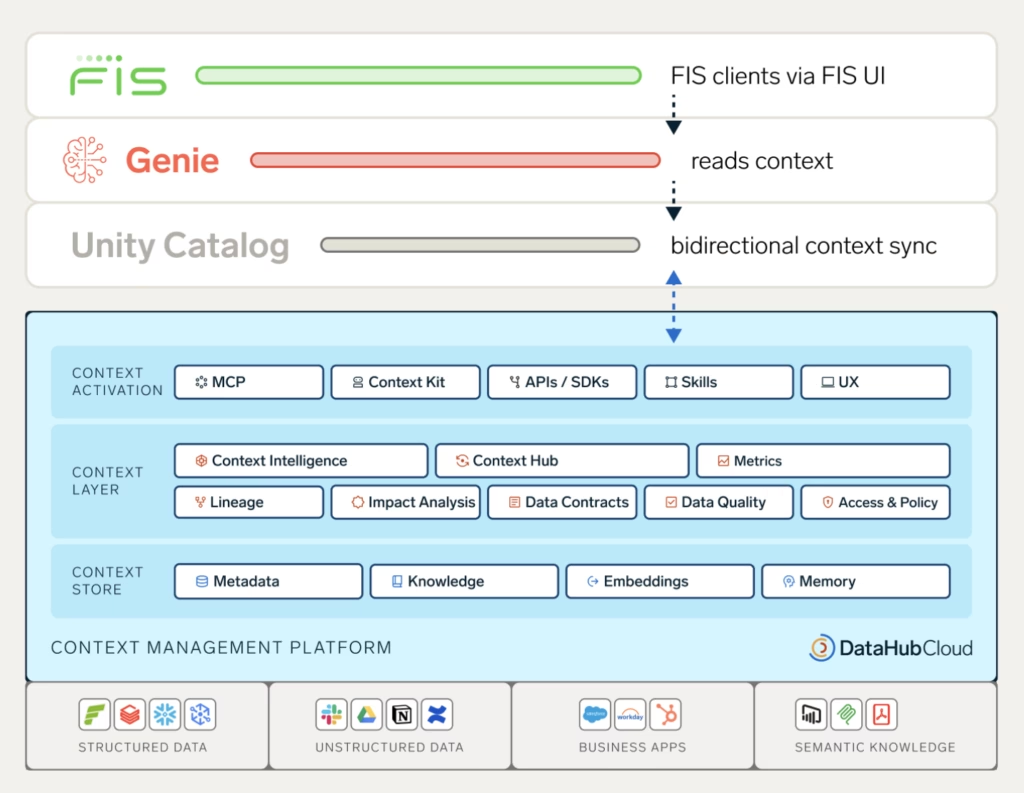
Four capabilities of the DataHub Context Platform got FIS there.
01 | Context Ingestion: DataHub scanned FIS’s data ecosystem continuously, building a unified context graph from mainframe-sourced tables, existing pipelines, and every system that touched them, even where the source columns carried no meaning on their own.
02 | Context Intelligence: Query history and existing patterns got mined into semantic meaning thatGenie’s ontology scan alone couldn’t reach. Genie’s scan got FIS about halfway there. Context Intelligence closed the rest with the definitions, edge cases, and institutional context that only lived in people’s heads.
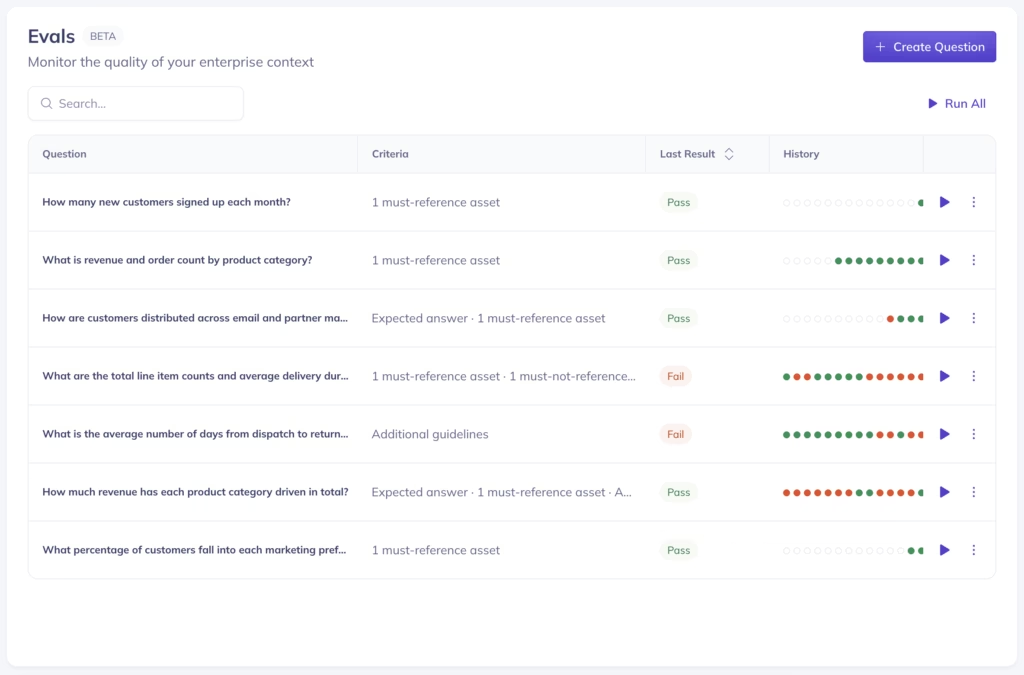
That kind of context isn’t a one-time setup anywhere it’s deployed. DataHub’s Evals capability runs continuously against real business questions, so if a definition drifts or a schema changes, the gap surfaces before someone downstream sees a wrong answer.
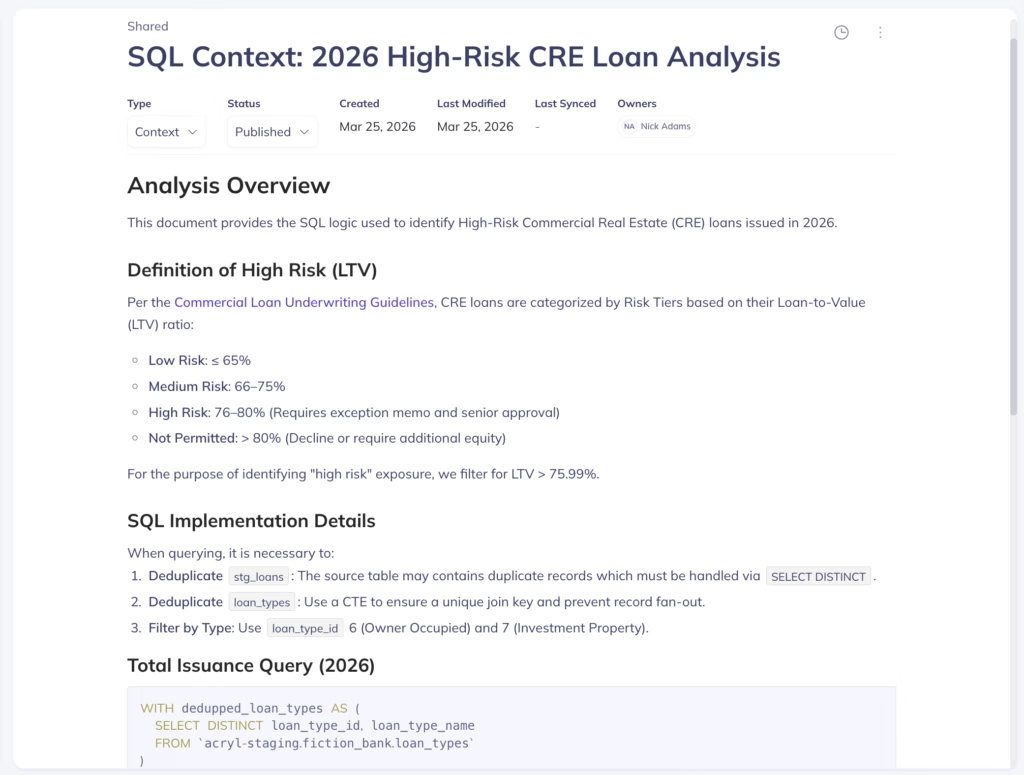
03 | Context Hub: Before anything reached Genie, FIS’s subject matter experts reviewed and approved the proposed context in a shared workspace built for them.
Where context is missing entirely, Context Hub also gives subject matter experts a way to add it directly, instead of routing it through a ticket to the data team.
04 | Context Activation: Context Activation makes validated context available to any agent, through APIs, SDKs, prebuilt skills, or MCP. Whichever surface an agent already uses, Context Activation meets it there.
“We got the full business and technical context, not just the column names. We have domains, ontologies. It's all in there. It's shareable.”
What DataHub’s context layer delivered for FIS
With DataHub Cloud and Genie at context layer in place, FIS reported the system delivers:
- Better Genie accuracy, because the agent is grounded in real business definitions instead of guessing at mainframe column names
- A net-new line of business, not just an internal efficiency win
- Context Activation: built once, then read everywhere, rather than re-documented per tool
- Full business and technical context including domains and ontologies
- Semantic meaning attached to every table in scope, closing the gap Genie’s ontology agent couldn’t close on its own
- Native integration into FIS’s existing product UI
Taken together, these outcomes aren’t one headline metric. They’re a repeatable way to ground new agents in a trustworthy context, regardless of platform.
“The net-net of it was we got better Genie accuracy. We got a net new line of business, a new product delivered.”