





Super Technologies turns 600 quality checks into company-wide confidence with DataHub and Snowflake

“Since launch, the overall organisation grew significantly while the number of questions about 'what does this table do', 'who owns this figure', or 'what is this column used for' dropped significantly.”

- Challenge: As the data and technology arm behind one of Europe's fastest-growing sports betting platforms, Super Technologies needed data quality, discovery, and ownership to scale reliably across 800+ professionals, four markets, and a product where data errors are not reporting problems but product failures.
- Solution: Deployed DataHub Cloud natively on Snowflake across the full organisation, combining 600+ custom SQL assertions running directly against Snowflake tables, automated metadata checks, lineage mapping, and a conversational discovery layer that connects every employee to governed, context-rich data.
- Impact: Caught a live P/L incident before it reached the business, reduced KPI lookup time from an orders-of-magnitude effort to seconds, and gave 200+ employees self-serve access to the answers that once required a data team member to provide.
The Challenge
What does it take to make data work at the speed of a live sports product?
Super Technologies is the technology and data arm powering Superbet, one of Europe’s fastest-growing sports betting and gaming businesses. With more than 800 professionals across engineering, product development, analytics, and data science, data is embedded in the product itself at Super Technologies. When data quality fails, it does not slow down a report. It compromises the product.
The company’s ambition is direct: become more data-driven, with AI accelerating engineering cycles, product design, and time to delivery. For AI to work at that scale, data processes need to be well documented, findable, and properly understood by everyone who depends on them, not just the people who built them.
Nikola Kljajo, Senior Engineering Manager at Super Technologies, was central to the deployment that made that possible. Before DataHub Cloud, the data estate had grown to the point where confirming ownership, pinpointing a KPI definition, or verifying lineage required effort that compounded with every new team member and every new data asset. Quality checks were entirely homegrown and manually maintained. As the estate grew, so did the cost of keeping those checks current, pulling engineering time toward upkeep and away from building.
A subtler problem made the scale harder still: AI-generated quality assertions, which Super Technologies tested, proved unreliable across a business operating in markets of very different sizes.
“AI assertions were creating a lot of noise, and it was relatively easy to have something misplaced. We have a business in a certain market that’s relatively minor compared to other markets. A data pipeline for it could go bust, feeding into the main fact table, and we would not know because an AI assertion would assume that this less-than-1% downscale was a normal business cycle.”
Nikola KljajoSenior Engineering Manager, Super Technologies
The Solution
How Super Technologies built data quality that scales
Super Technologies deployed DataHub Cloud to its data team first, as part of a phased rollout. The initial rollout period was used to tighten company-wide foundations that needed to be in place before a broader launch: KPI ownership definitions, report documentation standards, and the content infrastructure that would make the catalog genuinely useful to non-technical colleagues.
“DataHub Cloud overall had the best results in our data quality, lineage, and catalog PoC. They’ve also simply had the best team supporting us throughout that process, both from classical sales but more importantly, from the engineering perspective. All of our questions have been promptly answered, with a handful of them resulting in subsequent platform tweaks and updates.”
Nikola KljajoSenior Engineering Manager, Super Technologies
The deployment spans four DataHub Cloud capabilities that work together across the organisation.
01 | Glossary and ownership.The DataHub Glossary stores and defines KPIs across the organisation, with ownership and lineage connected to every entry. Combined with the DataHub Chrome extension, any employee can surface that context directly in the tool they are already using, without opening a separate system or asking the data team.
“It is now seconds for people to see the definition of the KPI figure they’re looking at and who owns it — a process that prior to DataHub took orders of magnitude more time.”
Nikola KljajoSenior Engineering Manager, Super Technologies
02 | Data Lineage. DataHub’s data lineage capability maps the movement of data across pipelines and systems, making it possible to trace where any figure originates and what depends on it. For a company where data is embedded in the product, lineage is an engineering tool as much as a governance one.
03 | Data Observability. Rather than defaulting to AI-generated smart assertions, the Data Platform team made a deliberate architectural choice: write more than 600 custom SQL assertions across raw, staging, and modeled data layers, combined with metadata checks for data freshness and volume.
The two-layer quality architecture runs continuously without the engineering overhead of a homegrown system. Metadata checks for freshness and volume execute at near-zero processing cost, providing immediate alerts the moment something shifts. The 600+ custom SQL assertions run in parallel, verifying data quality at depth across every layer.
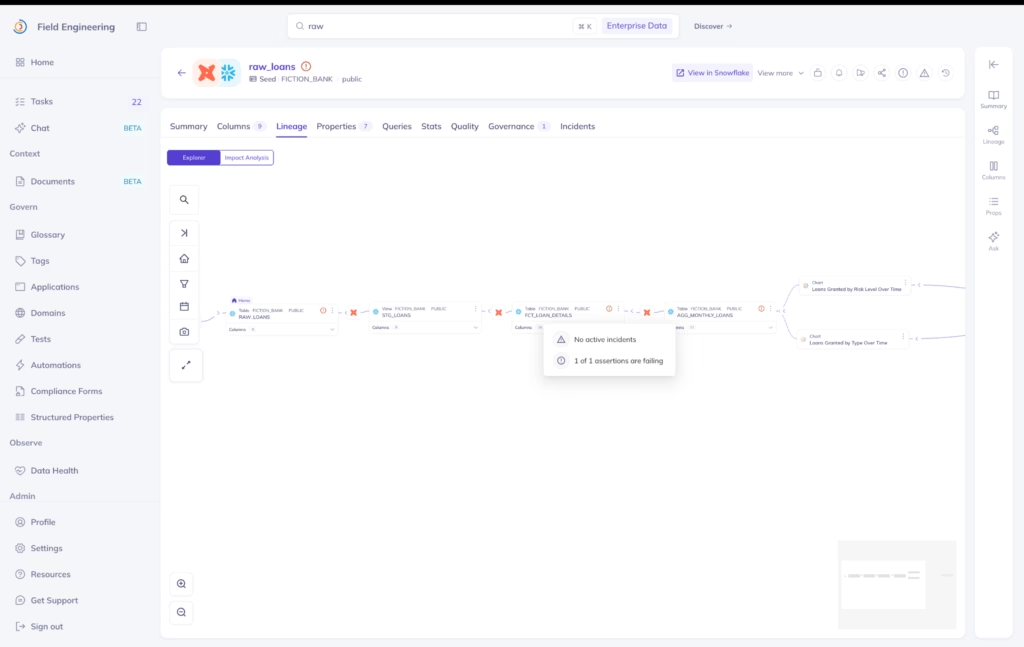
Because Data Observability on DataHub routes alerts to the right owners, and connects every check to lineage context automatically, engineers no longer spend time chasing failures through disconnected systems. They spend it building.
When the assertion framework detected a live disruption to the main P/L dashboard, the business never felt it.
“Because it was detected basically immediately, the on-call data engineer proceeded to fix it, and in the process discovered an underlying issue with another part of the data ingestion pipeline that would not have been a quick fix otherwise.”
Nikola KljajoSenior Engineering Manager, Super Technologies
04 | Ask DataHub. Data democratization and Self Service at Super Technologies is a company-level priority, and Ask DataHub is the mechanism the team is building that future on. Anyone in the organization can now ask where a figure comes from, who owns it, how fresh it is, or whether there are outstanding quality issues and get an answer grounded in governed, lineage-connected context. Engineering leadership became active champions because the answers arrived immediately, without routing requests through the data team.

Why Snowflake and DataHub Cloud are stronger together
DataHub Observe connects natively to Snowflake, running assertions directly against Snowflake tables without moving data out of the warehouse. Freshness and volume checks execute as lightweight metadata queries at near-zero processing cost. Custom SQL assertions run on existing Snowflake compute that don’t require a separate infrastructure, with no duplicate extraction or any additional security surface area.
When an assertion fails, every alert arrives with the upstream Snowflake lineage already attached. Engineers see exactly which table broke, what depends on it, and who owns it without leaving the platform.
For Super Technologies, that means 600+ continuous checks running across raw, staging, and modelled Snowflake tables, with incident routing and lineage context built in from the start.

The Impact
From specialist function to company-wide capability
Super Technologies turned data quality and discovery from tasks only the data team could handle into capabilities available to every person in the organisation. Key outcomes included:
- A live P/L incident caught and resolved before the business felt it. Data Observability on DataHub detected the disruption immediately, routed the alert to the on-call engineer, and in the course of the fix exposed a second hidden pipeline issue in the same session that would have been far harder to find otherwise.
- KPI lookup time reduced from minutes or sometimes an hour to seconds. Any employee can now surface the definition, owner, and lineage of any KPI figure via the DataHub Chrome extension, in the tool they are already using.
- Hundreds of employees now answer data questions without the data team. Across product, engineering, and business functions, self-serve discovery has become daily practice rather than a stated company priority.
- Engineering time shifted from maintaining infrastructure to building a product. The 600+ custom SQL assertions and near-zero-cost metadata checks replaced the homegrown quality system that had previously required ongoing engineer hours to sustain and scale.
- Engineering leadership became active internal advocates. Leaders described Ask DataHub as an extremely low barrier to entry, confirming that self-serve data access had reached the decision-makers who depend on it most.
What’s next
With the quality foundation in place, Super Technologies is now building a data quality dimensional model and KPI data mart fed directly from DataHub Cloud metadata, moving from anecdotal data health reporting to systematic measurement across uptime, time to resolution, and other core KPIs. In that model, DataHub Cloud becomes not just a catalog and governance platform but an operational data source, and the foundation for the AI-accelerated product development the company has set as its next horizon.
“We want everyone in the product part of the company to use it on a regular basis. Wherever there’s a data question DataHub Cloud can answer — lineage, where does something come from, who owns it, how often is it processed, are there any outstanding DQ issues — we’ll expect them to use it and not depend on the manual Q&A.”
Nikola KljajoSenior Engineering Manager, Super Technologies
Super Technologies: before and after DataHub Cloud
| Area | Before DataHub Cloud | With DataHub Cloud |
| Finding KPI definitions and owners | Significant effort to locate a definition, confirm ownership, and verify the source | Seconds, via DataHub Chrome extension surfacing definition and owner in context |
| Data quality checks | Entirely homegrown checks, manually maintained, with engineer time required to sustain and scale | 600+ custom SQL assertions plus metadata freshness and volume checks at near-zero processing cost |
| Pipeline failure detection | Alerting in place but observability limited to known failure modes | Assertions detect disruptions immediately, including in low-volume markets below 1% of total traffic |
| Inbound questions to the data team | Rising volume of “what does this table do/who owns this” requests as organization grew | Question volume fell as org grew, with Ask DataHub absorbing direct lookups |
Download the IDC Business Value study to see how DataHub Cloud customers achieve 91% faster data searches, 17% higher data engineering productivity, and 58% faster resolution of data-related outages.