



How Culture Amp Reinforced Data Governance and Cut Impact Analysis from Hours to Minutes

“With a single lineage view of what a table feeds, engineers, analysts, and data scientists can assess the impact of a schema change in minutes instead of hours. It reinforces our data governance program with clear visibility into how data flows.”

- Challenge: While strong documentation already existed across Confluence and GitHub, teams had to move between sources to use it.
- Solution: Culture Amp deployed DataHub Cloud as a unified front door for data context, with lineage across its warehouse and BI layer, and metadata search in Slack via DataHub MCP.
- Impact: Impact analysis time dropped from hours to minutes, with clear visibility into how data flows across thousands of data assets.
A note on how this works
DataHub and any AI or tools used with it only works with Culture Amp’s metadata. This includes information about the data such as a table’s name, its structure, and how it relates to others. It never touches the underlying records or values, including any customer data.
The Challenge
Ensuring documentation and data lineage is easily accessible
Culture Amp gives HR teams, leaders, managers, and employees the insights and tools to drive performance, retention, and growth. Customers trust Culture Amp with data from surveys, performance reviews, and 1-on-1s, so how that data is managed matters.
With 20 product teams feeding a multi-region data lake, Culture Amp’s Data Platform team, led by Product Manager Callum Lee, focuses on data governance and discovery. The opportunity was a more unified front door: one place where engineers, analysts, and data scientists could find data context and see how data flows, without bouncing between sources.
“While we already had documentation in GitHub and Confluence, the overhead of keeping it up to date and finding it was growing for both data producers and data consumers. The goal was a single place to manage and find it.”
Callum LeeProduct Manager, Culture Amp
The Solution
How Culture Amp built a central context layer for the data estate
DataHub is an open-source context platform that gives data teams a central catalog for data discovery, lineage tracking, ownership, and governance.
Culture Amp evaluated it against other data catalog providers and chose it for its lineage support across a multi-region architecture. DataHub’s fast development pace, open-source foundation, and a team that spoke the same technical language as Culture Amp’s engineers sealed it.
The reporting data warehouse was first, giving engineers end-to-end lineage from transformation models through to dashboards. Before DataHub, tracing a schema change’s downstream impact could mean several hours of manual querying through Redshift. Now an engineer can see the downstream assets a table touches in a single view and know immediately what a change affects and who to inform.
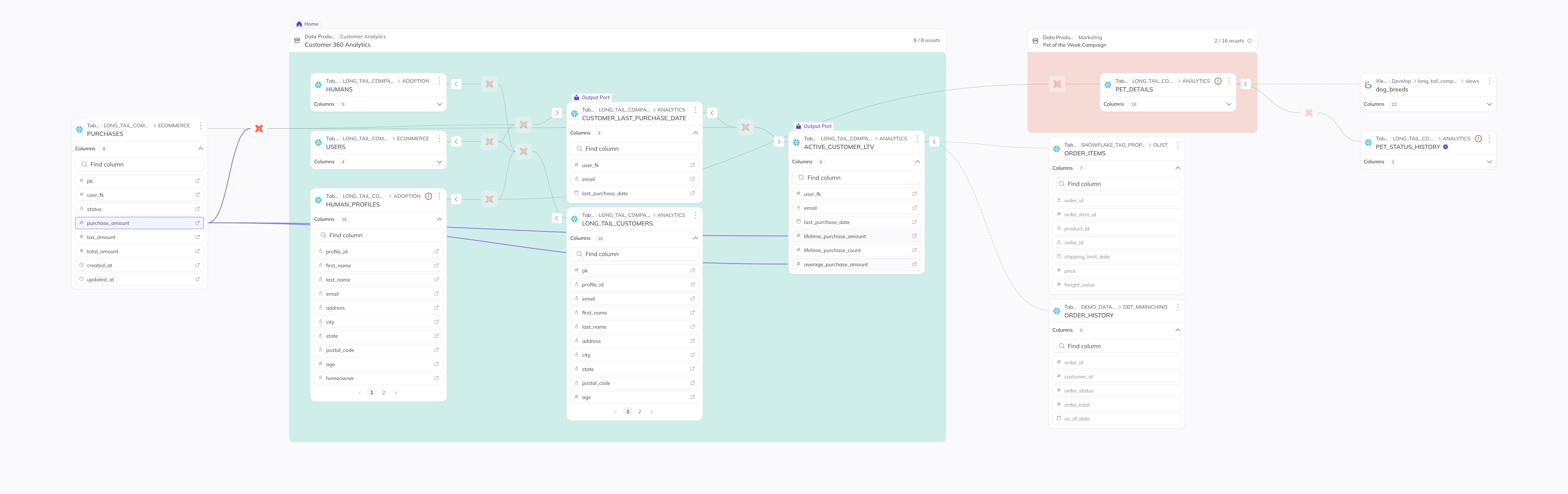
“We started from the reporting data warehouse and wanted to move backwards. The warehouse ingests from the data lake, the data lake from Kafka. This kind of multi-step data lineage meant we had several environments to catalog.”
Callum LeeProduct Manager, Culture Amp
“Having a well-documented inventory of our data, its owners, and its lineage is something we can point to directly when we’re asked about our governance program. When a customer asks whether we have lineage end to end, the answer is yes.”
Callum LeeProduct Manager, Culture Amp
“I was using a set of internal data models for an analysis and wanted to verify the source of some key fields in the SQL. I found the model in DataHub and traced it back to its origin. I could have used dbt’s own lineage for that, but DataHub’s become my default because it traces further back than dbt does, for example from a Looker chart all the way upstream.”
Naomi WoLead Product Analyst
Phase two expanded catalog coverage to Redshift Serverless clusters, roughly tripling the number of cataloged assets. This was also the right moment to connect DataHub’s Model Context Protocol (MCP) Server. Teams can now search the catalog to find and understand existing data assets, asking questions about table and column metadata directly in Slack via DataHub MCP, so context is available where they already work. Access is strictly limited to metadata.
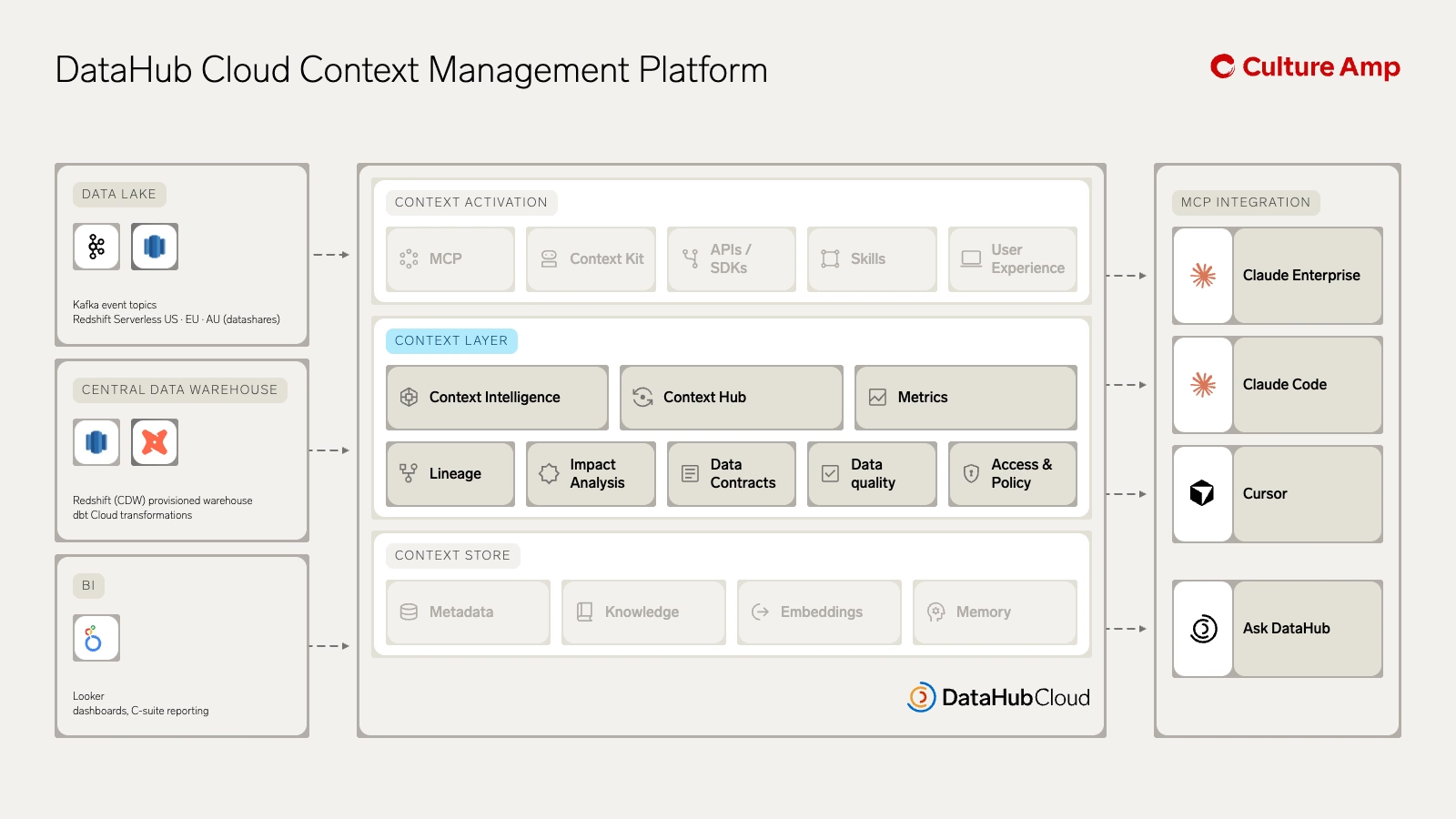
“People are less likely to adopt a new tool unless it fits how they already work. We wanted to meet users where they are, so more would use DataHub day to day.”
Callum LeeProduct Manager, Culture Amp
The Impact
Culture Amp gave its data engineers, analysts, and data scientists clear visibility into how data flows, inside the tools they already work in every day.
Key outcomes included:
Impact analysis cut from hours to minutes. Before DataHub, tracing a schema change on a widely-used table could mean hours of manual database querying to piece the picture together. Engineers can now see downstream lineage in a single view and know what is affected and who to inform before any change is made.
Lineage across systems from a single front door. With more than 11,000 assets cataloged, teams can follow how data moves between systems in one place.
Less rework. Teams can quickly discover whether a table already exists before building a new one. That means fewer duplicate assets to maintain, which improves governance.
Changes reviewed with context. Affected owners are identified and consulted before a change lands.
“My main use case has been using it as a double check for downstream impacts when I’ve been archiving or deprecating fields, views, and explores in Looker. It’s my final confirmation that I won’t break anything before merging the changes.”
Jill BourkeSenior Product Analyst, Culture Amp
Culture Amp: before and after DataHub Cloud
| Area | Before DataHub Cloud | With DataHub Cloud |
| Schema change impact analysis | Hours of manual database querying | Minutes, with downstream lineage visible in a single view |
| Change management | A manual, back-and-forth conversation between teams when making database, ETL, and dashboard changes | An automated feedback loop that flags downstream owners before a change ships |
| Dataset discovery | Search Glean, Confluence, Slack, contact the data owner | Search DataHub or query schema and lineage via the MCP |
| Documentation reach | GitHub repos and Confluence pages, cumbersome to navigate | Metadata surfaced in DataHub and via MCP |
| Duplicate work | Teams rebuilt business reporting tables that already existed | Users can quickly discover whether a table or dashboard exists, reducing the number of assets to maintain |
Learn more about DataHub Cloud Context Platform.