


What is CONTEXT 2026? DataHub’s Annual Context Management Summit
Your team has an analytics agent in production, or close to it. It answers questions about revenue, customers, and pipelines. Some of those answers are right. Some are wrong in ways nobody notices until a stakeholder does. Trace those wrong answers back, and you usually find a context problem.
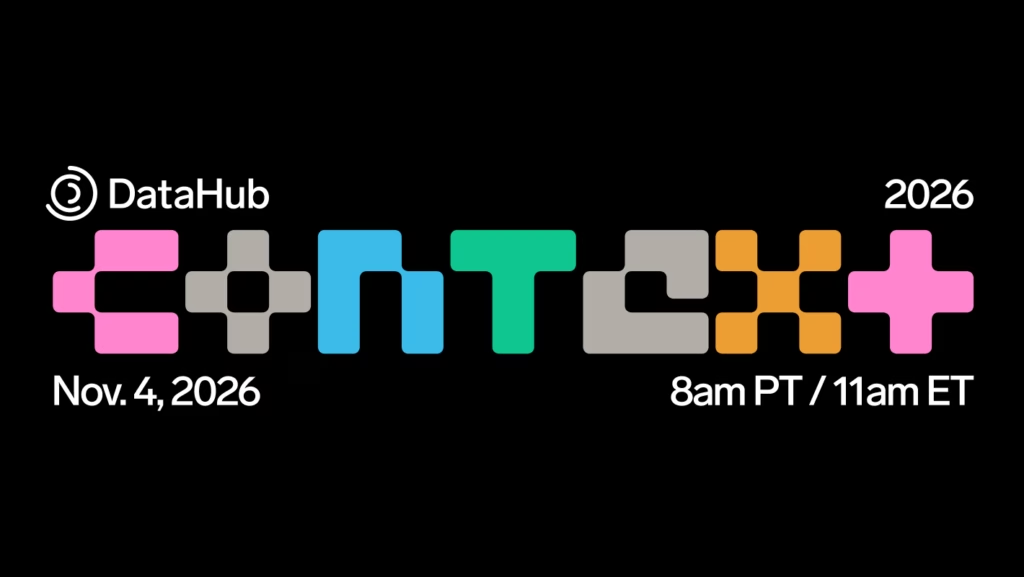
CONTEXT 2026 is where data and AI teams share how they fix it. Sessions cover how to build the context layer your agents rely on, turn domain knowledge into something agents can use, keep data trustworthy with quality checks and data contracts, and monitor agents once they’re live. It’s a free, half-day virtual summit on November 4, 2026, hosted by DataHub.
What is CONTEXT 2026?
CONTEXT 2026 is DataHub’s annual context management summit, built for practitioners putting agents into production on enterprise data. You’ll hear how teams run text-to-SQL, analytics, data quality, and impact analysis agents, and what data governance and data lineage have to look like to support them.
The event runs for half a day on November 4, 2026, is fully virtual, and costs nothing to attend.
What’s CONTEXT 2026 really about?
Our co-founder and CTO, Shirshanka Das, defined context management in his CONTEXT 2025 keynote as “the organization-wide capability to reliably deliver the most relevant data to AI context windows, enabling the governed and enterprise-scale deployment of agents.”
In that keynote, Shirshanka made a bet on behalf of DataHub. He predicted that context engineering was going to have its management moment. Context management, in his view, would become the most important emerging discipline in enterprise AI. Metadata built for human discovery isn’t the same as context built for agents, and without a foundation that lets agents safely read, write, and act on enterprise data, models fail in production.
DataHub backed that bet with a commitment: to evolve into a context platform purpose-built to give AI agents the relevant, reliable, and trustworthy context they need to act on data with confidence, and to set the standard for what an enterprise context platform should be. Watch Shirshanka’s full CONTEXT 2025 keynote, “Unlocking AI’s Potential Through Context Management“.
Since then, the context conversation has exploded, with new vendors entering the scene and legacy data catalogs making hard pivots to catch up. But the discipline is still young. Most of what works today came from teams that shipped an agent, watched it give wrong answers, and fixed the context underneath it. CONTEXT 2026 brings those teams together to explain what they put into production, what broke, and what it took to build an AI-ready context layer. You leave with patterns you can apply to your own data stack.
Why context management matters right now
Agents have made an old problem impossible to ignore. Institutional knowledge has always sat with a few tenured people, and everyone else fills the gaps as best they can. When a new hire misreads a metric, someone catches it, the new hire learns, and the team moves on. In most organizations today, an agent has no such loop. It repeats the same mistake in every response. And across hundreds or thousands of agents running at machine speed, one misread metric turns into wrong numbers in dashboards, reports, and decisions before anyone notices.
Most organizations haven’t closed that gap yet, even when they think they have. In the 2026 State of Context Management Report we sponsored earlier this year, 88% of IT and data leaders said they were confident they had a fully operational context platform. Yet, in the same survey, 61% said they frequently delay AI initiatives because they can’t trust their data.
Teams that invest in context see results. A 2026 BARC study on Context Engineering for Agentic AI found that organizations evaluated as context leaders were four times as likely to qualify as AI leaders (49% vs. 12%). At CONTEXT 2026, Kevin Petrie, VP Research at BARC, sits down with DataHub CEO Swaroop Jagadish to talk through what separates those leaders from everyone else and where context engineering goes next.
Miro shows what that difference looks like in practice. Its analytics agent answered correctly less than 40% of the time when it queried raw tables across more than 20,000 datasets. The team exposed metadata through the DataHub MCP Server, re-ranked tables using curation and usage signals, and had domain experts validate key definitions. Accuracy climbed past 90%. At CONTEXT 2026, Miro’s Data Products Manager, Ronald Angel, picks up where the story leaves off, joining a panel on what it takes to keep an analytics agent accurate once it’s live.
For more background on context management, start with these posts from the DataHub blog:
- Context Management: The Foundation for Trustworthy AI Agents
- AI Agent Context: The Four Layers Every Agent Needs (and How Each One Fails)
- Context Engineering for AI Agents: Why the Hard Part Isn’t the Context Window
- Why AI Agents Need Human-Validated Semantic Context
For a deeper dive, browse our full Context Management Learning Center for 50 free context management resources.
What’s on the agenda
CONTEXT 2026 opens with general sessions for all attendees, then splits into four tracks:
- Context
- Trustworthy Data at Scale
- OSS Innovation
- Observability
The event closes with a keynote for everyone.
The main program runs from 8:00 a.m. to noon PT. Tracks run in parallel, so you can build a schedule around the sessions you care about most. See the full timeline on the CONTEXT 2026 event page.
Who is speaking at CONTEXT 2026
CONTEXT 2026 speakers include data and AI leaders from Google Cloud, Optiver, Miro, ICA, BARC, and more. You’ll also hear from the DataHub product and engineering teams, who will walk through how the DataHub Context Platform works end to end, covering ingestion, curation, expert validation, and activation across agentic frameworks.
Here’s a look at the CONTEXT 2026 lineup so far, with more speakers still to be announced:
| Speaker | What they’ll speak on |
|---|---|
| Prajakta Damle Senior Director of Product Management, Google Cloud | How to onboard agents like new hires: bring context into one place, keep it current as agents take on more work, and why open source community investment matters for the future of context |
| Christophe Godefroy Global Head of Data Platform, Optiver | How Optiver uses DataHub as the context layer for analytics agents in production |
| Ronald Angel Data Products Manager, Miro | What changes after an analytics agent goes live, and the challenges teams hit at each stage of implementation |
| Björn Barrefors Metadata Management Lead, ICA | What it takes to ship domain knowledge into production at enterprise scale, keep it current, and hand part of the curation work to agents |
| Kevin Petrie VP Research, BARC | What BARC’s research says about the state of context engineering and what sets context leaders apart |
| Lestan D’Souza Co-Founder and CTO, ReKnew | How large financial services firms turn glossaries, ontologies, governed metrics, lineage, and institutional knowledge into strategic infrastructure |
| Nikola Kljajo Senior Engineering Manager, Super Technologies | How the team behind Superbet moved from homegrown quality checks to more than 600 continuous SQL checks in DataHub, and gave employees self-serve access to trusted data |
| Alexandre Miyazaki Data Engineer, iFood | How iFood put the DataHub Analytics Agent into production, and the classification, ownership, quality, and access rules data must meet before an agent can use it |
| Devashis Sarangi Distinguished Architect, Citrix | How to handle the day-two challenges of data governance and quality once an agent has rolled out |
| JARS Shaikh Full Stack AI Engineer, KENZ AI HUB | How to build a production-ready DataHub connector with datahub-skills, from the community champion who built DataHub’s Pinecone connector |
| DataHub co-founders Swaroop Jagadish (CEO), Shirshanka Das (CTO), and John Joyce | Why DataHub built the Context Platform and how it works, what BARC’s research means for context engineering, and where the context management category goes next |
| James Mayfield VP of Product, DataHub | A detailed look at the next phases of the DataHub product roadmap |
| Stephen Goldbaum Field CTO, Financial Services, DataHub | How agents can take on data stewardship work to scale AI readiness, and how enterprises keep domain knowledge current in production |
| Maggie Hays Founding Product Manager, DataHub | How to turn the schemas, lineage, and query history in your catalog into agent-ready context, and use the same inputs to build evals |
| Chris Collins Software Engineer, DataHub | How to write useful evals, run them nightly and in continuous integration (CI), and catch agent regressions before your users do |
| Adrian Machado Software Engineer, DataHub | How AI anomaly detection works on assertions in DataHub, and how companies are building data contracts |
| Nick Adams Software Engineer, DataHub | How agents can take on semantic modeling and other data work so AI readiness scales without adding headcount |
| Anush Kumar Software Engineer, DataHub | How to solve the cold start problem for context so agents answer cheaply and consistently from day one |
Who should attend
CONTEXT 2026 is for data and AI practitioners laying the context foundation for their businesses. You’ll get the most out of the summit if you:
- Lead or build a data platform that agents now query
- Build text-to-SQL, analytics, data quality, or impact analysis agents on enterprise data
- Own data governance, data lineage, data quality, or metadata management and need them to hold up under agent workloads
- Run DataHub open source or DataHub Cloud and want to see where the platform is headed
Register for CONTEXT 2026
The people with the most practical answers are the teams doing this work in production. CONTEXT 2026 puts those people in one virtual room. It’s also where we’ll show progress on the commitment DataHub made last year: to set the standard for the enterprise context platform.
Join us online on November 4 to learn how teams build, govern, and monitor the context their agents depend on. Registration is free. See you there!
Register for CONTEXT 2026 and save your spot
Catch up on CONTEXT 2025
Can’t wait for November 4? Gear up for CONTEXT 2026 by watching our most popular sessions from CONTEXT 2025 on demand:
- Unlocking AI’s Potential Through Context Management, the keynote from DataHub CTO Shirshanka Das
- Convergence of Context: Moving Towards a Global Catalog for Netflix, with Nitin Sarma of Netflix
- Context for Agents: Fireside Chat with João Moura from CrewAI, with DataHub CEO Swaroop Jagadish
- Leading Through the AI Revolution: A Conversation with Jeff Weiner, a fireside chat with LinkedIn Executive Chairman Jeff Weiner and DataHub CEO Swaroop Jagadish