


Why Data Governance Is Important: The Benefits, the Risks, and What to Get Right Before AI
What is data governance?
Data governance is the set of ownership assignments, quality standards, access controls, and shared definitions that determine how an organization’s data can be used. It answers four questions about every asset: who owns it, where it came from, whether it can be trusted, and who is allowed to see it.
For most of the last decade, incomplete data governance was annoying, but survivable. A person sat between the data and the decision. Analysts knew which customer table was the real one. They noticed when a number looked wrong. That institutional knowledge was an informal layer patching over whatever the metadata failed to record.
AI agents do not have that layer. An agent reads what the catalog tells it and proceeds. Missing ownership, stale definitions, and untraced lineage stop being documentation debt and start being runtime behavior.
What data governance covers
Data governance is the operating model for how data gets used responsibly. A data governance framework sits across six things:
- Ownership: Who is accountable for each asset
- Provenance: Where data came from and what happened to it along the way
- Quality: Whether the data meets a defined standard, and how you find out when it stops
- Classification: Which assets contain sensitive or regulated data
- Access: Who can see what, and how that gets decided
- Definitions: What the business terms attached to the data actually mean
Data governance is not the same as data management. Data management is the whole practice of collecting, storing, and moving data. Governance is the layer of rules and accountability that sits on top of it, and it applies to everyone managing data rather than to a single team.
It is also not a project with a completion date: Schemas change, pipelines change, and teams change. Governance either runs continuously or it goes stale.
Why does data governance matter more now than it did three years ago?
Simply put: the consumer of your data has changed.
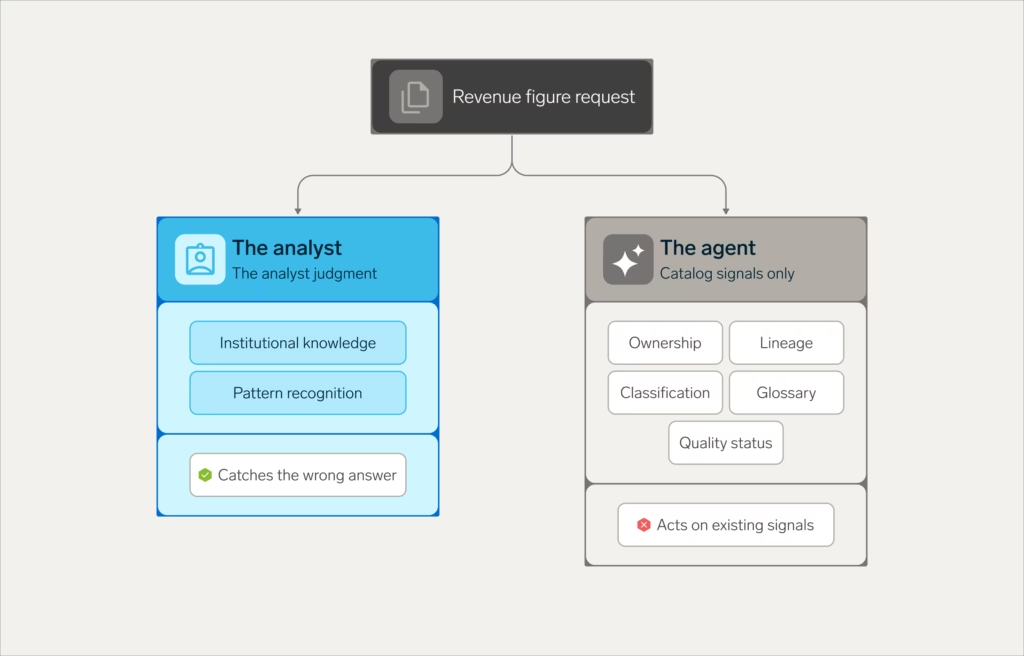
An analyst pulling a revenue figure brings judgment to the task. They know the finance team restated Q3. They know one of the three revenue tables is deprecated even though nothing says so. When the number comes back wrong, they catch it, because they have a sense of what right looks like.
An agent has none of that. It resolves the request using the signals available to it. If three tables match, it picks one. If ownership is blank, it proceeds anyway. If a column contains regulated data and nothing says so, that data goes into the context window along with everything else.
Governance was the thing that documented all of this for people who mostly already knew it. Now it is the thing that tells a system that knows nothing.
Interestingly, most organizations believe this work is already done
Here is where it gets uncomfortable. According to the 2026 State of Context Management Report, which surveyed 250 IT and data team leaders, organizations rate their own readiness far higher than their operational experience supports:
- 88% are confident they have a fully operational context platform, yet 61% usually or frequently delay AI initiatives because they lack trusted and reliable data
- 90% describe their data as AI-ready, yet 87% cite data readiness as a significant impediment to putting AI into production
- 82% would somewhat or completely trust AI agents with high-stakes tasks without reliable context, lineage, observability, and governance
The gap between the first number in each pair and the second is the point here. Organizations are not choosing to skip governance. They believe they have it.
What are the benefits of data governance?
Governance is usually sold on risk reduction, but that dramatically undersells it. Effective data governance produces four operational capabilities, and each one becomes more load-bearing once agents are querying your estate.
1. Quality and reliability
Governance replaces assumed quality with committed quality.
Data contracts turn producer promises into something verifiable. A producer commits to schema stability, a freshness window, and completeness thresholds. In DataHub Cloud, automated assertions check those commitments on a schedule, and anomaly detection catches the drift that fixed thresholds miss.
The difference in practice is when you find out. Without contracts, data quality problems surface as a broken dashboard or a failed pipeline, which means they surface downstream of the damage. With them, the check runs at the source.
For agents this matters more, because an agent has no instinct for a number that looks wrong. It cannot tell high-quality data from the other kind, and it returns what it finds with the same confidence either way.
The IDC Business Value of DataHub Cloud study (March 2026) put numbers on this. Across five interviewed enterprises, customers reported 56% fewer data completeness issues, 48% fewer timeliness issues, and 58% faster resolution when outages did occur.
2. Visibility and context
Visibility is the benefit everything else depends on.
Ownership assigns a name to every asset. That sounds administrative until you try to enforce anything without it. Unowned data assets cannot be certified, deprecated, or escalated. They just sit there, and people use them.
Lineage answers where data came from and where it went, across platforms rather than within one. Business glossaries settle what a term means so that “active user” resolves to one definition instead of four. Documentation generated from live metadata stays current in a way hand-maintained wikis do not.
An agent asked for revenue will use whichever asset it surfaces first. Whether that is the right one is decided by the quality of your ownership, lineage, and glossary data, not by the agent.
IDC found customers running DataHub Cloud had 153% more assets with complete metadata and 75% more datasets with mapped lineage.
Visa took this furthest. Its team built a logical model called Business Attributes, contributed back to the open source project, that centralizes terms, definitions, and classifications and maps them to columns across thousands of datasets. Definitions get maintained once by the stewards who own them, and every downstream consumer inherits the result.
3. Access and data security
Governance decides who can access what, and how long it takes to find out. Done badly, access control is a ticket queue. Someone requests a dataset, waits three days, and either gets it or gets forgotten. Teams route around it by copying data, which creates the ungoverned duplicates that cause the next problem.
Done well, access is self-service with the guardrails built in. In DataHub Cloud, requests can route to the owner automatically, with approval where that owner already works, and the audit trail as a byproduct of the workflow.
Classification has to travel for any of this to hold. Tagging a source table as containing regulated data accomplishes little if the six tables derived from it stay untagged. Classification that propagates through column-level lineage keeps the tag attached to the data as it moves.
Agents raise the stakes on both counts. They traverse more assets than any individual would, and they do it continuously.
DataHub customers report a 60% to 70% reduction in access request time and the IDC Business Value of DataHub Cloud study (March 2026) found customers running DataHub Cloud had a 254% increase in data assets with an assigned data owner.
4. Efficiency and scale
Data volumes grow. Governance headcount does not.
The only way that equation resolves is if governance stops being a set of tasks people perform and becomes a set of rules the system applies. Policies defined once and applied against metadata across the estate. Classifications that can propagate downstream. Compliance status that updates continuously instead of being reassembled each quarter.
IDC measured a 20% efficiency gain for governance teams and 8% for compliance teams among the enterprises it interviewed. The same teams covered more ground without growing.
Five risks of poor governance
If the benefits aren’t enough to move this up your roadmap, look at the flip side. Poor governance can cost you dearly, and the 2026 State of Context Management Report shows how much. DataHub commissioned TrendCandy, an independent research firm, to survey 250 IT and data team leaders for it.
1. AI outputs you cannot explain
In the 2026 report, 66% of organizations said AI models in their organization generate biased or misleading insights, attributed to low maturity of the data infrastructure supplying context.
The cost lands at the point of decision, not the point of ingestion. Someone acts on an output, and the question of data accuracy arrives afterward, once the decision is already made.
2. Provenance gaps that surface during an audit
The same research found 53% of organizations frequently or very frequently experience AI-related compliance issues caused by a lack of data provenance.
Audits do not create this exposure. They reveal it. Data integrity is only demonstrable if you can show the path a number travelled, and when an auditor asks which datasets feed a given model and the answer requires querying logs and interviewing engineers, the reconstruction is where the risk concentrates. Anything the manual trace misses is a finding.
3. Sensitive data reaching places it should not
Classification applied at the source and nowhere else leaves every derived asset ungoverned. The tag says the original table holds regulated data. The aggregation built on top of it says nothing.
This was already a problem. Agents make it a larger one, because they reach further into the estate than an individual analyst ever would, and they do it without pausing to wonder whether they should.
4. Work that gets duplicated or abandoned
The 2026 report surfaced two findings that landed on the same number:
- 57% of organizations duplicate AI efforts across departments for want of a unified context graph
- Separately, 57% find it challenging or very challenging to identify authoritative sources of truth
Both describe one problem, and data silos are where it starts. Entrepreneur cites an estimate that the average company holds more than 2,000 silos of information, each inaccessible to the rest of the business. Teams cannot find what already exists, so they rebuild it. The rebuild becomes another asset nobody can authoritatively identify.
The same 2026 report found 86% of teams spend some or a great deal of time searching for the right data, and only 2% lose no time to it.
5. Governance that becomes the bottleneck
The failure mode nobody selling governance tends to mention is governing badly in the other direction.
Review gates sized for human query volume do not survive continuous agent access. A quarterly certification cycle cannot keep pace with a data estate that changes weekly. When governance becomes the thing standing between a team and its deadline, the team routes around it, and the resulting shadow estate is worse than what you started with.
Optum ran into exactly this. Its centralized platform created bottlenecks in access, governance, and schema standardization across business units, with engineers and analysts waiting on a one-size-fits-all model. The fix was a decentralized platform, built on DataHub, that let teams produce and govern data products without routing through the center.
What to get right before you put AI into production
The sequence below is an order of operations, not a gate. None of it needs finishing before you start. But a data governance program built out of order tends to get redone.
| 1 | Ownership | Nothing downstream is actionable without a name attached to each asset. Certification, escalation, and access approval all assume someone is accountable. Start with the assets that already carry the most query volume. |
| 2 | Provenance and lineage | Lineage is what makes everything else verifiable. It answers the audit question, it scopes the impact of a change, and it is the mechanism by which classifications and documentation reach downstream assets. Column level matters more than table level here, because sensitivity lives in fields. |
| 3 | Classification that propagates | Tagging sensitive data once at the source is the easy half. The tag has to follow the data through transformations, or every derived asset becomes an exception you are not tracking. |
| 4 | Definitions for the terms agents will be asked about | If your organization has four definitions of active user, an agent will pick one, and it will not tell you which. Glossary terms linked to the actual columns resolve this. |
| 5 | Quality signals an agent can read. | A dashboard a human checks each morning does not help a system querying at three in the afternoon. Quality status has to be attached to the asset and retrievable through the same interface the agent uses to find it. |
| 6 | Access controls that resolve programmatically | If approval requires a human in a queue, agent access either waits or bypasses. Neither is acceptable. |
Most organizations already have some of this. The useful exercise in any data governance strategy is finding which step you skipped, because the steps compound. Classification without lineage does not propagate. Definitions without ownership go stale. For the implementation detail on each, see our guide on how to implement data governance without slowing your team down.
How DataHub connects governance to outcomes
Running that sequence across a fragmented toolset means restating every decision in every tool. DataHub runs it on one metadata layer.
- Decisions propagate instead of being repeated: Classify a column once and lineage-based propagation carries the classification downstream. Document a source field and the context follows it. The Actions Framework responds to metadata change events within seconds, so propagation and governance actions run as changes happen rather than on a review cycle.
- Agents can read your governance signals directly: The DataHub MCP Server implements the Model Context Protocol, which lets an agent retrieve ownership, tags, glossary terms, documentation, quality signals, and column-level lineage for any asset. Service accounts can be scoped with a default view, so an agent’s visibility is bounded by configuration rather than convention. Mutation tools can be set to propose changes for review instead of committing them, which keeps a human in the loop on metadata an agent wants to edit.
- Compliance state is tracked rather than reconstructed: In DataHub Cloud, compliance forms collect required attributes against defined asset groups and report completion as it happens. In DataHub Cloud, metadata tests validate governance rules and surface the assets that fail.
Notion uses this to run impact analysis, self-serve discovery, and GDPR compliance from one place, after consolidating documentation that previously lived separately in Snowflake and dbt.
The importance of data governance has not changed. What changed is the audience. Your governance is now legible to the systems reading your data, or it is not, and those systems will proceed either way.
Book a demo to see how governance runs on unified metadata.
FAQs
Why is data governance important if my data platform already has governance built in?
Why is data governance important if my data platform already has governance built in?
Platform-native governance covers the assets inside that platform. Most estates span several, plus BI tools, orchestration, and increasingly AI systems. Ownership assigned in a warehouse does not travel to the dashboard built on it, and lineage stops at the platform boundary. DataHub connects 100 or more sources into a single metadata layer so ownership, classifications, glossary terms, and lineage resolve consistently across all of them. Platform-native controls remain the enforcement point for the data itself. This is why most teams pair them with dedicated data governance tools. The catalog layer is what makes governance coherent across the estate rather than accurate in one corner of it.
How does DataHub apply governance policies without manual review?
How does DataHub apply governance policies without manual review?
Through two mechanisms. Metadata tests let you define governance rules declaratively, for example that every tier one dataset must have an owner, a description, and a classification term. The platform evaluates those rules continuously and surfaces failures immediately rather than at the next audit. The Actions Framework subscribes to metadata change events and triggers policy actions when they fire, so a new dataset matching defined criteria can be tagged or assigned an owner the moment it appears. Both are DataHub Cloud capabilities.
How does DataHub keep sensitive data classifications accurate across downstream tables?
How does DataHub keep sensitive data classifications accurate across downstream tables?
Column-level lineage traces each field from source through transformations to the dashboards and models that consume it, and is available in both DataHub Core and DataHub Cloud. Lineage-based propagation carries classifications and documentation downstream along that graph; historical backfill across existing assets is a DataHub Cloud capability. Tag a source column as containing personal data and derived assets inherit the tag without anyone tagging them by hand. This is what keeps classification accurate as the estate changes, since manual tagging falls behind the moment pipelines are modified.
How do data access requests work in DataHub?
How do data access requests work in DataHub?
Access request workflows, available in DataHub Cloud, let a user request access to an asset from the catalog itself. The request routes to the asset owner, who can approve it through Slack or Microsoft Teams rather than a separate system. Every request and decision is recorded, which gives compliance teams an audit trail as a byproduct of normal operation. The design goal is removing the multi-day wait that pushes teams toward copying data instead of requesting it.
How does DataHub track which assets meet governance standards?
How does DataHub track which assets meet governance standards?
Compliance forms let you define the attributes a group of assets must carry, assign them to owners, and track completion in real time. Structured properties extend the metadata model with custom typed fields for classification schemes or regulatory tracking, and can be made mandatory and searched across. Metadata tests validate rules continuously and flag non-compliant assets before they reach production. Together these replace the point-in-time snapshot with a live compliance picture. All three are DataHub Cloud capabilities.
Can AI agents access governance context from DataHub?
Can AI agents access governance context from DataHub?
Yes. The DataHub MCP Server implements the Model Context Protocol, giving agents direct access to catalog metadata. Read tools return ownership, tags, glossary terms, documentation, usage statistics, and quality signals for any asset, and can traverse lineage upstream or downstream at table and column level. Agents can also be constrained: service accounts support a default view that limits which assets the agent can see at all, and mutation tools can be configured to submit proposals for human approval rather than writing directly. The hosted MCP server is a DataHub Cloud capability, and a self-hosted open source version works with DataHub Core.
What governance capabilities are in DataHub Core versus DataHub Cloud?
What governance capabilities are in DataHub Core versus DataHub Cloud?
| Capability | Core | Cloud |
|---|---|---|
| Data ownership management | Yes | Yes |
| Business glossary | Yes | Yes |
| Bi-directional metadata sync | No | Yes |
| Compliance forms and workflow engine | No | Yes |
| Metadata tests | No | Yes |
| Approval workflows for documentation, glossary, tags, terms, and ownership | No | Yes |
| Access request workflows | No | Yes |
DataHub Core provides the governance foundation of ownership and shared definitions. DataHub Cloud adds the automation and workflow layer that lets those foundations run without manual effort, along with search-based access control and an SLA-backed managed deployment. Two capabilities this post leans on, column-level lineage and data contracts, are available in both editions. The docs list them under discovery and observability rather than governance.