



Context Management for Data Analysts
What Comes After AI Writes the SQL
TL;DR
The data analyst role is evolving from purely querying data to curating the business context that makes data trustworthy for both humans and AI agents. Translating business questions into SQL (the skill that built the profession) is being commoditized by LLMs, and context management is the new point of leverage.
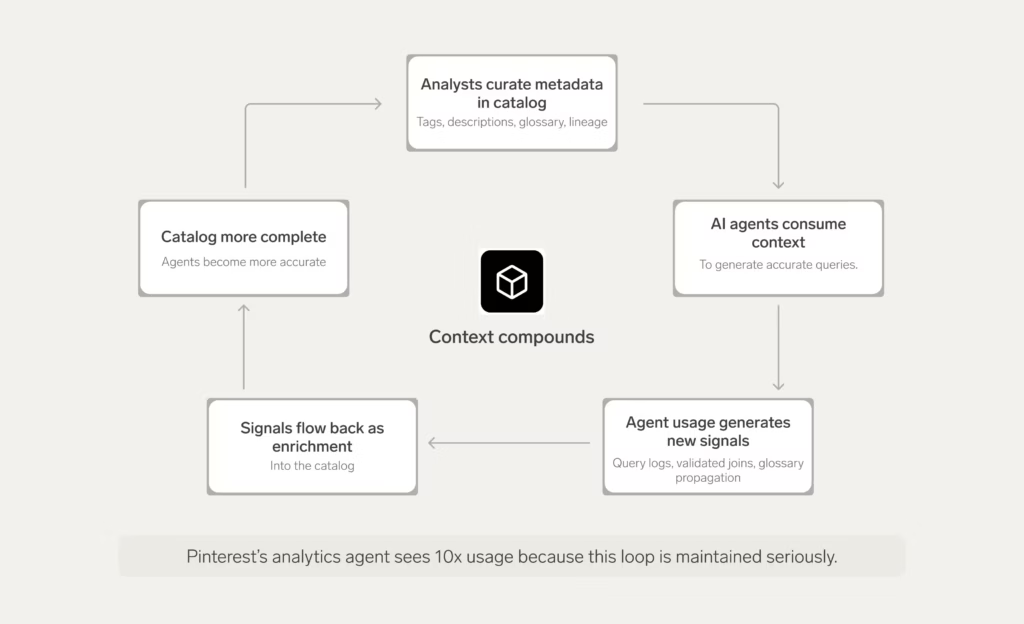
Organizations that treat their data catalog as a metadata warehouse, a structured store of everything an agent needs to produce trustworthy results, are seeing dramatically better AI outcomes. Pinterest’s analytics agent sees 10x usage of any other internal tool because the context layer behind it is maintained seriously.
Context management is not a departure from what strong analysts already do. It is a reorientation of where the value lies, from writing queries to governing the environment that makes AI-generated queries accurate.
A quote from my friend Britton Stamper stopped me mid-scroll recently:
“The gap that separated business questions from working queries is closing fast now that LLMs can write decent SQL. It’s happening fast enough that all my data analyst friends are feeling an urgent need to evolve their skills and uplevel their toolkits in order to stay relevant in the AI era.” — Britton Stamper, Push.ai
Gartner predicts that organizations will abandon 60% of AI projects in 2026 due to a lack of AI-ready data, and we see that the bottleneck is quickly shifting from hiring human beings who can write SQL to something else entirely. LLMs need human beings to impart their understanding of the data environment into a metadata environment structured around their businesses in order to write correct SQL to accurately answer business questions.
That “something else” is context management.
What happens now that AI can write SQL?
LLMs can now write decent SQL, but only when they have access to the metadata that tells them how the business actually works. A model needs to know which tables are authoritative, how metrics are defined, and how data flows across systems before it can answer a business question correctly. That kind of context lives in metric specifications, semantic layers, lineage graphs, ownership records, and business glossaries. None of it sits inside the warehouse, and all of it has to be built and maintained by humans.
dbt Labs ran fresh benchmarks in 2026 that show this dynamic clearly: text-to-SQL backed by a structured semantic layer approached near-perfect accuracy, while the same models running against unmodeled tables performed dramatically worse.
The instinct most data people have when confronted with a situation like your tech skills becoming less scarce/valuable is to act like an ostrich and bury their head into the sand.
They’ll say things like “I understand this business in ways AI does not. I know that the Q3 numbers look weird because of a migration. I know that ‘revenue’ in the CRM is defined differently than ‘revenue’ in the finance system. No LLM will ever understand what I understand so I’m going to be fine.”
There is a parallel here to when Microsoft Excel launched in the mid-1980s. There were worries about fewer junior roles being hired to do manual calculations, and people further along in their careers needing to learn all new software. But Excel actually ended up increasing the demand for analysts who could learn it and use it effectively. AI might feel a bit scarier for the short term because it does more of the human-like thinking, but ultimately, both tools can be productivity multipliers for data analysts.
Here’s the comfort in that parallel: the models are getting better at writing SQL, but they cannot invent the business context that makes the SQL correct. That context is exactly what data analysts are best positioned to build, and building it is becoming the most important work in the profession.
The new responsibility taking shape: Context management
What is context management?
Context management is the ongoing discipline of building and maintaining the metadata layer that AI agents need to reason accurately about business data. It includes defining authoritative metrics, governing business terminology, maintaining data lineage and quality signals, and connecting unstructured institutional knowledge to structured data assets. Where context engineering is a systems-level discipline focused on infrastructure (see The Data Engineer’s Guide to Context Engineering), context management is the operational practice data analysts perform day to day to keep that infrastructure accurate, current, and trustworthy.
A new responsibility for data analysts is beginning to take shape in the organizations that are furthest along in deploying AI to production data workflows around context management. It does not yet have a catchy name like “ETL” or “Data Viz” quite yet, though Gartner did name context engineering a strategic priority. A few formal job postings are beginning to appear that mention it as well.
Context management is about creating the metadata layer that sits between raw data and AI-generated output. Data analysts are no longer just tasked with writing the queries that answer business questions; they now also have to build the environment in which AI agents can reason about the data ecosystem and write queries themselves.
An AI agent reasoning about business data needs more than a schema:
- It needs to know which tables are authoritative and which are deprecated
- It needs to understand that “active user” means different things across different product surfaces
- It needs to know that last week’s engagement drop was caused by a monitoring incident, not a real behavior change
- It needs column-level lineage, ownership records, quality assertions, business definitions, and the semantic relationships between entities
None of that is in the warehouse. All of it has to be built, maintained, and made accessible.
What context management adds to the data analyst job description
The work of context management in a metadata warehouse is not a departure from what strong data practitioners already do. It is a reorientation of where the value lies and the tooling that makes it easier to sustain.
In practice, that reorientation is showing up in four areas of the analyst’s day-to-day work:
1. Metric architecture
Defining authoritative business metrics and making those definitions machine-readable is central to the work. When an AI agent generates a query about retention, it needs to know exactly what retention means in this organization, what filters apply, what tables are authoritative, and what the correct business logic is. That definition needs to exist in a system the agent can access, not in a document somewhere.
In practice, that machine-readable definition looks something like this:
| Business term | Definition | Owner | Associated data asset |
| Net revenue | Total sales minus returns | Finance team | prod_sales.net_amt |
| Active user | Logged in within 30 days | Product team | user_logs.last_login |
The table is illustrative, but the principle is the point: every business term an analyst or agent might query needs to map to a specific column or transformation, with a named owner and a clear definition. Anything less, and the agent is guessing.
2. Semantic modeling
Building the abstraction between raw warehouse tables and the questions the business actually asks. This goes beyond transformation logic. It means capturing how KPIs relate to each other, how business entities connect across systems, and what conditions govern accurate results.
3. Context enrichment and feedback loops
Structured data represents only part of the picture. The full context of why a metric moved often lives in Slack messages, incident reports, product changelogs, and CRM notes.
A context manager designs systems that connect unstructured context to structured data and (critically) captures analyst behavior as signal. Every query pattern, every reused join, every validated golden query is evidence about how the business works. Building systems that learn from that evidence is part of the job.
4. Trust and governance
An AI agent reasoning over stale or incorrect metadata does not fail loudly. It produces answers that are subtly wrong in ways that are hard to detect. Maintaining the accuracy and currency of the context layer (including data quality assertions, ownership records, and lineage documentation) is an ongoing operational responsibility, not a one-time setup task.
What context management looks like at Pinterest
Pinterest’s engineering team described this problem precisely in a recent architecture post.
A new analyst joining a data team, they observed, cannot accurately answer mission-critical business questions on day one. They spend weeks reading old Slack threads, reverse-engineering queries from BI dashboards, and building a mental model of which tables to trust and what terms actually mean across the organization. An AI agent faces exactly the same problem — it starts with an empty context window and needs access to the same institutional knowledge, or it will produce answers that are structurally correct and substantively wrong.
Pinterest’s solution was to build a structured semantic layer of sorts. It wasn’t just designed to create facts, dimensions, and metrics. It is actually a governed store of metadata about what their data means, not just where it lives, but a marrying of technical and business context. The result is an analytics agent that now sees ten times the usage of any other internal tool at the company because it can give trustworthy results.
What Pinterest also demonstrated is that this layer can improve over time through deliberate design. Their team analyzed historical query logs and automatically propagated glossary terms across more than 40% of their columns without manual tagging. They used an LLM to reverse-map historical queries into semantic descriptions of the business questions those queries were designed to answer—effectively turning every query ever run by an analyst into a signal that makes the next analyst, or agent, more accurate.
The catalog enriches the agent; the agent’s usage enriches the catalog. The result is an infrastructure that compounds in value rather than decaying and you don’t saddle the data analyst with toilsome work of keeping the catalog up to date manually. For a deeper analysis of how Pinterest’s approach maps to a modern context platform, my colleague John Joyce wrote a companion piece on the DataHub blog.
Why context management needs real infrastructure
The framing that positions AI as a threat to the data analyst misidentifies where the real change is happening. The query authoring is being automated by AI, but the judgment about what should be measured, how it should be defined, and whether the infrastructure that supports AI is the new point of leverage.
Context management makes enterprise AI reliable at scale and I argue that it is a more consequential job than writing queries. The organizations that recognize this transition early (and invest in developing context tooling and uplevelling their people to use them well) will be the ones whose AI investments actually deliver what was promised.
Here’s the part most teams underestimate: managing enterprise context at this scale is not something a person, or even a team, can sustain by hand. You’re looking at tens of thousands of tables, hundreds of contributors, business logic that changes every quarter, and a rate of metadata churn that defeats spreadsheets and wiki pages within a week. The metadata layer has to be real infrastructure—a system that captures context automatically, exposes it to humans and agents through APIs and tool calls, and learns from how it’s being used.
That’s the work we’ve been building DataHub to do.
“Before implementing DataHub, we received a lot of different inquiries about data… Since implementing DataHub, we’ve mostly found that we don’t experience this challenge anymore. A lot of these ad hoc inquiries are down to maybe one at most per day.” – Nathan Siao, Data Analyst, HashiCorp
The flywheel Pinterest spent years assembling (query history mined for patterns, glossary terms propagated across the data estate, golden queries surfaced as ground truth, lineage and governance signals that tell agents which sources to trust) are the primitives DataHub provides without requiring you to engineer them yourself.
Most organizations don’t have Pinterest’s runway. They shouldn’t need it.
If you’re feeling the shift I’ve described in this post and want to see what context management looks like on infrastructure built for it, come talk to us.
FAQs
What is context management for data analysts?
What is context management for data analysts?
Context management is the discipline of building and maintaining the metadata layer that AI agents need to reason accurately about business data. For data analysts, this means defining authoritative metrics, curating business glossary terms, maintaining data lineage, and connecting unstructured institutional knowledge to structured data assets. It is the operational practice that ensures AI agents have the relevant context they need to produce trustworthy results.
How is context management different from context engineering?
How is context management different from context engineering?
Context management sits alongside two related disciplines: prompt engineering, which focuses on the inputs to a single AI request, and context engineering, the systems-level discipline of architecting how data and tools flow to AI agents at scale. Context management is the day-to-day operational work analysts do: defining what metrics mean, validating which tables are authoritative, and maintaining trust signals in the metadata layer. Context engineering is the systems-level discipline engineers practice: architecting infrastructure, pipelines, and governance frameworks that deliver context to AI agents at scale. The two are complementary roles that work together to make enterprise AI reliable. See our full post on context management versus context engineering.
Will AI replace data analysts?
Will AI replace data analysts?
AI is automating query authoring, not the judgment behind it. When Microsoft Excel launched in the mid-1980s, similar concerns arose about junior analyst roles. Excel ended up increasing demand for analysts who could use it effectively. AI is following a similar pattern: it changes the work rather than eliminating it. Analysts who build and maintain the critical context AI agents reason inside will be more valuable, not less.
What skills do data analysts need for context management?
What skills do data analysts need for context management?
While context engineering skills typically belong to data engineers building infrastructure, the context management skills data analysts need build on existing analyst capabilities and add new ones: Metric architecture: Defining business metrics in machine-readable formats Semantic modeling: Mapping how KPIs and entities relate across systems Context enrichment: Connecting unstructured sources like Slack threads and incident reports to structured data Metadata governance: Maintaining accuracy, freshness, and trust signals in the data catalog
How does a data catalog support AI agents?
How does a data catalog support AI agents?
A well-maintained data catalog provides the context AI agents need to write correct SQL: column-level lineage, ownership information, data quality scores, business definitions, and semantic relationships between entities. Technical table names like usr_acq_cohort_v2 are unintelligible to both business users and AI agents without this kind of semantic mapping. Without it, agents querying enterprise data produce queries that may be syntactically valid but substantively wrong. Recent benchmarks from dbt Labs show that text-to-SQL backed by a structured semantic layer approaches near-perfect accuracy, while queries against unmodeled tables perform dramatically worse.
Is a data catalog now a context platform?
Is a data catalog now a context platform?
For most of the industry’s history, the data catalog was a compliance and discoverability tool. Teams of humans cataloged their datasets to satisfy audit requirements or help analysts find the right table. That dynamic is changing. In an environment where AI agents reason over your metadata continuously and autonomously, the quality of the metadata layer is the quality of the AI’s output. Treating context as critical infrastructure rather than as documentation is the shift that turns a catalog into something agents can rely on. The modern data catalog, maintained seriously, becomes a context platform. A context platform functions as a metadata warehouse: the structured store of everything an AI agent needs to reason correctly about your business, including column-level lineage, ownership, quality metrics, business definitions, transformation logic, freshness windows, and semantic relationships between entities.
Why does AI-generated SQL need a semantic layer to be accurate?
Why does AI-generated SQL need a semantic layer to be accurate?
LLMs can write syntactically correct SQL, but correctness and accuracy are different things. Even setting aside context window limitations, an agent needs to know that ‘revenue’ means different things in the CRM and the finance system, that certain tables are deprecated, that an engagement drop last week was caused by a monitoring incident. Without business context, lineage, and quality signals, the failure modes are dangerous: AI-generated queries return plausible answers that can be subtly and substantively wrong.