


AI-Ready Data: What It Is and the 5 Pillars You Need to Know
Quick definition: What is AI-ready data?
AI-ready data is data that has been prepared, structured, and governed so AI systems can consume, learn from, and act on it at scale. It is accurate, complete, traceable, and delivered alongside the business context an AI system needs to interpret it correctly, without a human available to fill in the gaps.
In DataHub’s 2026 State of Context Management Report, 90% of organizations described their data as AI-ready. In the same survey, 87% named data readiness as the biggest impediment to putting AI into production. Both numbers came from the same respondents. The distance between them is the honest state of AI-ready data heading into 2026.
AI-ready data used to mean clean, governed, well-documented data, prepared by a data team and handed to a model. That definition assumed a human sat between the data and the decision, someone who knew that rev_final_v2 was the table finance actually trusted. AI agents removed that person from the loop. What they need instead is data plus the context that made the data legible, delivered through a context platform that both humans and agents can query.
What is AI-ready data?
For a decade, data readiness was measured against human analysts, who supply their own context. An analyst who pulls a revenue table knows which of the four revenue columns the finance team uses at quarter close, because they asked someone once and remembered. An AI agent has no equivalent. It has whatever the retrieval layer hands it.
So AI readiness is now two things at once: a property of the data, and a property of the infrastructure that delivers the data. Datasets can be immaculate and still fail an agent that cannot tell which of them is authoritative.
Four things have to be true at once for data to earn the label:
- It is accurate and complete enough for the specific job
- Its origin, freshness, and transformation history are traceable
- Its meaning is documented somewhere a machine can reach
- Its trustworthiness can be evaluated by the consuming system, rather than vouched for by a person
It is also worth exploring what AI-ready data is not: It is not the same as high-quality data by traditional standards. Analytics workflows often strip outliers to make patterns legible to people. Fraud detection and anomaly models need those outliers, because the outliers are the signal. Readiness is judged against the workload, not against a universal cleanliness bar.
AI-ready for what?
Readiness is not a property data holds in the abstract. It is a judgment about a specific dataset against a specific use case, and the same table can pass one test and fail another:
- A customer table with 18 months of history is ready for a churn model and unfit for a seasonality forecast that needs five years
- A product catalog with clean SKUs and no written descriptions is ready for inventory reconciliation and useless to a support agent that needs to answer questions about what a product does
Nothing about the data changed between those two verdicts. The question changed.
Three consequences follow from this:
- Readiness is assessed per workload: There is no single certification that clears a dataset for all AI use.
- Readiness expires: Schemas drift, definitions get revised, and upstream systems get replaced. A dataset that passed six months ago may not pass today.
- Readiness is a capability, not a project: Organizations that treat it as a one-time cleanup phase before an AI program tend to repeat that phase before every subsequent program.
This is why checklists alone do not get organizations to production. A checklist tells you what good looks like. But it does not tell you whether this dataset is good enough for the agent you are about to deploy on Tuesday.
Why is AI-ready data important?
AI-ready data is the difference between a model that demonstrates well and a system that operates in production. The reported gap between the two is wide, and it is not closing on its own.
The 2026 State of Context Management Report surveyed 250 IT and data leaders. Among them:
- 87% cite data readiness as a significant impediment to putting AI into production
- 61% frequently delay AI initiatives because they lack trusted, reliable data
- 66% report that AI models in their organization generate biased or misleading insights because their infrastructure does not supply enough context
- 57% struggle to identify which data source is authoritative
The readiness gap
90% of organizations describe their data as AI-ready. 87% say data readiness is the biggest impediment to putting AI into production.
Source: 2026 State of Context Management Report.
When data is genuinely AI-ready, organizations reap benefits:
- Time to value shortens: Teams spend less of every project re-establishing what the data means.
- Fewer initiatives stall: Delays caused by untrusted data are the single most commonly reported blocker in the survey data above.
- Governance becomes provable: You can demonstrate which data trained a model and under what controls, rather than reconstructing it after the fact.
- The foundation compounds: Work done to make data ready for one workload carries to the next, instead of being rebuilt each time.
The costs of poor data readiness
AI initiatives rarely fail because the model was wrong. They fail because poor quality data reached the model in ways nobody could see.
The consequences scale with the stakes of the decision:
- A recommendation engine trained on incomplete viewing data surfaces the wrong titles, and viewer retention drops
- Missing lineage in a financial system makes a regulatory request unanswerable, creating compliance exposure and reputational damage
- A clinical model trained on partial patient records produces a misdiagnosis
Some of these things can feel like the kinds of “death by a thousand cuts” frustrations that data organizations are well-versed in, though AI can compound them quickly. Regulatory exposure ups the ante:
Under Article 99 of the EU AI Act, the headline penalty of EUR 35 million or 7% of worldwide annual turnover applies to prohibited AI practices under Article 5, things like social scoring and untargeted facial scraping. However, most data governance and documentation failures fall into the tier below it: up to EUR 15 million or 3% of worldwide annual turnover for non-compliance with high-risk system obligations.
That is still a material number, and the obligations it covers, including data provenance, lineage, and technical documentation, are exactly the ones weak data readiness leaves unmet.
Beyond direct cost, poor readiness erodes something harder to rebuild. Once a business team has been burned by an AI output they could not verify, they stop trusting the next one.
The five pillars of AI-ready data
An agent does not just read data. It evaluates whether the data can be trusted, traces where a number came from, decides which of three similar tables is the right one, and then acts, often without a human reviewing the intermediate steps. Every judgment a human analyst made silently now has to be encoded somewhere the agent can reach.
The market is moving faster than the foundations are. In McKinsey’s State of AI survey published in November 2025, 88% of organizations reported regularly using AI in at least one business function, while only 7% said AI had been fully scaled across the organization. On agents specifically, 23% reported scaling an agentic system somewhere in the enterprise, and in any given business function no more than 10% were scaling agents. Adoption is near universal, but deployment at scale is rare, and the survey data points at the foundations as the reason.
Multi-modal systems add another dimension. A model working across text, images, audio, and sensor streams needs each modality validated and described differently, which multiplies the readiness surface rather than extending it.
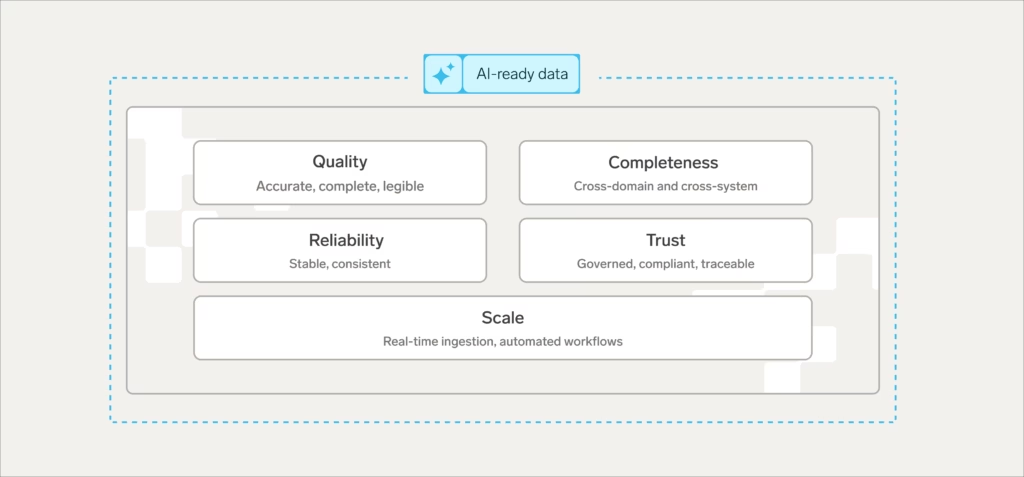
Five pillars describe what data needs to clear that bar:
1. Quality
AI-ready data must be accurate, complete, and unbiased. Missing values, outdated records, biased samples, and skewed distributions degrade model performance and produce unreliable predictions.
For agents, data quality also has to be legible at retrieval time. An agent needs to know that a table failed its freshness check this morning, and it needs to know it in a form it can act on rather than a dashboard a human would have checked.
2. Completeness
Data silos create gaps. AI systems need a view that spans departments, domains, and systems, because models trained on partial information encode that partiality as fact.
Completeness now extends past the data itself. The documentation, definitions, and institutional knowledge that explain what a field means are part of the picture an agent needs, and most of it lives in wikis, tickets, and threads rather than in the warehouse.
3. Reliability
Stable data pipelines are the precondition for everything else. Upstream schema changes, broken dependencies, and inconsistent refresh cycles silently degrade AI outputs and waste compute.
Silent degradation is the specific risk with agents. A human analyst notices when a number looks wrong. An agent acts on it.
4. Trust
AI systems must run on data that is governed, traceable, and compliant. Without lineage and version control, it is impossible to validate model behavior or meet AI governance requirements.
Trust also has to be machine-readable. An agent needs a signal it can evaluate, not a certification badge in a catalog that a person was supposed to look at.
5. Scale
AI workloads operate at a different magnitude than human reporting. Data infrastructure must support real-time ingestion, automated processing, and metadata-aware workflows across large volumes.
Agent traffic changes the shape of the load. Where a human might run a handful of queries, an agent may make hundreds of context requests to complete a single task, and each one expects a fast answer.
Top challenges to achieving AI-ready data
The five pillars are straightforward. Living up to them is not. Each one runs into persistent problems that most organizations have not solved.
| Pillar | Challenge | Description |
| Quality | Monitoring is manual and periodic | Freshness checks, schema validation, and bias detection are done by hand or scattered across disconnected tools. Errors reach models unnoticed, and the subtle ones are never caught at all. |
| Completeness | Data sits in silos and its meaning goes undocumented | Critical datasets stay locked in CRMs, ERPs, and departmental systems, and the metadata explaining them is missing. 86% of data teams spend considerable time searching for the right data, and 81% report analysts losing time to spreadsheets and institutional knowledge held by individuals.* |
| Reliability | Pipelines degrade silently | Schema changes, brittle dependencies, and inconsistent refresh cycles erode outputs without failing loudly. A pipeline that breaks gets fixed. A pipeline that drifts gets trusted. |
| Trust | Provenance cannot be proven after the fact | Governance requirements rise while the processes meant to satisfy them stay manual. 53% frequently face compliance issues stemming from a lack of data provenance, and 57% duplicate AI efforts because nobody can see what already exists. |
| Scale | Batch-era architecture buckles under agent-era load | Volume, variety, and velocity have outgrown systems built for nightly batch and human-scale reporting. 70% of organizations say less than half their unstructured data is discoverable and usable for AI. |
*2026 State of Context Management Report
Scale is where most programs actually stall. Pilots run on hand-curated data that someone picked, cleaned, and stood beside while it ran, and none of that survives contact with production. Closing the gap takes continuous ingestion, automated governance, and observability sufficient to debug an agent’s reasoning after the fact. That is an infrastructure problem rather than a data cleanup problem, and it is the distance between McKinsey’s 88% adoption figure and its 7% full-scale figure.
Most AI failures stem from data failures. Without a strategy for quality, context, and governance, AI-ready data remains out of reach.
Sat DuggalCMO, DataHub
How a context platform delivers AI-ready data
A data catalog answers what data exists. A context platform answers what the data means, to whoever is asking, including agents.
Catalogs were built so people could find and evaluate datasets, which is why so much of their value depends on a human reading the page. A context platform takes the same metadata foundation and adds the semantic definitions, documentation, and institutional knowledge that give it meaning, then delivers all of it through interfaces machines can query, including APIs and Model Context Protocol (MCP) servers.
Here’s how it helps deliver on those five pillars:
| Pillar | What a context platform delivers |
| Quality | Continuous observability across freshness, schema, and validation, plus machine-readable trust signals agents can act on at retrieval time |
| Completeness | Metadata ingestion across every source, extended past structured systems into documentation and institutional knowledge |
| Reliability | Lineage-driven impact analysis, health dashboards, and incident response that turn silent degradation into a visible event |
| Trust | Embedded governance with audit logs, usage tracking, and policy management, all verifiable through APIs or the interface |
| Scale | Event-driven architecture, high-performance APIs, and an extensible metadata model that absorbs new asset types without a re-architecture |
1. Quality control with unified observability
DataHub tracks freshness, schema, and validation metrics through a single observability layer, so quality is measured continuously rather than checked periodically.
Proactive alerts triggered by anomaly detection and lineage-driven impact analysis shows what’s downstream of a problem before it reaches a model. Agents benefit differently: Machine-readable trust signals let them distinguish a reliable dataset from a degraded one at retrieval time, without a human in the loop.
2. Completeness through cross-domain metadata ingestion
Blind spots close when metadata comes from everywhere. DataHub ingests metadata across databases, warehouses, SaaS tools, and streaming systems, then extends past structured sources into the documentation and knowledge stores where definitions actually live.
The result is cross-domain discovery for both humans and agents, spanning the data and the context that explains it.
3. Reliability with lineage-driven impact analysis
Reliability comes from seeing dependencies before they break. DataHub combines lineage-driven impact analysis with data health dashboards, real-time quality signals, and incident response.
Tracing a dataset from source to model output turns silent degradation into a visible event, which is the difference between fixing a pipeline and discovering months later that an agent was acting on drift.
4. Trust through embedded governance and provenance
Governance is embedded rather than applied afterward, through audit logs, usage tracking, and fine-grained access policies.
Humans and AI systems can both verify provenance, what controls apply, and how data is used through APIs or the interface, which is what makes a model’s behavior explainable when a regulator asks.
5. Scale with an event-driven, extensible architecture
DataHub’s event-driven architecture and high-performance APIs support bulk operations and large-scale metadata queries across cloud, on-premises, and hybrid environments.
The extensible metadata model matters most here. New agent frameworks, new asset types, and new governance requirements arrive constantly, and an extensible model absorbs them without a re-architecture.
Pinterest documented how it built a semantic foundation to power its text-to-SQL agent, and Apple built an extensible data architecture on DataHub to keep metadata management moving at the pace of its machine learning work.
What’s next: AI-ready data is becoming table stakes
The 2026 State of Context Management Report asked leaders which stage best describes their organization’s current situation. The distribution is revealing:
| Stage | Description | Share |
| 1 | Primarily spreadsheets, chat tools, and institutional knowledge held by individuals | 16% |
| 2 | Metadata harnessed so humans can use and manage data | 21% |
| 3 | A single pane of glass for humans and machines to use and manage data and AI assets | 24% |
| 4 | Accurate context for AI agents to use and manage data and AI assets | 39% |
Stage 3 is where a well-run data catalog gets you. Assets are inventoried, lineage is mapped, and both people and systems can see what exists.
Stage 4 is different in kind. It is not more inventory. It is accurate context, delivered to agents, in a form they can act on. That means semantic definitions agents can resolve, documentation connected to the assets it describes, quality signals readable at retrieval time, and governance that travels with the context rather than sitting beside it.
The 39% self-assessing at Stage 4 sits awkwardly against the rest of the same survey, where 61% frequently delay initiatives for lack of trusted data and 57% cannot consistently identify authoritative sources. Organizations with accurate agent-ready context would not report those numbers. The likelier reading is that many organizations at Stage 3 believe they have already arrived.
Whatever leaders believe about their maturity, their spending plans say they expect to build:
- 89% of teams are likely to invest in context management infrastructure within the next 12 months
- 93% are likely to treat context as shared infrastructure rather than team-specific tooling
The catalog is the foundation, not the thing you replace
The move from Stage 3 to Stage 4 sounds like a rebuild. It is not.
The metadata foundation that makes a catalog work, including the connectors, the lineage graph, the ownership model, and the governance policies, is the same foundation a context platform runs on. What gets added is the layer above it: the semantic definitions, unstructured documentation, and delivery interfaces that let agents consume it.
DataHub is built for that progression. The same platform that serves the catalog serves the context, on the same metadata model, through the same connectors, with the governance already in place. Organizations extend what they have rather than migrating off it.
Read the full findings in the 2026 State of Context Management Report, or see the measured business impact in the IDC Business Value of DataHub Cloud study.
Where this leaves you
AI-ready data is no longer measured by how clean the data is. It is measured by what an agent can reliably do with it, without a human standing by to explain what the columns mean.
That is a higher bar for AI success, and it is arriving faster than most readiness programs were scoped for. The good news is that it builds on work most data teams have already done. The catalog, the lineage, the governance, and the ownership model all carry forward. What changes is what sits on top of them.
See how DataHub’s context platform delivers governed context to humans and AI agents from the metadata foundation you already have.