




Trustpilot surfaces 19 years of data and builds the foundation its AI future depends on

“It's nice to see teams starting a DataHub-first approach to data. When they're discussing something, it's 'have you looked in DataHub?' rather than just asking questions. It's become a key part of the data ecosystem, and that's true going forward for AI and for agents.”

- Challenge: After 19 years of growth, Trustpilot's data estate had scaled to 500,000+ of assets across AWS and GCP, with no central catalog, no consistent ownership model, and no lineage visibility, meaning governance and self-serve discovery required a level of manual effort that couldn't keep pace with the estate's scale.
- Solution: Deployed DataHub Cloud as Trustpilot's central platform for data discovery, ownership, lineage, and quality, structured around a five-pillar governance framework and rolled out progressively across engineering and analytics teams in three countries.
- Impact: Trustpilot used DataHub to anchor ownership, PII tagging, and governance fundamentals across its data estate giving teams end-to-end visibility of the data journey for the first time. Engineers plan migrations with confidence. Business users find the right answer without asking the data team. And the governed foundation is in place for the AI workflows the business is building toward.
The Challenge
What does governance look like after nearly two decades of scaling?
Trustpilot is the world’s leading open review platform, operating a business where trust is not just the product name but the operating principle. With 1,000+ employees across offices in multiple countries, its engineering organisation had grown into a complex, multi-cloud estate spanning AWS and GCP, with nearly two decades of data assets accumulated across both.
The scale of the estate made this visible. There was no central catalog. Ownership sat with individual teams, distributed across a complex multi-cloud environment. Answering the core question, ‘where is that data, who owns it, and what depends on it?’, meant a manual search across GitHub, Slack threads, and institutional knowledge held in people’s heads.
David Walker, Staff Engineer at Trustpilot, was one of two people in the data operations team at the time. The team’s job was data infrastructure. Without a catalog, the team spent a significant amount of time on data discovery and navigation work, helping engineers and analysts locate data that a central catalog would have made directly accessible.
“Even just trying to understand what we had, where it was, who owned it, was a dream at that point. Time was spent trying to help out and go and investigate where we thought the data was, answering people's data-related questions, whereas if this had been in a data catalog, it would have been so much easier for teams to go and self-serve.”

At 19 years of scaling across two clouds and hundreds of thousands of assets, no central catalog meant that even well-understood ownership and lineage knowledge lived in people’s heads rather than in a system the whole organisation could use. Making that knowledge accessible and durable required more than tooling. It required a plan.
The Solution
How Trustpilot built a culture where governance actually sticks
Trustpilot evaluated DataHub alongside other vendors before choosing DataHub Cloud. The decision came down to three things: DataHub’s depth of integration across the platforms Trustpilot already used, its open-source foundation, and the cultural fit with Trustpilot’s “we win together” operating principle. Trustpilot’s engineers have since contributed pull requests and fixes back to the DataHub open-source project, and participated in early testing of new ingestion capabilities.
“DataHub’s coverage of the platforms that we use was much better, and it continues to excel in that. Plus, with DataHub being open source, that was a big driver. It fits well withTrustpilot’s culture of ‘we win together.’”
David WalkerStaff Engineer, Trustpilot
Rather than launching DataHub as a technical platform and asking teams to figure out what to do with it, the data enablement team built a structured five-pillar framework to give teams a clear, sequenced ask.
The five pillars are ownership, classification, metadata, lineage, and data quality.
01 | Ownership
Ownership came first, deliberately. Without knowing who owned a dataset, nothing else could follow. Once owners were established, the team could go to them directly and ask for descriptions, classifications, and context. Ownership was the unlock for everything downstream.
“That institutional knowledge was in people’s heads. Get it out into DataHub and it becomes much more accessible.”
David WalkerStaff Engineer, Trustpilot
02 | Classification
Asset criticality and importance were defined as non-negotiables from the start. Every asset required these attributes, regardless of team. The initial focus was AWS assets, where Trustpilot’s transactional layer sits. PII classification is the next planned step, a priority the team is actively working toward as the framework matures across both clouds.
03 | Metadata
The metadata pillar was deliberately scoped narrow at launch. The initial ask was for descriptions at the table and column level. The goal was to build the habit of documentation without overwhelming teams with too large a request. The pillar was designed to expand as teams matured.
04 | Cross-platform lineage
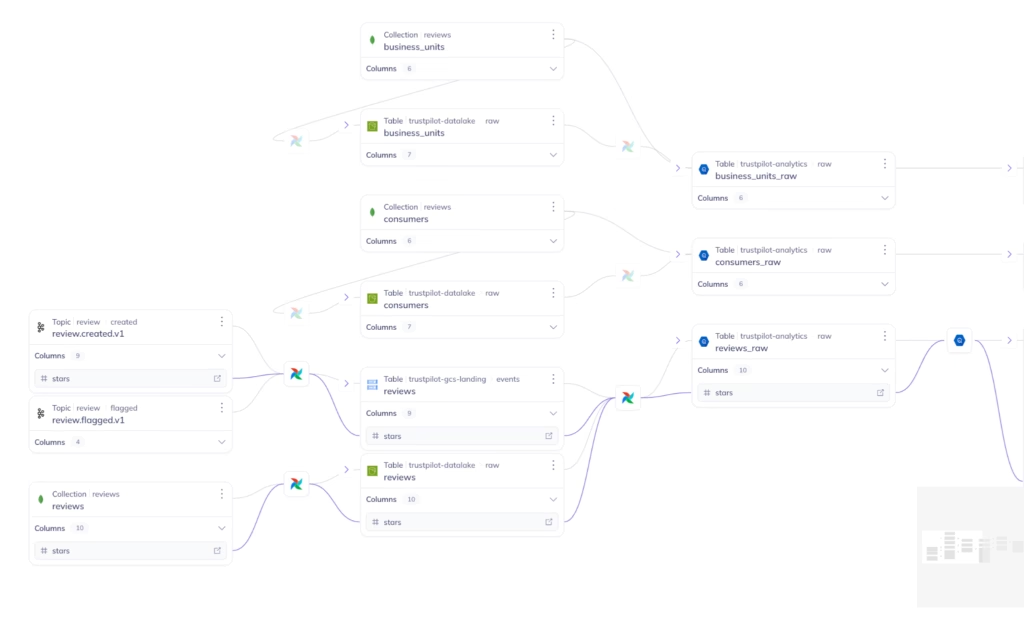
Lineage is the pillar that changed how engineers work. For the first time, that knowledge was in a system the whole organisation could navigate, rather than distributed across GitHub, Slack threads, and the people who built the pipelines.
For engineers planning complex migrations, the difference is material. Before DataHub, impact analysis meant searching GitHub, posting across Slack channels, and relying on knowledge held in people’s heads. At the scale of Trustpilot’s estate, that was time-intensive work that could only ever produce a partial picture of downstream dependencies.
Now, engineers trace the full downstream impact of a MongoDB collection migration by clicking through the DataHub UI, querying via chat, or pulling lineage context directly into Claude Code or Copilot through DataHub’s MCP integration.
“Lineage is one of the really big selling points. What people really want to do with that information is usually lineage-based — who do I need to go and ask, who’s querying my table, is it being used? All these things are lineage-based.”
Hugo HobsonSenior Data Engineer, Trustpilot
05 | Data quality
Trustpilot has put assertions in place across a number of sources as part of its broader quality approach, giving the team an early signal before issues reach downstream consumers.
How analytics teams put DataHub to work
The five-pillar framework gave the data enablement team a structure to drive governance across engineering. But some of the strongest adoption has come from teams building on top of that foundation themselves.
For Trustpilot’s analytics organization, the core use is the business glossary. Business users had no authoritative place to find what a metric actually meant, definitions lived in scattered docs and people’s heads. The team adopted DataHub as the business-facing source of truth, maintaining the glossary there and attaching each term directly to the dashboards and datasets it governs. Now there’s one answer to “what does this metric mean, and where does it come from?”
The team also tags its trusted, kitemarked dashboards in DataHub so business users can tell which ones are the governed source of truth. All of this context reaches users directly inside Looker through the DataHub Chrome extension. Business users can now see documentation, ownership and trust status without leaving the dashboard or opening a separate tool.
The Impact
Trustpilot’s data estate is now visible, owned, and governed. Engineers understand the full journey of their data, compliance fundamentals like PII classification are anchored in the catalog, and teams across the business can find what they need without routing each question through the data team.
Key outcomes included:
- A DataHub-first culture across engineering and analytics. The default question has changed. When teams discuss data, they now ask “have you looked in DataHub?” before routing the question to someone else. That shift from asking to self-serving is the outcome the team points to most.
- Confident migration planning. Trustpilot is migrating from self-hosted MongoDB in AWS to Amazon DocumentDB. Before DataHub, engineers searched GitHub, traced through Slack threads, and relied on knowledge held in people’s heads. At the scale of Trustpilot’s estate, building a complete picture of downstream impact through manual methods required significant time and coordination. Now lineage traversal via the DataHub UI, chat, or MCP integration gives engineers a clear and confident view of downstream impact before any migration begins.
- Business users finding the right answer without the data team. Out of nearly 500 Looker dashboards, business users can now identify the kite-marked, governed source of truth without technical knowledge and without asking anyone. Context is available directly in Looker via the DataHub Chrome plugin.
- An additional layer of data quality monitoring. Trustpilot has put assertions in place across a number of sources, giving the team earlier visibility into data issues as they emerge alongside its broader quality approach.
What’s next
Trustpilot is actively exploring how DataHub’s context layer can underpin reliable AI and agent use for non-technical users: people who cannot validate whether an AI-generated answer is using the right table.
“It’s raised awareness of how complex our data estate actually is. There are lots of moving parts that people maybe weren’t aware of and it’s raising data literacy across engineering.”
David WalkerStaff Engineer, Trustpilot
Trustpilot: before and after DataHub Cloud
| Area | Before DataHub Cloud | With DataHub Cloud |
| Data estate visibility and trust | Institutional knowledge and manual search, with no centralised catalog or unified ownership model and no standardised signal for dashboard trustworthiness across ~500 Looker views | 500,000+ assets cataloged across AWS and GCP; business users guided to curated kite-marked dashboards as a source of truth |
| Ownership | Discrepancies in how ownership is tracked across most assets | Ownership, criticality, and PII tagging in place and |
| Incident detection and resolution | Data quality monitored through existing tooling, without a dedicated assertions layer for early detection across instrumented sources | Assertions provide an additional monitoring layer on top of existing quality control, extending proactive detection across instrumented sources. |
| Migration planning | Impact analysis conducted through manual GitHub searches and Slack threads, with lineage coverage limited by the scale of the estate | Lineage traversal via UI, chat, or MCP gives confident blast radius analysis |
| Self-serve | Data team fielding inbound questions about data location and ownership | Teams start with DataHub; question volume to the data team has decreased |
Download the IDC Business Value study to see how DataHub Cloud customers achieve 91% faster data searches, 17% higher data engineering productivity, and 58% faster resolution of data-related outages.