


Inside the Context Platform: June 2026 Town Hall Highlights
A year ago, the open question was whether a data catalog could feed an AI agent at all. That question is settled. The June town hall took up the next one. Once an agent depends on your catalog, how do you keep the context inside it trustworthy, discoverable, and current?
The theme was “Inside the Context Platform”, and the sessions stacked into one picture. To answer a business question well, an analytics agent needs three kinds of knowledge:
- It needs to know what is true about the data.
- It needs to know how the organization actually uses those truths.
- And it needs a durable place to read and write state.
Cong Wang from PingCAP opened by drawing that split. The DataHub team spent the rest of the hour on that first layer, the DataHub Context Platform, and where it heads next.
From the community: summits, meetups, and a hackathon
A quick lap around the community before the sessions:
- Summit season: We had a strong run at Snowflake Summit and Databricks Summit in San Francisco, with DataHub-wrapped rideshares circling Moscone Center, an aerial banner over the conference, and a steady stream of customers and community members stopping by to try the product.
- July events: We ran a partner webinar with Scalefree on building a metadata layer with Data Vault, then co-hosted a Chicago meetup with Optiver on building a context layer agents can trust, aimed at practitioners in financial services and trading.
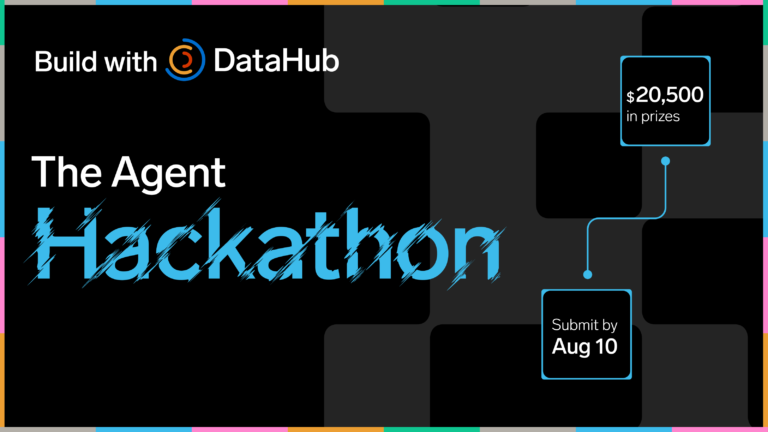
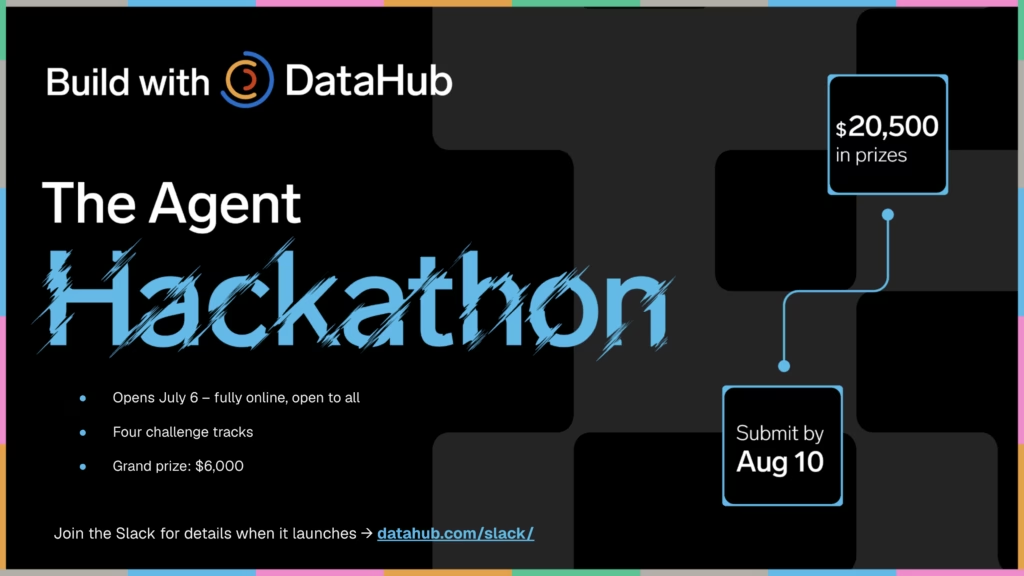
- Agent hackathon, live now: Build with DataHub: The Agent Hackathon opened July 6 and is running fully online, open to everyone, with $20,500 in prizes including a $6,000 grand prize across four challenge tracks. Jump into the agent-hackathon channel in the DataHub Slack.
- New regional chapters: We launched two, one covering Germany, Austria, and Switzerland, and one for India, with an open invitation to lead a chapter in other regions.
PingCAP: TiDB, mem9, and where agent context comes from
Cong Wang, Principal Software Engineer at PingCAP, opened the sessions with the question at the heart of the town hall: When an enterprise agent answers a data question, where does its context actually come from?
Cong’s answer split the problem three ways, mapped to three systems. DataHub holds the governed source of truth about the data. It tells the agent what to use and where to find it. mem9, PingCAP’s agent-memory product, holds a different kind of context. It remembers how a team works: customer preferences, priorities, decision rules, and communication patterns a data catalog never sees. TiDB sits underneath as the durable layer, storing both operational data and agent memory state. It is MySQL-compatible and reached over SQL. As a new DataHub source, TiDB’s metadata can now be cataloged alongside the rest of a team’s stack.
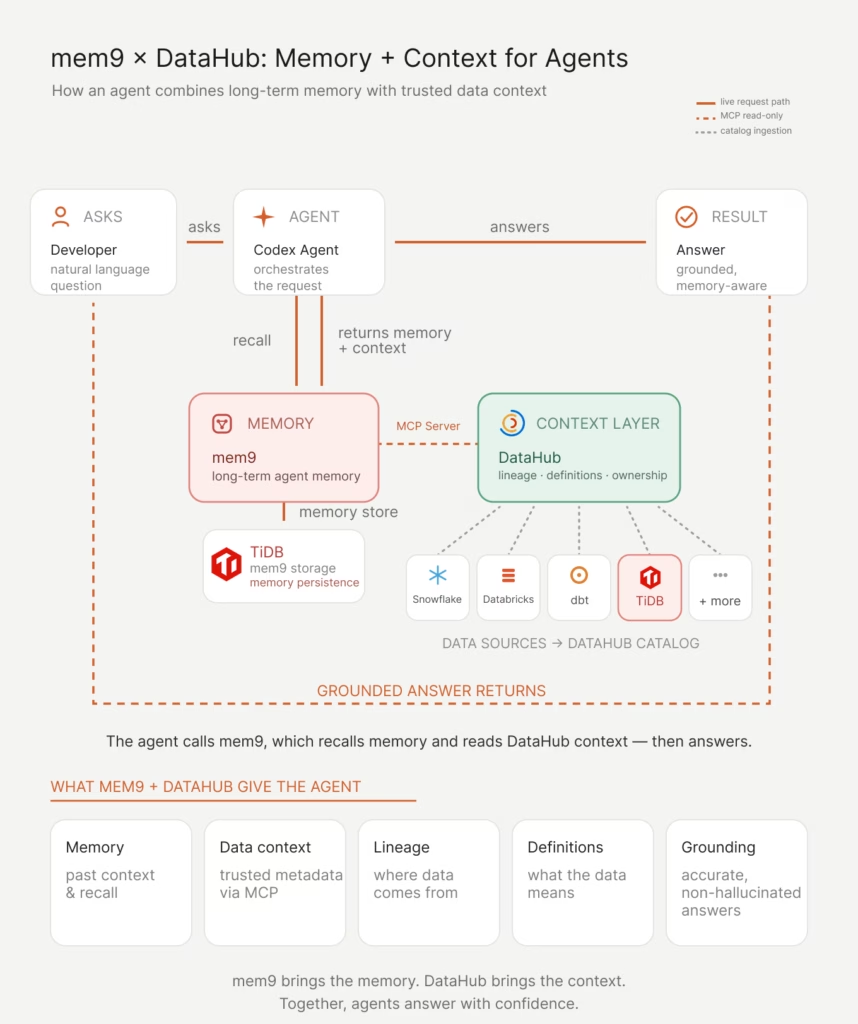
“DataHub says what’s true about the data. mem9 remembers how the team should use it.”
Cong WangPrincipal Software Engineer, PingCAP
Cong demonstrated the split with a fictional company, Atlas, preparing a CFO-facing quarterly business review. Run without memory, the agent reached the data through DataHub, cleared the customer-health dashboard for use, and used DataHub’s freshness signal to flag that some of it was stale. Run with memory, the same agent kept that DataHub context and added a rule it recalled from mem9: For CFO-facing questions, check freshness and lineage before making a business claim. Combining the two, it confirmed the dashboard as the approved, governed customer-health source, surfaced its owner from DataHub’s metadata, and held the answer for that owner’s sign-off.
The takeaway was clean. DataHub gives the agent governed truth about the data. mem9 gives it durable memory of how the team should act on that truth. TiDB gives it a place to read and write both. Together they let an agent reason with evidence instead of guessing from the prompt alone.
Inside the DataHub Context Platform
Why do analytics agents need context?
John Joyce, Co-Founder at DataHub, focused on the use case that has taken hold fastest in data: the text-to-SQL analytics agent that lets anyone ask a question in plain language and get a data-backed answer.
John framed two problems any such agent has to solve.
- It has to find the right data across an ecosystem that can run to hundreds of thousands of tables and millions of columns.
- It has to know the right patterns to query that data, the filters, joins, and historical query shapes that produce a correct result.
Both depend on semantic context, the business understanding that has traditionally lived in analysts’ heads. Without it, John listed the failure modes DataHub has seen in production: agents picking the wrong source, the wrong metric logic, or a faulty join, with no way to explain why.
“Without DataHub context, your agent has to guess. With it, your agent just knows.”
John JoyceCo-Founder, DataHub
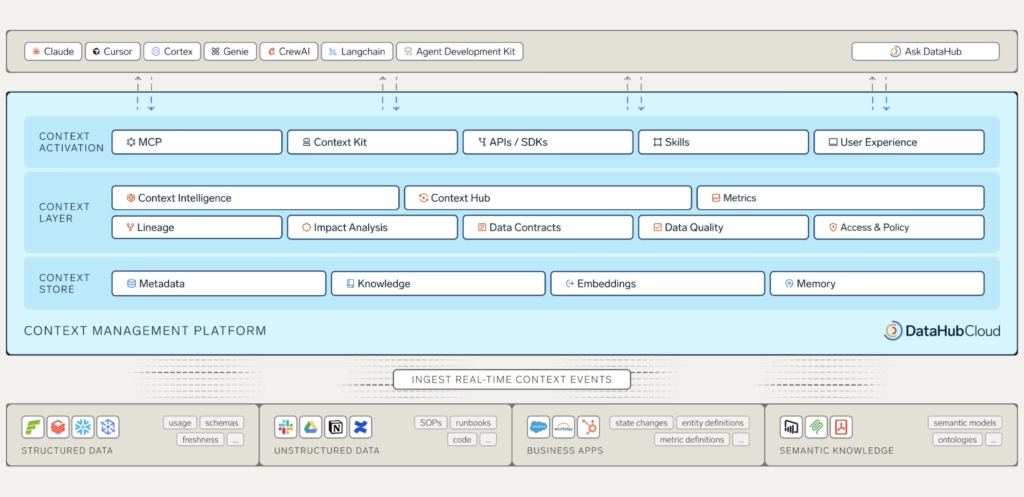
Four pillars, one context layer
The reason that context is hard to serve, John explained, is that it tends to fail in four specific ways. It is fragmented across table comments, dbt and Looker, sample queries in GitHub, and docs in Confluence, Notion, and Google Drive. It is inaccessible, with no single surface an agent can query. It is unvalidated, so pointing an agent at raw Slack or Confluence lets it use anything anyone ever said. And it goes stale, because keeping it current was never an explicit process.
The Context Platform answers each with a pillar:
- Context Ingestion brings technical and unstructured context into one place.
- Context Intelligence reads the technical exhaust a warehouse already produces, such as query logs and dashboard logic, and turns it into knowledge an agent can search, without manual curation.
- Context Hub gives humans a place to review and publish that context before agents see it.
- Context Activation lets agents search all of it from wherever they run, whether that is Claude, Snowflake, Databricks, or a custom framework.
Early results at Pinterest and Miro
Two early adopters put numbers to it. Pinterest built a context layer on DataHub, and its analytics agent now runs at 10x the usage of the next most-used internal agent. Miro connected its agent to DataHub context and roughly doubled the agent’s accuracy, measured against a suite of more than 1,000 evals. For more detail on Miro, check out the Context Platform launch post, and for the full Pinterest story, check out their case study.
How does the DataHub Context Platform work in practice?
Manuela Wei, Principal Product Manager at DataHub, turned the pillars into a live demo, running the same question through two agents in Snowflake CoWork: How much revenue has each product category driven in total? One agent was connected to DataHub, one was not.
The unconnected agent found some tables but no join path, and stalled without more direction. The connected agent found the SQL context DataHub had generated, identified the right table, wrote the query, and returned the correct answer.
“With DataHub, you can reach this same unified context from anywhere your users ask questions.”
Manuela WeiPrincipal Product Manager, DataHub
Manuela then walked the pillars from the inside. Context had been ingested from Snowflake query history and dashboards. An admin configures context generation by domain and platform, defines evals as golden questions with pass criteria, and can turn on auto-publish once enough of them are passing. On the review side, a task-center inbox collects the AI-generated context documents, each unpublished until a human approves it, showing the questions answered, the tables to use, and the calculations behind them. Reviewers can edit, comment, and rerun evals before publishing.
For Context Activation, the fourth pillar, Manuela moved to Claude, connected to DataHub’s Model Context Protocol (MCP) server, and asked how many active customers there were and their average lifetime value. The definition of “active” was ambiguous, so a plain-language correction( “a purchase in the last 60 days”) updated the generated SQL. That correction can be written back to DataHub through the MCP, where it flows through the same expert review before any other agent picks it up.
What’s next for semantic models and metrics?
Maggie Hays, Founding Product Manager at DataHub, closed the platform block with the DataHub product roadmap.
The near-term work, over the next two to three months, is first-class support for semantic models and metrics. A semantic model brings together the plain-language meaning of a set of tables and the joins that connect them, closer to a business-readable entity-relationship diagram than a raw schema. Metrics nest inside it, one level deeper, capturing the exact fields, logic, and filters used to measure something over time. The pattern mirrors what the Context Platform already does, pairing a natural-language question with the technical implementation that answers it. Models and metrics will export to and import from Open Semantic Interchange (OSI) YAML, keeping DataHub aligned with the standard that Snowflake, dbt, and others are building toward.
“Everything we do at DataHub stays compatible with OSI standards.”
Maggie HaysFounding Product Manager, DataHub
For teams that have already invested in a semantic layer, the point is to meet them where they are. DataHub will update its ingestion for Snowflake semantic views, dbt metric models, and Databricks metric views, which it currently models as datasets, with a clean migration planned. Metric-level lineage will let a team see downstream which metrics and dashboards a column change affects, and upstream which fields a metric draws on. The top-level model and ingestion support will land in open source, with tighter integration into the Context Platform on DataHub Cloud.
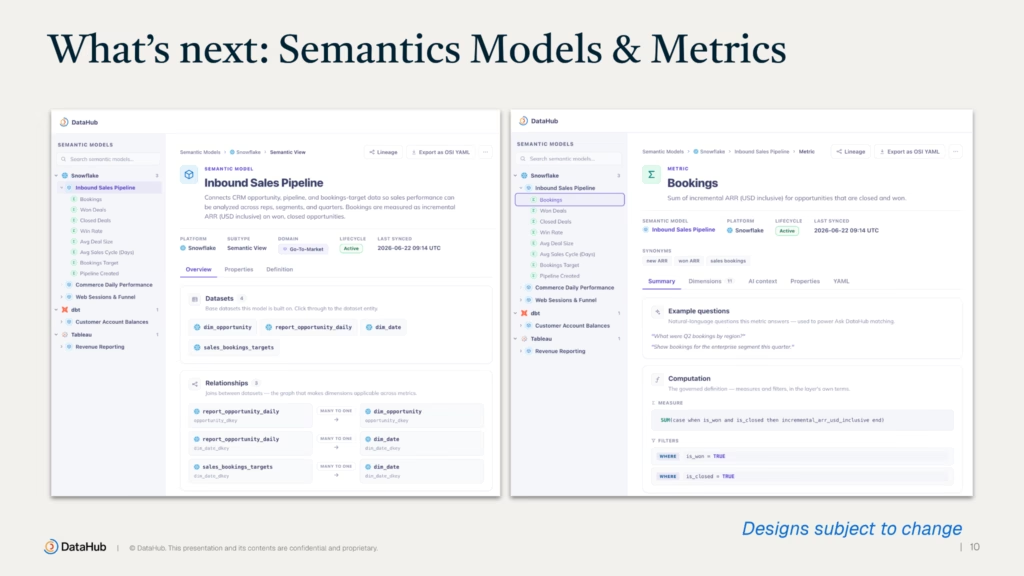
The Context Platform is available now in private beta on DataHub Cloud, a fit for teams running production data agents at scale, or eager to collaborate and share feedback.
CONTEXT 2026: from prediction to practice
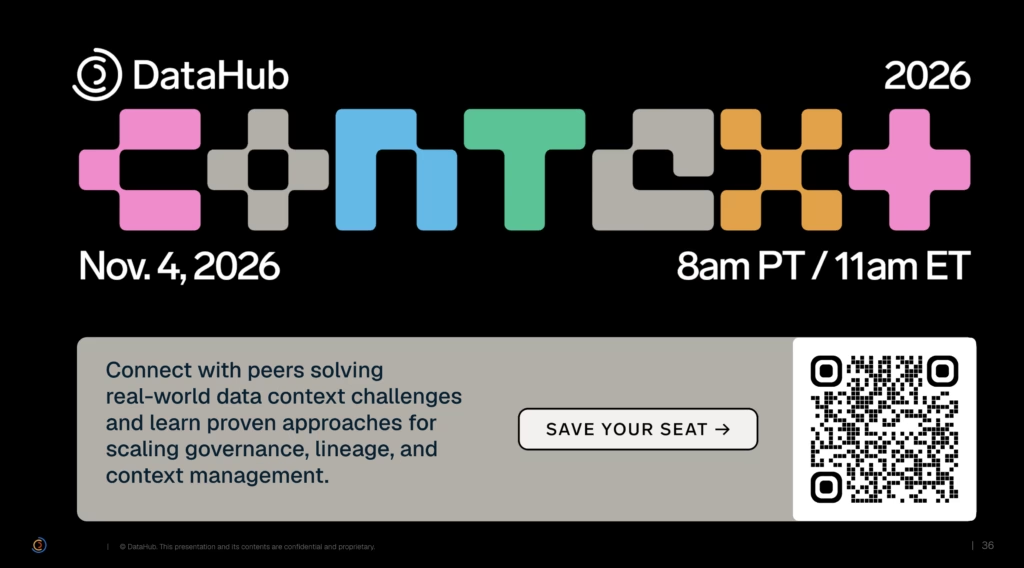
Shirshanka Das, Co-Founder and CTO of DataHub, announced this year’s CONTEXT summit.
At CONTEXT 2025, last year’s summit, Shirshanka had predicted that context engineering, then a gold rush of prompt, tool, and context-window tricks, would have its management moment. The work would move beyond individual teams assembling their own retrieval-augmented generation (RAG) stacks toward delivering and governing context for a whole organization, across many agents, with humans in the loop. That shift has happened. Most data and AI companies now describe themselves as a context something.
“The context pitch is everywhere. This year is about the practice of context.”
Shirshanka DasCo-Founder and CTO, DataHub
The conference theme is the practice of context, the implementations that have actually shipped to production rather than the pitch. CONTEXT 2026 runs November 4 as a half-day virtual summit for practitioners. DataHub’s product and engineering teams will share what they are building, alongside hands-on tutorials on building a context management stack from scratch. The call for speakers is open until July 23, and it leans practitioner: real production stories over vendor pitches.
From the Q&A
Is DataHub built for large, constantly changing data environments?
Yes. DataHub runs on a real-time, high-volume foundation, and its open-source Actions Framework reacts to metadata changes as they happen. The design judgment is in surfacing the changes that matter to the right subject matter experts without flooding them with alerts every time something trivial shifts, like a region label being renamed from “US” to “North America.”
Can the community add connectors for sources DataHub doesn’t cover yet?
Yes, that is the model. Slack and Confluence connectors already pull in plain-language docs, and a GitHub integration is on the way. That GitHub integration is open source, so the community can extend it to GitLab and Bitbucket with the team’s help, the way the Tableau connector was community-built. Longer-tail sources like SharePoint get built and maintained the same way, by the people who need them.
Where this leaves us
The sessions came at context from different angles and landed in the same place. PingCAP showed the layers an agent needs around it. John, Manuela, and Maggie showed how DataHub builds and serves the context layer, and where semantic models take it next. Shirshanka set all of it against an industry that has stopped debating whether context matters and started shipping it.
A few ways to go deeper:
- Watch the full town hall recording for the live demos.
- Explore the DataHub Context Platform and apply for the private beta.
- Save the date for CONTEXT 2026 on November 4, and submit a talk.
- Join the agent hackathon in Slack before the tracks close.
- Browse the DataHub integrations index for TiDB and the rest of the connectors.
- Sign up for the July town hall in the DataHub Slack.
Context stopped being the new idea a while ago. This month was about the machinery that makes it hold up.