


Context Platform vs. Data Catalog: What’s the Difference?
TL;DR
- A data catalog indexes structured metadata about data assets. A context platform unifies that metadata with unstructured organizational knowledge into a context graph and delivers it to both humans and AI agents at machine scale.
- The line between them is architectural. Adding AI features to a data catalog does not produce a context platform because the underlying scope of context handled and the delivery model are fundamentally different.
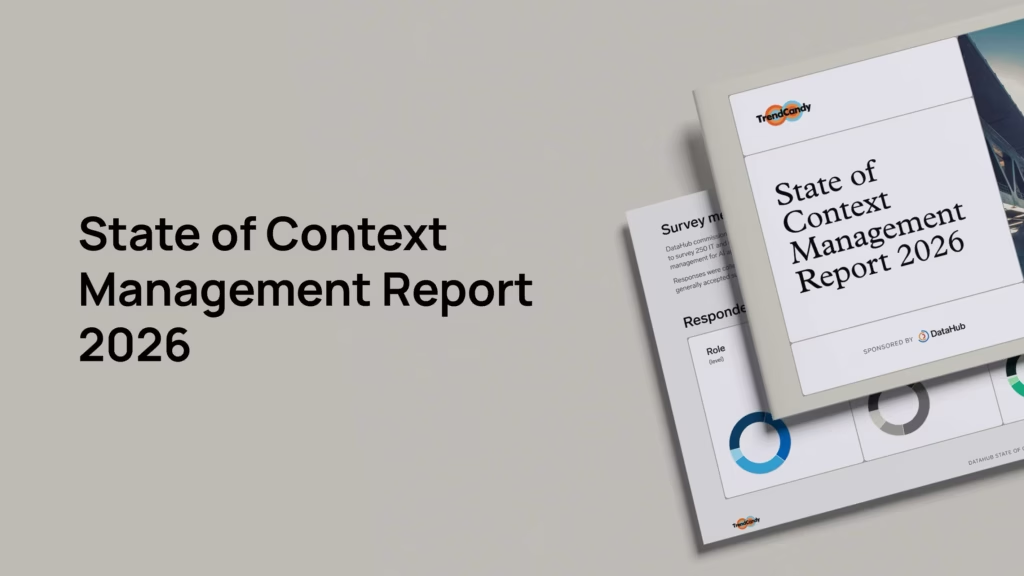
- Most enterprises are operating at catalog maturity while believing they have crossed into context platform territory. The State of Context Management Report 2026 found 88% of data and AI leaders claim a fully operational context platform, yet 87% cite data readiness as their biggest blocker to putting AI into production.
The difference between a data catalog and a context platform is not a checklist of capabilities. It is an architectural distinction that determines whether your infrastructure can support agentic AI in production, or whether it will quietly stall every initiative that depends on grounded, governable context.
The short version: A data catalog indexes structured metadata about data assets so humans can find and govern them. A context platform unifies that metadata with the unstructured knowledge that gives it meaning, and delivers the result to AI agents at machine scale. The first is a tool; the second is infrastructure.
What is a data catalog?
Data catalog definition
A data catalog is a centralized inventory that indexes structured metadata about data assets (schemas, lineage, ownership, quality, classification) and makes it searchable through data discovery interfaces. It serves data professionals through a portal interface and helps them find, understand, and govern the data that exists across the enterprise.
That definition has held for a decade. Modern AI data catalogs have extended it: event-driven metadata processing instead of batch, AI and ML asset coverage alongside traditional data assets, automated documentation and classification, and APIs that support programmatic access. Those advances matter, and they represent the current state of the data catalog category.
But the data catalog, even in its modern AI-native form, indexes one specific thing: Structured, technical, and operational metadata about data assets. That scope is the boundary where the catalog category ends.
For the fully expanded answer on what a data catalog is and how the category has evolved, see our companion piece on what a data catalog is.
What is a context platform?
Context platform definition
A context platform is infrastructure that unifies structured metadata with unstructured organizational knowledge into a context graph, and delivers that context to humans and AI agents through portals, APIs, and MCP servers. It handles what a data catalog handles, plus the documentation, decision logs, and institutional knowledge that give metadata its meaning.
The platform handles what the catalog handles, plus the knowledge that lives in runbooks, FAQs, decision logs, query history, business glossaries, Confluence pages, and Notion docs. It treats human-curated documentation as first-class infrastructure, not as a sidebar to the metadata graph. And it makes the resulting context available at machine scale to the agents and applications that need it.
A context platform is the infrastructure layer for context management: The practice of making enterprise data and knowledge usable by AI at scale. It is what a data catalog must become for an organization to successfully run AI agents in production.
Why this isn’t a feature comparison
Many data catalog vendors are re-labeling themselves as AI-ready or context-aware without changing their underlying architecture. The marketing claims parity. But the architecture has not moved.
A feature checklist obscures the question that actually determines production viability. Does the platform handle unstructured organizational knowledge as a first-class part of the graph, or only structured metadata? Does it deliver context to agents at machine scale through purpose-built interfaces, or does it serve a portal with APIs bolted on?
Two architectural lines of difference structure the rest of this piece: the scope of context the platform handles, and the model by which that context is collected and delivered
The first line of difference: Scope of context
A data catalog indexes structured, technical, and operational metadata about data assets. Schemas, lineage, ownership, quality metrics, usage patterns, classification tags. This is the metadata graph: A connected representation of what data exists, where it lives, and how it relates to other data.
A context platform unifies that metadata graph (technical and business metadata) with unstructured organizational knowledge. The runbook that explains how the finance team handles month-end close. The decision log that records why the customer dimension was modeled the way it was. The FAQ that documents the difference between two similar revenue metrics. The query history that shows how data engineers actually use a given table in practice. The business glossary that defines what counts as an “active customer.”
When that knowledge is connected to the metadata graph, the result is architecturally different. It is a context graph: A representation of what data means, who is responsible for it, and whether it can be trusted, not just where it lives.
This is the distinction that matters for AI. An agent querying a metadata graph gets schema. An agent querying a context graph gets schema plus the institutional knowledge required to use that schema correctly. The difference between a query that returns a column and a query that returns a column with the business definition, the owner, the freshness signal, the upstream lineage, and the linked decision log explaining why this column exists is the difference between an agent that hallucinates and an agent that performs.
Pinterest’s data platform team independently arrived at this architectural conclusion. Their text-to-SQL agents required a unified context layer that combined technical metadata with business semantics, and they implemented it on DataHub. The architecture is documented on Pinterest Engineering’s Medium and we have written about the broader pattern of the semantic backbone for analytics agents elsewhere.
A data catalog deals only in metadata about structured data assets. A context platform handles metadata and the unstructured knowledge that gives that metadata meaning. When you connect those two layers and surface the relationships between them, you stop building a metadata graph and start building a context graph. That is the architectural line.
The second line of difference: Collection and delivery
The second architectural distinction sits at the layer of how context gets into the platform and how it gets out.
A data catalog collects metadata passively. Connectors harvest schemas, lineage, and operational signals from pipelines on a schedule. Modern catalogs have moved much of this to near real-time, but the collection model is the same: The catalog observes the data infrastructure and reflects what it sees.
A context platform supports passive collection, too. But it also provides infrastructure for humans to actively contribute and curate domain knowledge, capturing context from the artifacts where it already lives and keeping subject matter experts in the loop to validate and correct that context over time. Context Documents are first-class nodes in the graph, classifiable by type, linkable to specific data assets, versionable, and discoverable. Runbooks, FAQs, and policies created in Notion or Confluence ingest into the same graph as the metadata they describe.
The delivery model is the second half of this distinction. A data catalog delivers to humans through a portal. APIs exist, but the design center is the human interface. Agents and automation consume what the portal exposes.
A context platform delivers context to humans through a portal and to machines through purpose-built infrastructure. MCP servers expose the context graph to any MCP-compatible AI tool, including Claude, Cursor, and Windsurf, and support not just read access but mutation, so agents can enrich the graph rather than only consume it. SDKs and integrations connect the graph to agent frameworks like LangChain, Vertex AI, Snowflake Cortex, and Copilot Studio. Semantic search makes unstructured context retrievable by meaning rather than exact match, so agents find relevant context based on intent.
This delivery layer is what makes a context platform relevant to agentic AI. A portal-first catalog with a bolted-on API does not operate at this layer, no matter how many AI features get added to the portal.
Where catalogs end and context platforms begin
The Context Management Maturity Index, drawn from the State of Context Management Report 2026, locates the architectural threshold this piece is about.
| Stage | Category | What it does | Who it serves |
| 1 | Do nothing | Data context lives in spreadsheets, Slack, Teams, and institutional knowledge | Small teams, early-stage organizations |
| 2 | Traditional data catalog | Harnesses metadata so humans can discover, use, and manage data assets through a portal interface | Data professionals (Alation, Collibra, Informatica, AWS Glue) |
| 3 | AI data catalog | A single pane of glass for humans and machines to discover, use, and manage data and AI assets. APIs are first-class. Up-to-date metadata. Unified data and AI scope | Data professionals plus programmatic consumers |
| 4 | Context platform | Accurate, governed context for AI agents to discover, use, and manage data and AI assets at enterprise scale. Unstructured knowledge sits in the graph alongside metadata. Delivery happens through MCP, APIs, and SDKs purpose-built for agent consumption | Humans and AI agents, at enterprise scale |
The transition from Stage 3 to Stage 4 is the architectural threshold this piece is about. Below that line, the platform is a tool humans consult. Above it, the platform is infrastructure agents depend on.
The aspiration-reality gap
The State of Context Management Report 2026 surveyed 250 IT and data leaders. Five numbers tell the story:
- 88% of respondents claim to have a fully operational context platform
- 87% cite data readiness as the biggest impediment to putting AI into production
- 61% frequently delay AI initiatives due to lack of trusted and reliable data
- 83% agree agentic AI cannot reach production value without a context platform
- 66% report AI models generating biased or misleading insights due to insufficient context
Read those numbers together. Nearly nine in ten leaders say they have the context infrastructure their AI initiatives need. Nearly nine in ten also say a lack of that infrastructure is what is blocking those initiatives.
This is what happens when an organization labels its catalog a context platform without changing the architecture. The capability gets claimed. The work continues to stall on the same data readiness problems the catalog was supposed to solve. The vocabulary moves; the infrastructure does not.
The question to ask of any platform claiming context platform status is not whether the marketing has been updated. It is whether the architecture handles unstructured knowledge as a first-class part of the graph, and whether delivery to agents happens through infrastructure designed for them.
What a working context platform actually does
The architectural distinction is the argument. The capabilities and outcomes below are what the architecture enables in practice.
Grounds agents in semantically coherent context
Every result an agent retrieves carries quality signals, lineage, trust indicators, and business definitions, not just schema. The agent does not need to ask whether a table is the right one to use; the context graph already encodes that judgment.
Supports agent enrichment of the graph
The MCP layer provides not just read access but mutation tools for tagging, ownership assignment, description updates, and glossary term management. Agents become contributors to the context graph rather than only consumers of it.
Surfaces unstructured context through semantic search
Documents are chunked and embedded during ingestion, so agents and humans can find relevant context based on meaning rather than exact match. The runbook that explains a calculation is retrievable by an agent that needs the calculation, even if the agent never learned the runbook’s exact phrasing.
Delivers to any agent framework
SDKs and integrations connect the context graph to LangChain, Vertex AI, Snowflake Cortex, and Copilot Studio. Agents built in any of these frameworks consume context through purpose-built infrastructure.
Demonstrates the graph through a human-facing interface
Ask DataHub lets a data user query across structured metadata, Context Documents, and external connectors in a single question. A question like “how do we calculate monthly loan aggregations” returns an answer grounded in both the metadata graph and the linked Notion document, with citations.
The IDC Value Study of DataHub Cloud 2026 quantifies what this looks like in production: 119% more AI and ML models reaching production, 91% reduction in time to discover trustworthy data (from 50 minutes to 5), and a 24% lower AI/ML project failure rate. These outcomes follow from the architecture, not from any single feature.
When you need each
Not every organization needs Stage 4 infrastructure today. The honest framing is that catalogs continue to serve real needs for organizations whose primary requirement is human discovery and governance of structured data assets.
A traditional or AI data catalog is the right fit when the work that depends on the platform is human work: Data teams finding tables across data sources, data stewards enforcing data governance policy on structured assets, engineering teams documenting data flows. If AI in production is not on the immediate roadmap, the architectural question can wait.
A context platform becomes necessary when one of three things is true:
- AI agents are moving from pilot to production and need grounded, governable context to perform reliably
- Context needs to be delivered to machines at machine scale, not consumed by humans through a portal
- Unstructured organizational knowledge needs to be governed alongside the data it describes, because that knowledge is what makes the data usable
The forward-looking question is the one most organizations should be asking. The State of Context Management Report 2026 shows that AI in production is on nearly every enterprise roadmap inside the next 12 to 24 months. If that is true for your organization, the architectural question is already on the table, even if implementation is still some way off.
Choosing a Stage 3 catalog with the assumption that AI features will close the Stage 4 gap is a bet against the architecture. The track record of that bet, looking at the aspiration-reality gap above, is not encouraging.