


The Context Layer for AI: What Enterprises Get Wrong
Quick definition: What is a context layer for AI?
A context layer for AI is the infrastructure that delivers enterprise knowledge to AI systems and human users from a single, governed source of truth. It combines structured metadata (schemas, lineage, quality metrics) with unstructured business knowledge (documentation, definitions, institutional expertise). It sits between an organization’s data estate and the AI applications that need to reason about that data.
Something interesting happened in enterprise AI over the past year. Semantic layer vendors started calling their products a context layer. Knowledge graph companies did the same. Consultancies published frameworks. Data catalog vendors, analytics platforms, and AI startups all converged on the same phrase.
Everyone agrees that AI needs a context layer. That consensus is real, and it’s earned. Large language models cannot operate reliably in enterprise environments without structured access to metadata, business definitions, lineage, quality signals, and institutional knowledge. The models are powerful. The context they receive is what determines whether that power is useful or dangerous.
But consensus on the problem has not produced consensus on the solution. Each vendor is defining “context layer” to match whatever they already sell. The semantic layer company says context is metric definitions and calculation logic. The knowledge graph company says context is entity relationships and domain models. The consulting firm says context is a six-step maturity framework. The AI startup says context is a vector database and a retrieval pipeline.
They’re all partially right. And that’s the problem.
The problem that sparked the conversation
The context layer conversation exists because enterprise AI keeps failing in the same way. Not because models lack intelligence, but because they lack the organizational knowledge that humans carry around in their heads and have never systematized.
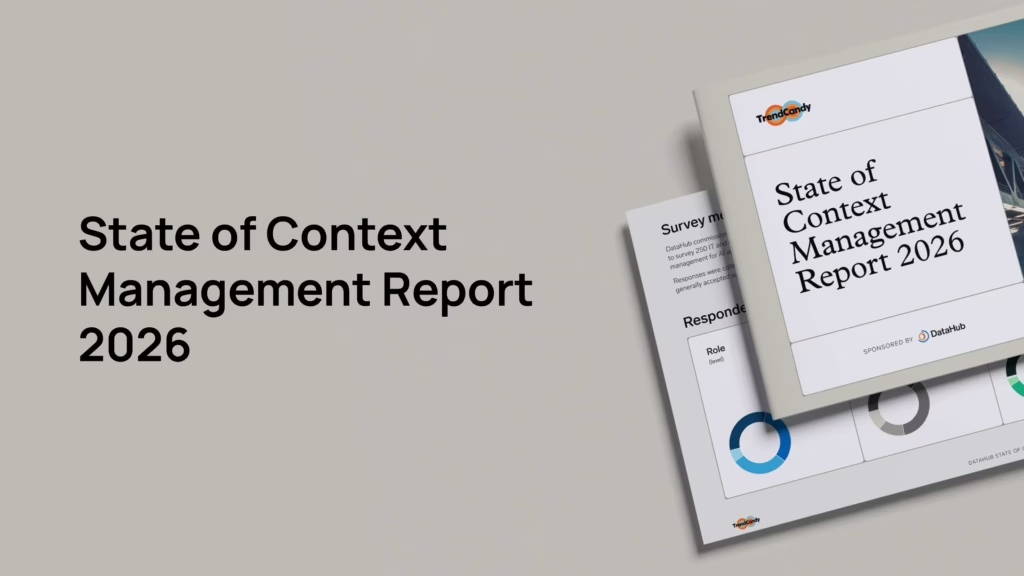
The scale of this gap is striking. According to the DataHub State of Context Management Report 2026, 88% of organizations claim to have fully operational context platforms. Yet 61% of those same organizations frequently delay AI initiatives due to a lack of trusted and reliable data. This is not a marginal discrepancy. It is a structural contradiction that reveals how wide the gap is between what organizations believe they have and what their AI systems actually need.
The operational evidence reinforces this. 86% of data teams report spending considerable time searching for the right data. This discovery chaos is the human version of the problem that AI agents inherit and amplify at machine speed. 66% say their AI models frequently generate biased or misleading insights due to insufficient context in the underlying data infrastructure. 57% find it challenging or very challenging to identify authoritative sources of truth for their data. These are not edge cases. These are the norm at organizations that believe they have solved the context problem.
And when organizations try to scale AI agents from pilots to production, the obstacles they hit are not model limitations. They are infrastructure gaps: data fragmentation (41%), tool integration complexity (43%), and security and privacy risks (51%). Gartner predicts that by 2027, over 40% of all agentic AI projects will be canceled. The cancellations will not be caused by model quality. They will be caused by the absence of the infrastructure those models need to operate reliably.
This is the environment in which every vendor in the data stack has rushed to declare that they provide a “context layer.” The demand signal is unmistakable. The question is whether the supply is up to the job.
Why partial context layers fail
The most common mistake in building a context layer for AI is treating one component as the whole solution. Each of the dominant approaches captures a real piece of the picture, but none captures the full scope of what enterprise AI requires.
The semantic layer: Right about definitions, wrong about scope
Semantic layers solve an important problem. They standardize metric definitions, encode business rules, and ensure that queries against enterprise data return consistent results. When an AI agent asks about gross margin or quarterly revenue, a semantic layer ensures it uses the right calculation, the right fiscal calendar, and the right join paths.
But a semantic layer is optimized for analytics: It answers the question “what does this metric mean?” It does not answer “where did this data come from?”, “who owns it?”, “is it fresh?”, “what downstream systems depend on it?”, or “does this user have permission to access it?” For the full range of enterprise AI use cases, from agentic workflows to automated compliance to cross-functional decision support, a semantic layer is necessary but not sufficient.
The knowledge graph: Right about relationships, wrong about scope
Knowledge graphs are powerful representations of how entities in a business relate to each other. Customers connect to accounts. Accounts connect to products. Products connect to incidents. The graph structure makes it possible for AI systems to traverse relationships and reason about connections that flat data models obscure.
The limitation is that a graph without governance is a map without road signs. It shows you the territory but doesn’t tell you which paths are safe, which data is authoritative, or which connections are stale. An AI agent traversing an ungoverned knowledge graph can follow plausible-looking relationships to incorrect conclusions, with no lineage trail to diagnose what went wrong.
Context engineering: Right about delivery, wrong about scope
Context engineering is the set of techniques for managing what goes into an AI model’s context window: Memory, retrieval, tool calling, guardrails, structured outputs. It is the craft of assembling the right information, in the right format, at the right time, for a specific AI application.
Context engineering matters. It is also, by design, application-scoped. It solves the problem of filling one agent’s context window effectively. It does not address where that context originates, whether it is trustworthy, or how to ensure consistency when 50 different teams are each engineering context for their own agents. As DataHub’s research confirms, 82% of IT and data leaders now agree that prompt engineering alone is no longer sufficient to power AI at scale. Context engineering is the next step. But it still needs a foundation beneath it.
The consulting framework: Right about the vision, missing the infrastructure
Several consultancies have published context layer frameworks: Maturity models, architectural blueprints, implementation roadmaps. These are useful for thinking about the problem, and some are genuinely well-reasoned. But a framework without infrastructure is a plan without execution. It gives you a vocabulary for describing what you need. It does not give you the system that delivers it.
The deeper issue
What these partial approaches share is a common structural flaw: Each defines the context layer from the inside of its own product category, drawing the boundary exactly where its capabilities end.
- The semantic layer vendor sees context as metric definitions because that is what semantic layers manage
- The knowledge graph vendor sees context as entity relationships because that is what knowledge graphs model.
No single product category is wide enough to contain the full scope of what enterprise AI requires, which is why organizations that adopt any one of these approaches as their complete context strategy keep encountering the same gaps in production.
What a *real* context layer requires
If partial approaches keep falling short, what does a complete context layer for AI actually look like? Based on what we see across the organizations building and scaling production AI, four requirements are non-negotiable.
Unified context, not context islands
The State of Context Management Report found that 93% of organizations plan to treat context as shared infrastructure rather than team-specific tooling. That intention is correct, but most organizations have not yet achieved it. The current reality at most enterprises looks like this:
One team uses one vector database and embedding model for its RAG pipeline. Another team chose a different stack. A third team built something custom. The customer-facing agent and the internal analytics agent are pulling from different knowledge bases. They give different answers to the same question.
This is the microservices problem all over again. The industry learned the hard way that without shared standards, proliferating microservices creates more complexity than they resolve. The same lesson applies to context. Without unification, every new AI agent adds another context island, and the inconsistencies compound.
A real context layer serves as a single, governed context graph that analysts discovering data and AI agents executing workflows can both access from the same trusted source of truth. Not separate systems for humans and machines. One layer, one source of truth.
Governed, not just available
Making context available is not enough. Context must be governed.
83% of IT and data leaders agree that agentic AI cannot reach production value without a context platform. The reason is straightforward. When AI agents make decisions at enterprise scale, every decision needs to be explainable, auditable, and compliant. Where did the agent get its context? Was the source authoritative? Did the agent have permission to access that data? Can you prove it?
Without governance, context is a liability. Agents operating on ungoverned context create compliance exposure under GDPR, HIPAA, and emerging AI regulations. 51% of organizations cite security and privacy risks as the biggest obstacle to scaling AI agents. Governance is not a feature to add later. It is a prerequisite for production deployment.
Continuously synchronized
Manual documentation is the enemy of reliable context. The moment someone writes a data dictionary or updates a wiki page, the clock starts ticking on its accuracy. Schemas change. Pipelines evolve. Ownership shifts. Within weeks, static documentation drifts from operational reality.
A real context layer cannot be a snapshot. It must be a living system that continuously syncs metadata from across the data estate, reflecting what is actually happening in production rather than what someone documented three months ago. Event-based architecture, automated lineage tracking, and active metadata are the mechanisms that keep a context layer current. Without them, AI agents reason about a world that no longer exists.
Agent-ready, not human-only
Most existing metadata and knowledge management systems were designed for human consumption: Browse a catalog, search a wiki, click through a lineage diagram. These interfaces do not serve AI agents. Agents need programmatic, machine-speed access through APIs, MCP servers, semantic search endpoints, and native connectors to the platforms where AI development happens.
95% of data leaders agree that context engineering is important to power AI agents at scale. But context engineering depends entirely on the infrastructure that delivers context reliably. If the context layer cannot serve agents natively, each team ends up building its own retrieval pipeline, its own caching layer, its own access control shim. This is context engineering without context infrastructure, and it does not scale.
The distinction that matters: Context layer vs. context management
This is where the conversation needs to advance:
- A context layer is the infrastructure: The unified, governed, continuously synchronized system that stores and delivers enterprise context.
- Context management is the organizational capability that makes it work.
The distinction matters because infrastructure without operational discipline is just another system that decays. Data warehouses taught us this. Building a warehouse was the infrastructure investment. Data management was the ongoing capability that kept it useful: Data quality programs, governance policies, stewardship, lifecycle management. Organizations that built warehouses without investing in data management ended up with expensive storage that nobody trusted.
The same pattern is emerging with context layers. Organizations that build a context layer without investing in context management will end up with another metadata repository that starts strong and degrades over time. The context layer is the what. Context management is the how.
And the “how” involves hard organizational questions that infrastructure alone cannot answer.
- Who is responsible for context quality?
- How do you measure whether context is fresh, complete, and trustworthy?
- What happens when two systems provide conflicting definitions?
- How do you onboard a new AI application so it inherits the organization’s context rather than building its own from scratch?
These are context management problems. No amount of technology resolves them without an organizational capability wrapped around it.
The investment signals suggest the industry is beginning to recognize this. 89% of teams plan to invest in context management infrastructure within the next 12 months. 91% are likely to build or buy tools to create a context platform. 92% expect that investment to increase year over year. The question is no longer whether organizations will invest. It is whether they will invest in a unified approach or perpetuate fragmentation by stitching together partial solutions.
How DataHub powers the context layer for AI
DataHub Cloud is the enterprise context platform that unifies technical metadata, business knowledge, and documentation into a governed context layer for both humans and AI agents. Rather than treating context delivery as a feature bolted onto a legacy catalog, DataHub was built from the ground up as shared context infrastructure.
Its event-based architecture continuously syncs metadata from 100+ data systems and documentation sources so context always reflects operational reality, not stale documentation. The governed context graph that results serves analysts discovering data and AI agents executing workflows from the same trusted source of truth. And it is agent-ready from day one: DataHub exposes its context graph through MCP servers, semantic search APIs, and native integrations with platforms like Snowflake Cortex and AI IDEs like Cursor, making trusted context instantly usable by AI without custom integration work.
This is what a context layer looks like when it is backed by context management as an organizational capability. Not a semantic model. Not a knowledge graph. Not a framework. A governed, unified, continuously synchronized context platform that serves as the foundation for every AI initiative across the enterprise.
See how DataHub Cloud delivers a governed context layer for humans and AI agents. Book a demo.