



Data Governance Platform for Automated Compliance
Manual governance shouldn’t slow your data teams down. DataHub Cloud automates workflows and enforcement. Teams move fast, stay compliant, and governance scales without adding headcount.

Governance that keeps up with your data teams
IDC, “The Business Value of DataHub Cloud,” March 2026, sponsored by DataHub
Get hands-on with DataHub Cloud, on your schedule.
DataHub Cloud helps thousands of teams power reliable, AI-ready data. Now, you can see it in action—on your own terms.
Enforce standards automatically.
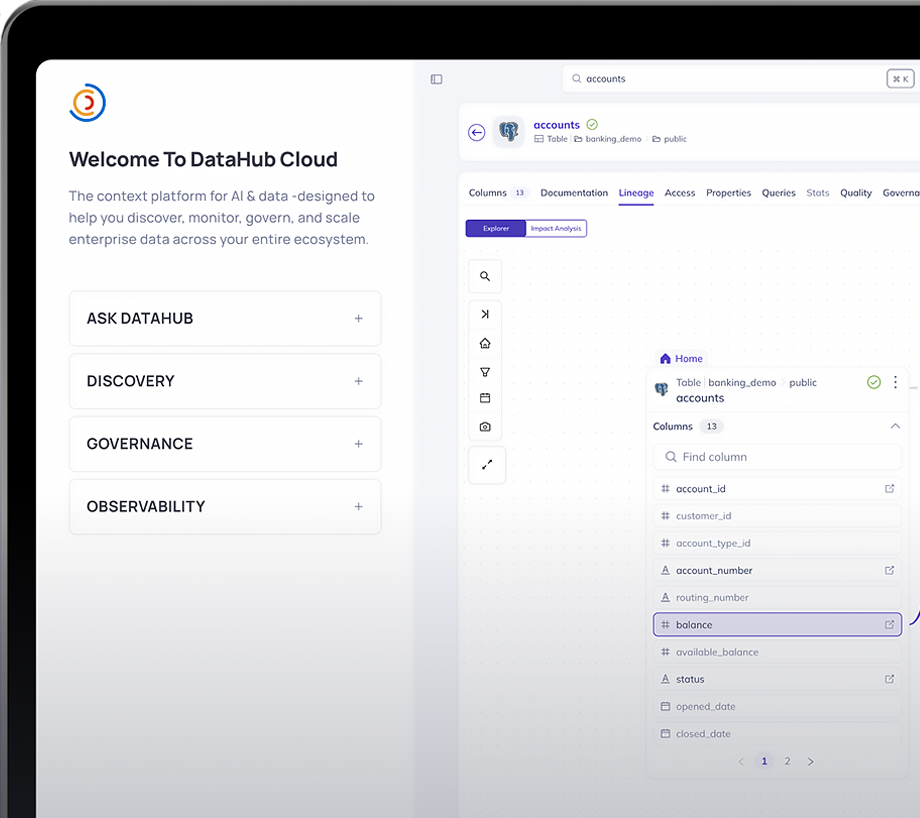
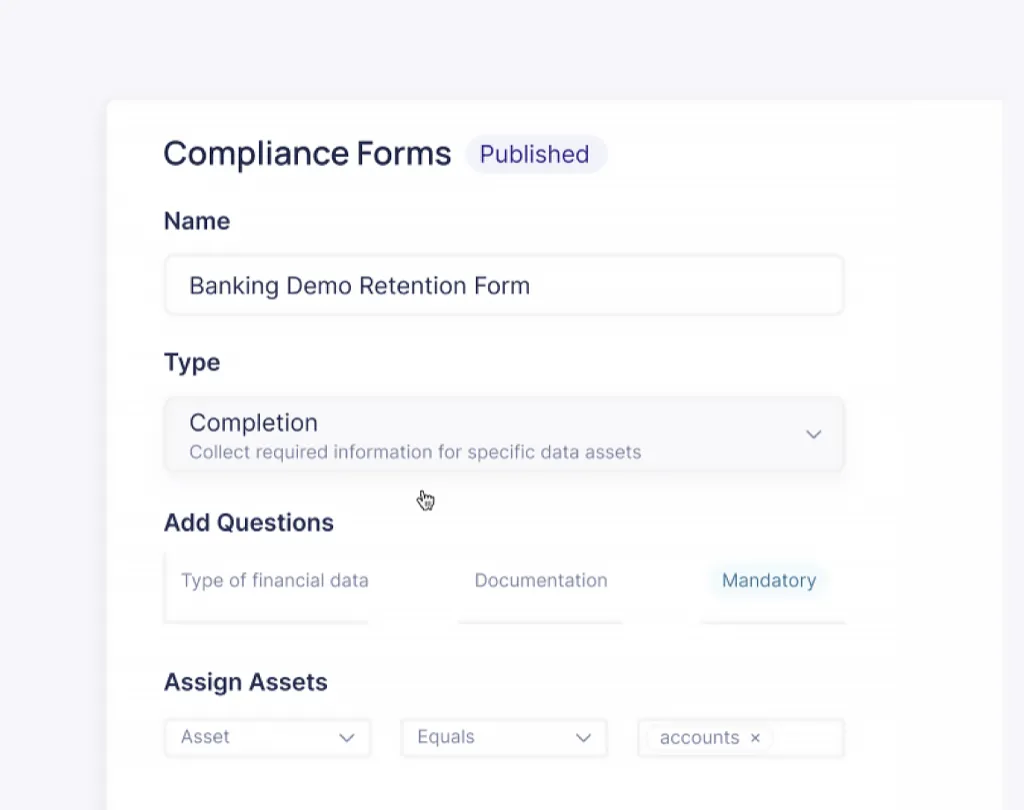
Customizable compliance workflows enforce your governance standards automatically. Track certification status in real time and flag non-compliant assets before they reach production.
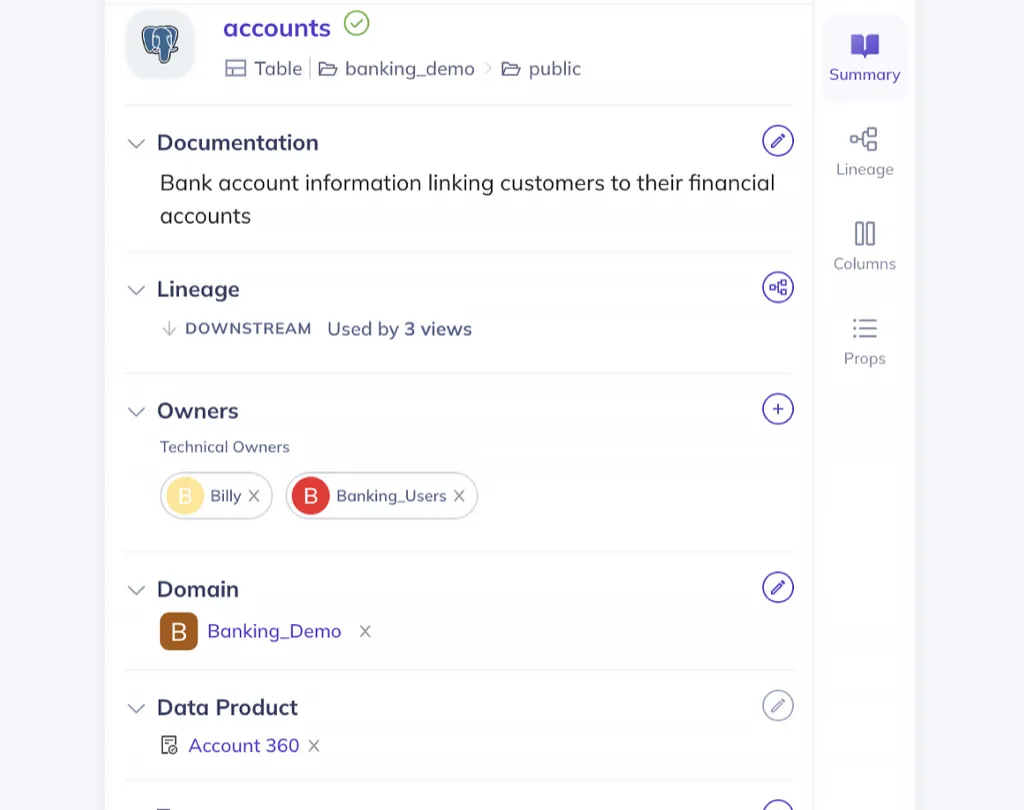
Replace ownership spreadsheets with automated tracking.
Assign and track dataset owners automatically as you scale. Automated alerts keep owners informed of quality issues, access requests, and schema changes.
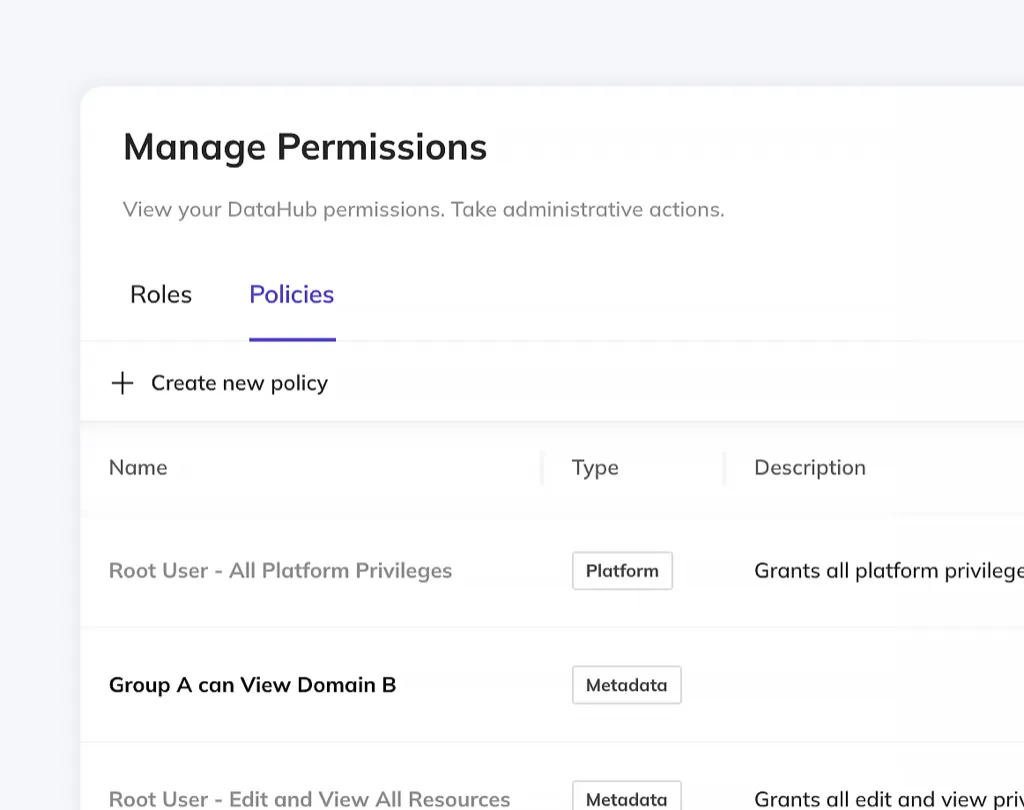
Enable self-service access without sacrificing control.
Eliminate data access bottlenecks with intelligent approval routing. Automated access workflows enable self service with full audit trails to maintain compliance visibility.
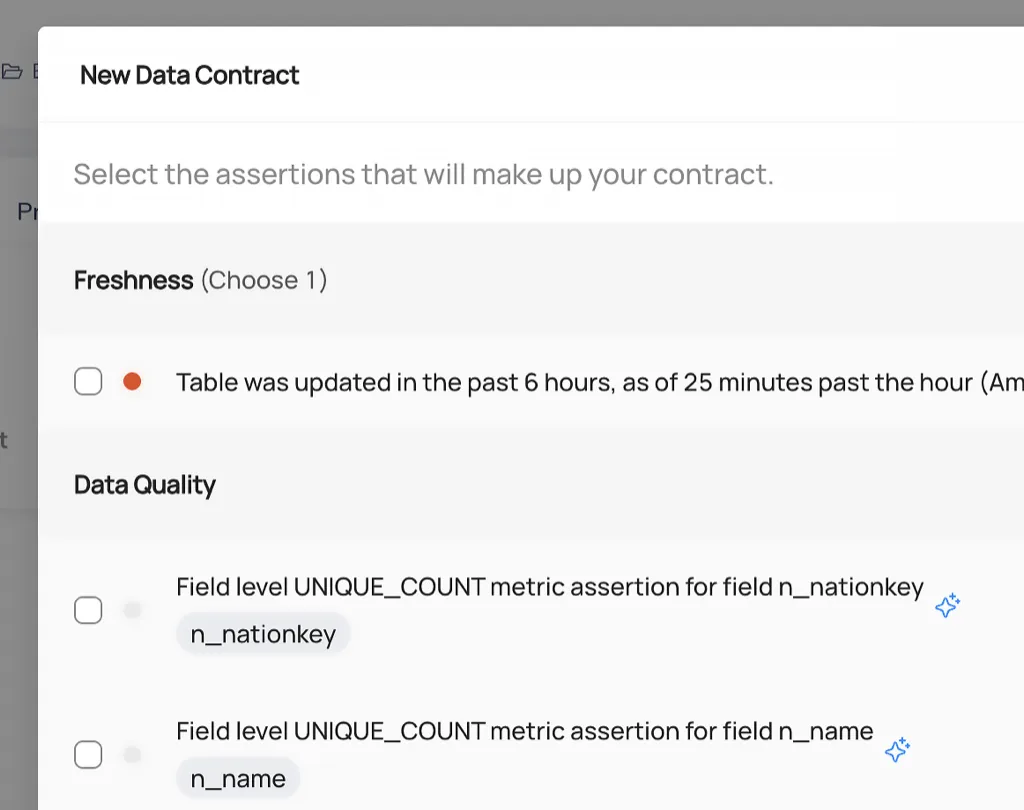
Define standards once and enforce them everywhere.
Define policies once as code and apply them across your data estate. Automated data contract validation prevents breaking changes and enforces data reliability standards.
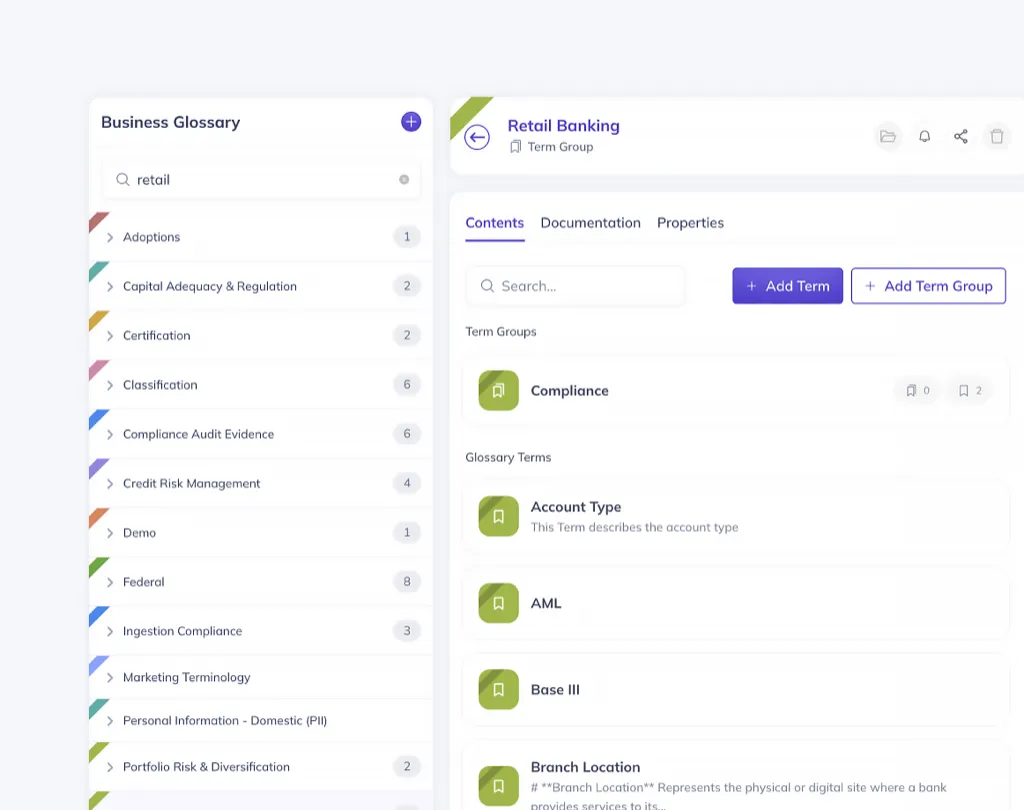
Ensure teams speak the same data language.
Define business terms in a central glossary for consistent tracking and reporting. Create custom fields and set required properties to enforce your unique governance requirements.
How teams use DataHub to eliminate data incidents.
Data Analysts get trusted data in minutes, not days.
Analysts request access through self-service workflows and get trusted data quickly while maintaining full compliance visibility.

Data Engineers automate PII classification and deprecation workflows.
AI-powered PII classification, ownership enforcement, and deprecation workflows free engineers from repetitive manual tasks.

Governance teams scale oversight without scaling headcount.
Automated workflows and programmatic policies scale governance operations across your growing data ecosystem.

Real data governance results from enterprise teams.

Checkout.com automates data governance

The most important bit of why we use DataHub is to allow us to make real-time changes as soon as an event happens.
Challenge
Manual governance couldn’t scale across 42+ teams, causing dataset sprawl, rising storage costs, and inefficient PII identification.
Solution
Implemented DataHub for event-driven PII masking, automated deprecation tracking, and real-time metadata change notifications.
Impact
Automated workflows reduced storage costs, ensured real-time PII compliance, and eliminated manual governance.
Built to meet data governance requirements
Automated workflows and continuous enforcement
- Self-serve access with intelligent routing
- Programmatic policy enforcement
- Dynamic compliance forms
- Automated validation for data contracts
Enterprise performance
- Event-driven stream processing
- Real-time enforcement across millions of entities
- Cross-platform coverage
- Multi-cloud deployment support
Security and extensibility
- 100+ pre-built connectors
- Role-based access controls
- SOC 2 Type II certified infrastructure
- Comprehensive API documentation
Ready to scale governance without slowing down?
DataHub Cloud delivers automated workflows and continuous enforcement that scale governance across your data ecosystem without slowing teams down.
Let us show you how it works.
Book a demo with our team.
FAQs
Why is data governance important?
Why is data governance important?
Data governance ensures organizations can trust, secure, and use data at scale. Without it, teams waste time searching for reliable data, compliance risks multiply as sensitive information spreads untracked, and inconsistent definitions create conflicting reports that erode confidence in data-driven decisions.
As data ecosystems grow, data governance becomes the operational foundation that lets organizations scale data usage without adding compliance risk or slowing teams down.
What are the key capabilities and components of a data governance solution?
What are the key capabilities and components of a data governance solution?
Modern data governance solutions (like DataHub) deliver automated metadata management, policy enforcement, and quality validation that scale across distributed platforms:
- Control access and track changes: Role-based permissions restrict sensitive information while comprehensive logs document all changes—providing the audit trails GDPR and CCPA require.
- Map lineage and assess impact: Column-level dependencies trace data flows from sources through transformations to dashboards, so teams understand downstream impact before making changes.
- Define terms and validate quality: Business glossaries propagate consistent terminology across data assets while automated assertions validate freshness, schema stability, and custom rules—building trust through continuous checks.
- Assign owners and enable self-service: Clear ownership eliminates wasted time hunting down subject matter experts while self-serve data discovery lets analysts find trusted datasets independently—scaling data access without bottlenecking engineering.
100+ integrations across your data stack and workflow automations ensure data governance operates continuously instead of requiring periodic manual interventions.
Take the DataHub product tour to see it in action
How can I ensure a data governance tool supports future compliance needs like AI regulations?
How can I ensure a data governance tool supports future compliance needs like AI regulations?
Evaluate whether your data governance platform can adapt to emerging data management regulations without requiring replacement:
- Trace data flows end-to-end: Map lineage from raw sources through feature engineering to model inputs—providing the audit trails AI regulations will require for model explainability and algorithmic accountability.
- Extend metadata as requirements emerge: Add regulation-specific fields like model risk ratings, fairness metrics, or responsible AI classifications through structured properties when compliance requirements change.
- Enforce new rules through code: Use APIs and plugin frameworks to implement custom validation rules as regulations solidify—like mandatory bias assessments without waiting for vendor feature releases.
Platforms with these capabilities (like DataHub) evolve alongside regulatory complexity instead of requiring migration when AI compliance frameworks evolve
Is the data governance tool customizable?
Is the data governance tool customizable?
Yes. DataHub’s data governance workflows are customizable through an extensible metadata framework that enforces any rules your organization requires—from simple policies like “datasets must have owners” to complex data quality checks.
The same framework powers DataHub’s built-in structured properties, access policies, and data quality rules in production.
Does DataHub support role-based access control for data governance?
Does DataHub support role-based access control for data governance?
Yes. DataHub provides role-based access control (RBAC) that scales from simple permission management to fine-grained governance policies.
- Roles assign permissions for common patterns: Grant data stewards data catalog management capabilities while limiting analysts to read-only discovery access.
- Policies control specific metadata on specific assets: Enforce rules like “only domain owners can edit glossary terms on their datasets” or “analysts can view table metadata but cannot modify ownership or tags.”
This combines role-based templates with attribute-based policies. Teams start with predefined roles for standard access patterns, then layer policies that enforce data governance requirements like restricting PII metadata visibility to compliance teams or limiting schema modification permissions to platform engineers.
How does DataHub make data governance accessible to non-technical users?
How does DataHub make data governance accessible to non-technical users?
DataHub provides no-code interfaces that eliminate the SQL queries, YAML editing, and command-line tools traditional data governance platforms require:
- Define business terms without technical skills: Create and organize shared terminology through visual hierarchies—defining terms like “Customer” or “Revenue” with plain-language definitions that propagate across assets.
- Complete governance tasks through guided forms: Pre-built question types walk users through ownership assignment, PII classification, and documentation completion using dropdown selections and autocomplete instead of writing queries.
- Build access controls through checkboxes: Three-step interface creates policies through checkboxes and search selections—restricting sensitive data visibility without coding or understanding permission syntax.
- Organize assets with tags and domains: “Add Tag” buttons and domain dropdowns let anyone categorize assets—autocomplete suggests existing values while search filters by categories.
This transforms data governance from technical work requiring platform expertise into point-and-click workflows accessible to analysts, stewards, and business users alike.
Can DataHub automate policy enforcement across data platforms?
Can DataHub automate policy enforcement across data platforms?
Yes. DataHub automates policy enforcement through a centralized engine that evaluates access controls in real-time:
- Define rules once, enforce everywhere: Configure data governance rules in DataHub and enforce them across metadata operations for Snowflake, BigQuery, Redshift, and other integrated systems—eliminating separate policy configuration in each tool.
- Respond to changes automatically: The Actions Framework triggers Slack notifications, access review workflows, or additional restrictions when metadata changes. For example, automatically starting a review when someone tags data as PII.
- Propagate classifications through lineage: Built-in automations spread glossary terms and tags across lineage relationships at the column level—ensuring classification labels flow consistently to related assets downstream.
DataHub enforces policies on metadata operations by controlling who can view, edit, or delete documentation, ownership, and tags. The Actions Framework integrates with external platforms to orchestrate compliance workflows and update policies across your data stack through APIs.
Can DataHub governance features integrate with existing compliance workflows?
Can DataHub governance features integrate with existing compliance workflows?
Yes. DataHub integrates data governance features with existing compliance systems:
- Connect through APIs: GraphQL and REST APIs programmatically create, update, and query compliance forms with full CRUD operations—so external workflow tools can trigger data governance tasks or pull completion status into compliance dashboards.
- Trigger workflows on governance events: The Actions Framework subscribes to real-time events like form completions, metadata changes, or tag additions—routing notifications to Slack, MS Teams, or custom webhooks that trigger approval processes in external systems.”
- Alert through channels teams already use: Email and Slack notifications fire automatically when forms are assigned or completed.
- Export data for reporting: Download raw compliance data tracking completion rates and assignee performance to feed external BI tools or regulatory reporting systems.
As a unified enterprise AI data catalog, DataHub participates in multi-system compliance workflows instead of requiring process redesign around a standalone data governance tool.
How can DataHub reduce the manual effort of preparing for a compliance audit (e.g., GDPR)?
How can DataHub reduce the manual effort of preparing for a compliance audit (e.g., GDPR)?
DataHub automates the manual coordination and documentation tracking that dominates audit preparation:
- Assign tasks automatically: Compliance forms auto-assign to dataset owners based on asset metadata—eliminating email chases and spreadsheet tracking with automatic Slack and email notifications when tasks need attention.
- Collect data consistently at scale: Pre-built question types capture PII classifications, retention periods, legal basis for processing, and data steward assignments—ensuring consistent documentation across thousands of assets without manual tracking.
- Track progress in real time: Analytics dashboards show completion rates by domain, team, and individual—providing visibility into audit readiness without building or consolidating spreadsheets.
- Provide complete audit trails instantly: Event logs document every metadata change, PII tag addition, and form completion with timestamps and user attribution—answering auditor questions like “who accessed sensitive data in Q3?” immediately.
This transforms audit preparation from weeks of manual coordination into automated workflows where domain experts provide answers once while governance teams monitor progress centrally.
Can I use DataHub to set up continuous compliance monitoring for our data warehouse?
Can I use DataHub to set up continuous compliance monitoring for our data warehouse?
Yes. DataHub provides continuous compliance monitoring through two integrated capabilities:
- Monitor governance compliance: Compliance Forms assign documentation, PII classification, and ownership tasks to data stewards—tracking completion rates through daily dashboards that surface which assets lack required metadata.
- Monitor technical compliance: DataHub data observability validates freshness, volume, schema stability, and custom compliance rules across Snowflake, BigQuery, Redshift, and Databricks in real time—detecting retention violations, unexpected PII propagation, or quality issues before audits find them.
These capabilities work together to monitor both governance compliance (proper documentation and classification) and technical compliance (data quality and retention standards) continuously instead of through manual quarterly reviews.
Additional Resources
How to Implement Data Governance Without Slowing Down Your Team
How do you implement data governance without killing velocity? Learn the shift-left and design principles that helped ICA Gruppen succeed.
Data Governance: Building Production-Ready Foundations for AI and Analytics
Learn how modern data governance enables production AI with continuous monitoring, automated validation, and unified metadata management.
Data Governance in Financial Services: How to Turn Compliance Into Your AI Advantage
Two bank data governance leaders reveal why BCBS 239 compliance infrastructure is the same foundation that makes AI possible—and how to build it.