Data Discovery Platform for Instant Answers

Your teams shouldn’t spend hours searching for data. DataHub Cloud delivers instant answers through AI-powered search—no more hunting through Slack threads or tracking down engineers. Smart recommendations surface trusted datasets so your teams spend less time searching and more time shipping.

Look once.
Find everything.

Ask questions, get instant answers

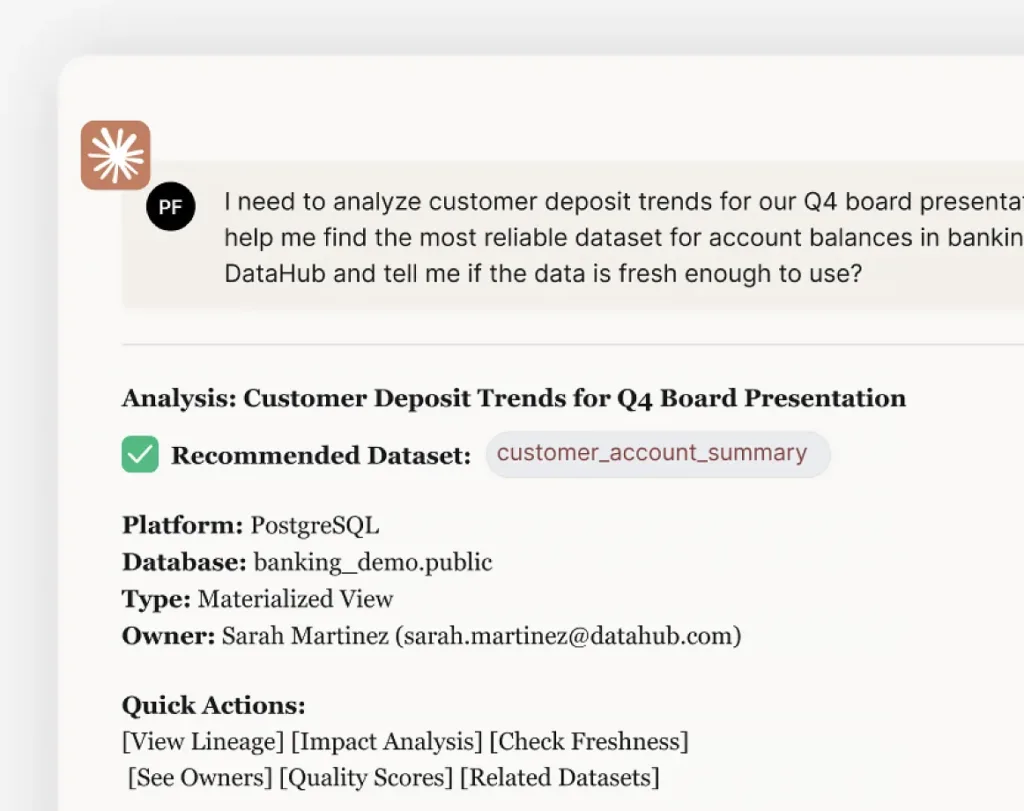
The Ask DataHub chat agent delivers immediate answers to natural language questions about your data—right in DataHub, Slack, or Teams. Business users self-serve insights instead of waiting for engineers to trace problems manually.

Connect AI agents directly to your data stack

Enable AI tools like Claude, Cursor, and Windsurf to search your data ecosystem with the DataHub MCP Server. AI agents query metadata, traverse lineage, and assess quality programmatically.

Generate documentation automatically

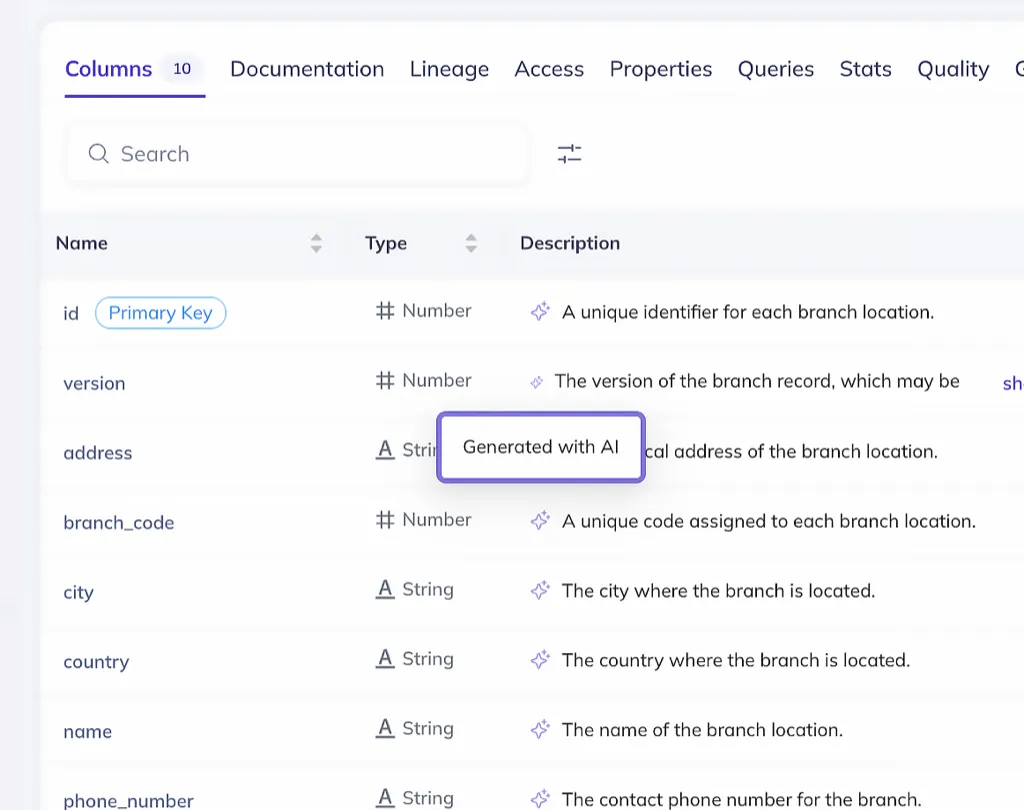
DataHub AI examines schema, relationships, and usage patterns to generate detailed docs. Then, formats everything to match your custom standards. Plus, you can upload attachments to keep all context in one place.
Surface curated, trusted assets first

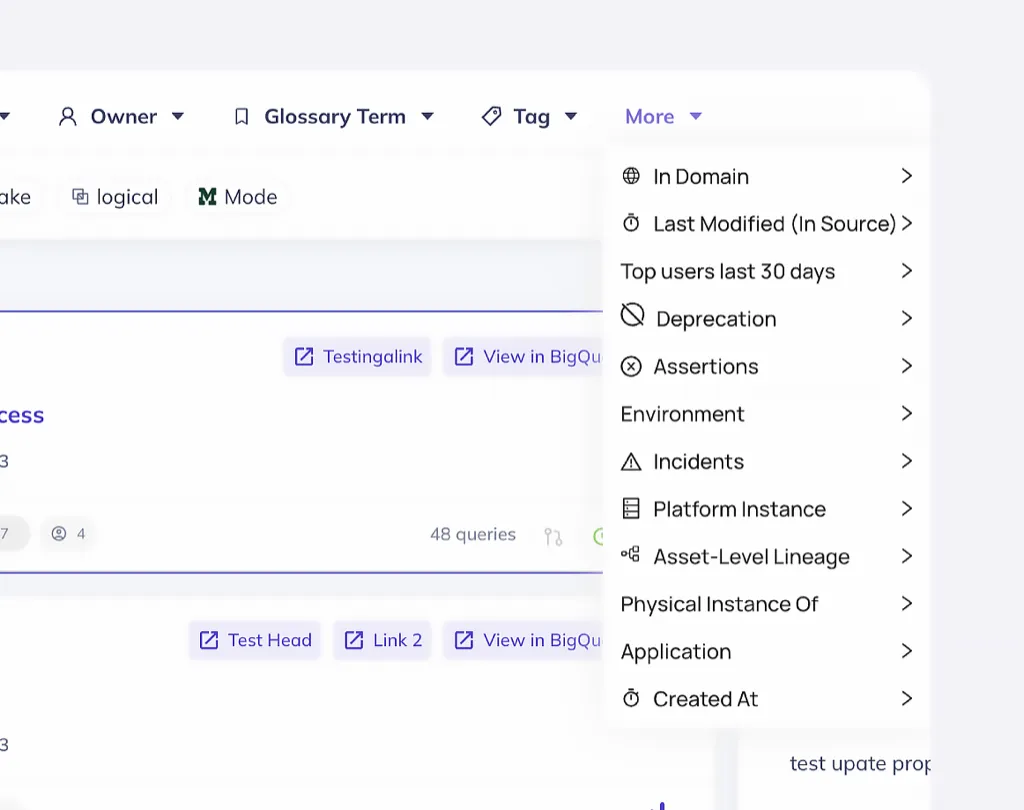
Smart ranking ensures teams discover vetted datasets. Data product owners curate collections that guide teams toward production-ready, governed assets.

Access data context without leaving your tools

View lineage, data quality scores, and ownership directly in BI platforms through the Chrome extension. Personalized homepage views prioritize your frequently used datasets and role-specific filters for faster discovery.
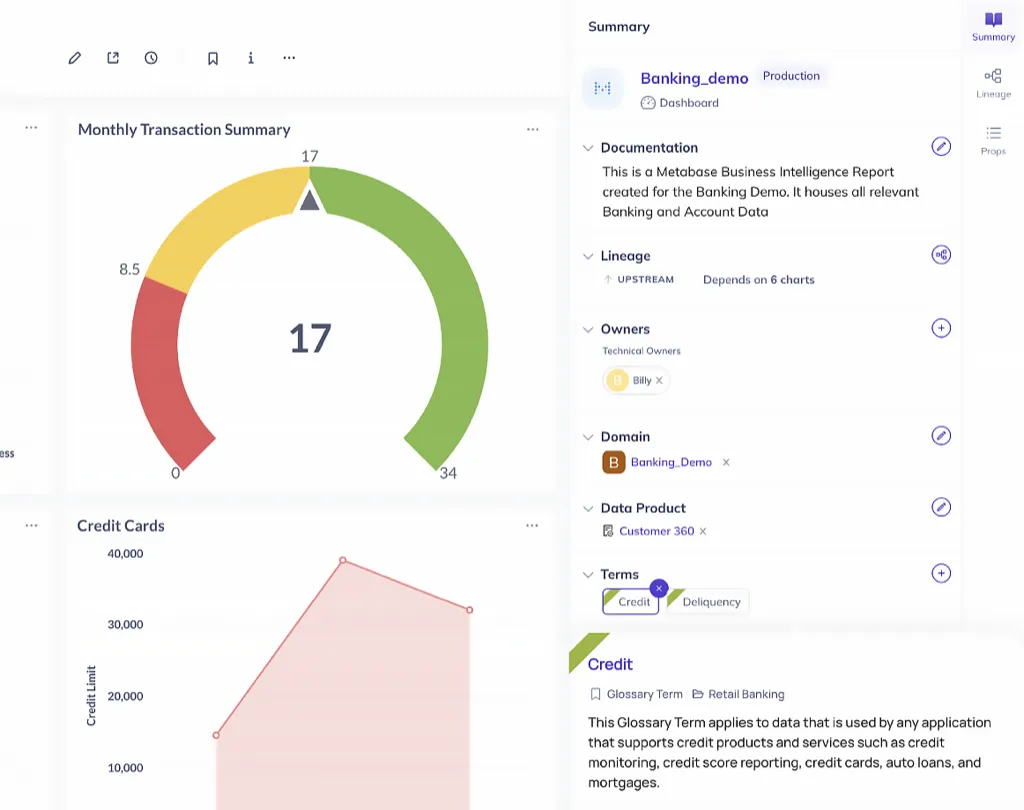
How teams use DataHub to eliminate discovery bottlenecks

Data analysts ship analysis faster

Discover trusted datasets without guessing table versions. Accelerate analysis and reduce rework from incorrect data sources.

Data engineers identify and eliminate unused datasets

Track which datasets teams actually query and which sit untouched. Confidently deprecate redundant tables and reduce cloud costs.


Data scientists find training data in minutes, not weeks

Find relevant datasets with quality indicators and business context built-in. Solve complex problems faster without  bottlenecks.

Real data discovery results from enterprise teams

Notion logo

Notion eliminates data discovery bottlenecks

“We rely on DataHub to gain insights and ensure our critical data is reliable. DataHub’s managed product takes DataHub to the next level through automation and emphasis on time-to-value.”

ADA DRAGINDA
Data Engineer, Notion Labs Inc.

CHALLENGE

Rapid growth led to data complexity with 2,000+ tables across multiple data sources, making it difficult for business users to discover relevant data and distinguish valuable datasets.

SOLUTION

Implemented DataHub as a centralized data catalog to organize, tag, and document all data assets with governance capabilities and data lineage tracking.

IMPACT

Created a “one stop shop” that reduced data noise, shortened new hire onboarding cycles, enabled compliance processes, and prevented breaking changes through impact analysis.

Built to meet enterprise discovery requirements

Discovery where you work
  • Native integrations with Slack, Teams, Chrome, and BI tools
  • Natural language search with Ask DataHub chat agent
  • Smart ranking surfaces trusted data
  • MCP Server connects AI tools to your catalog
Enterprise performance
  • Sub-second search response times
  • Automatic metadata indexing
  • Smart ranking surfaces trusted data
  • End-to-end platform visibility
Security and extensibility
  • 100+ pre-built connectors
  • Role-based access controls
  • SOC 2 Type II certified infrastructure
  • Comprehensive API documentation

Ready to turn discovery from bottleneck to breakthrough?

Data discovery doesn’t have to hold up every project.

DataHub Cloud delivers instant, AI-powered data discovery and intelligent recommendations that guide teams to trusted datasets.

Let us show you how it works. Book a demo.

FAQs

Data discovery breaks down when knowledge fragments across email threads, wiki pages, and people’s heads. As data platforms scale, problems compound:

  • Context lives everywhere except your data catalog: Analysts interview multiple engineers just to learn what a table contains or whether it’s safe to use because critical information is scattered across tools and team conversations instead of living with the data.
  • You can’t tell if data is trustworthy: Finding a potentially relevant table tells business users nothing about freshness, accuracy, or ownership—so they waste time tracking down engineers to confirm it won’t break their analysis.
  • Dependencies are invisible: Understanding how data flows from sources through transformations to dashboards requires reading code and reconstructing undocumented relationships—making each impact analysis a lengthy investigation.

Data teams spend hours or days on discovery that should take minutes, while hidden dependencies cause cascading failures nobody saw coming.

With the right data discovery tool, data teams reclaim the hours wasted hunting for data they already own. Businesses deploy data discovery platforms like DataHub to solve critical bottlenecks, enabling users to:

  • Get answers faster: Engineers and analysts find datasets, understand their meaning, and validate quality in minutes instead of days—reclaiming the discovery time that often takes longer than the actual analysis.
  • Stop rebuilding what already exists: Teams find existing features and transformations before recreating them—preventing the duplicate pipelines and wasted storage that pile up when engineers can’t see what’s already built.
  • Let analysts self-serve instead of asking engineers: Documentation, lineage, and quality indicators answer analysts’s questions directly—so data engineers stop spending half their day responding to ad hoc messages about where data lives.

Discovery tools unlock the business value sitting in undocumented datasets while scaling data access beyond the few engineers who know where everything is.

An automated data discovery platform (like DataHub) eliminates the manual search and validation work that eats up ML engineering time. DataHub shortens AI development cycles by making feature reuse and dataset selection immediate instead of investigative.

  • Find and reuse features without rebuilding them: Search existing feature pipelines, training datasets, and model inputs with full context on freshness, quality, and usage patterns—so you reuse consistent definitions across models instead of recreating features from scratch.
  • See what breaks before you deploy: Cross-platform lineage traces dependencies from raw sources through transformations to production models—so you know what breaks when upstream schemas change before incidents happen.
  • Avoid corrupted training data: Quality indicators show assertion results and freshness status directly in search—so data scientists catch bad inputs before they cause model drift.
  • Stop asking engineers where data lives: Documentation and ownership information live directly in the catalog—eliminating the email threads and Slack pings you use to verify production readiness.

Organizations like Foursquare use DataHub to cut feature discovery from days to minutes while maintaining the audit trails production AI systems need for explainability and governance.

DataHub combines AI-powered search with robust data health signals across dataset names, columns, tags, and documentation with filtering by platform, domain, and ownership. Analysts see comprehensive context that eliminates the ad hoc pings and engineer interviews needed to validate datasets today.

  • See quality signals in search results: Assertion pass rates, freshness status, and usage patterns show up directly in search—so analysts pick reliable sources without tracking down engineers for confirmation.
  • Connect technical names to business concepts: Business glossary terms link tables and columns to familiar metrics—bridging the gap between schema names like “usr_acq_cohort_v2” and the business metrics analysts actually need.
  • Confirm the data that feeds your dashboards: Column-level lineage shows whether discovered datasets connect to the reports and dashboards you care about—so you don’t build analysis on data that’s disconnected from production metrics.

Data discovery becomes immediate, eliminating the internal investigation that delays analysis. Organizations like HashiCorp went from multiple ad hoc inquiries per day to zero with DataHub’s data discovery features.

Yes. DataHub provides full-text search across dataset names, descriptions, columns, dashboards, pipelines, ML models, tags, glossary terms, owners, and domains from all connected platforms. Fuzzy matching handles typos and partial matches.

Advanced filtering narrows results by entity type, platform, or domain to scope searches to specific warehouses, BI tools, or teams—so users don’t waste time wading through irrelevant assets.

The unified search eliminates tool-switching. Users find data across Snowflake, dbt, Tableau, and 100+ other sources in one place instead of searching multiple tools or asking teammates where assets live.

Yes. DataHub tracks user activity to surface relevant assets without manual search.

  • See what you worked on recently: Recently viewed assets, search history, and edited datasets show up on your homepage and in the search bar—so you can jump back into tables, dashboards, and pipelines without searching for them again.
  • Find what your team uses most: Popular datasets across your team appear higher in search results—guiding new analysts toward the sources that experienced teammates trust.
  • Discover related assets: Lineage relationships and similar metadata surface upstream sources and downstream dependencies on entity profiles—helping you find data connected to your current work.

This eliminates rediscovering assets you use regularly while surfacing the datasets your team relies on most.

Yes. DataHub searches across your data landscape, including Snowflake, BigQuery, Redshift, Databricks, dbt, Looker, Tableau, and 100+ data sources through one unified index—so analysts find assets without knowing which tool owns them.

Search runs simultaneously across all platforms with filters for platform type, domain, owner, or tags when you need to narrow results. Metadata federation delivers fast performance across hundreds of thousands of assets without hitting source systems at query time.

Engineers and analysts search once to find tables, dashboards, pipelines, and models regardless of where they live—eliminating the tool-switching that fragments discovery across modern data stacks.

Yes. DataHub automates metadata enrichment to reduce manual documentation work:

  • AI generates descriptions automatically: AI creates table and column descriptions using context from schema, lineage, and usage patterns—filling the blank documentation fields that make efficient data discovery impossible.
  • Tags and terms propagate through lineage: Documentation, glossary terms, and tags flow automatically across upstream and downstream assets through column-level lineage—so you don’t manually tag every related table.
  • Metadata syncs back to your warehouse: Sync DataHub metadata with Snowflake, BigQuery, and Databricks—keeping documentation consistent between your catalog and native platform.

All automated enrichment tracks attribution for audit trails to support data governance programs. Backfill historical assets or roll back changes to manage propagation at scale while preserving the ability to correct mistakes.

DataHub tailors discovery to each user’s role through persona-based views and behavioral learning that surfaces relevant assets automatically:

  • Personas filter to role-relevant assets: Users select Technical User, Business User, Data Steward, or Data Engineer during onboarding. Each persona shows relevant entity types like dashboards for analysts or pipelines for engineers.
  • Platform preferences narrow results: Configure which data platforms you work with regularly so search results and recommendations focus on Snowflake, dbt, Tableau, or other tools in your daily workflow instead of across irrelevant tools.
  • Behavior informs suggestions: Recent searches, viewed assets, and usage patterns personalize your homepage and search suggestions. Analysts rediscover reports they use frequently while engineers see pipelines they maintain.

This eliminates catalog-wide views where everyone sees everything—focusing discovery on the entities and platforms each role actually needs.

Additional Resources