


Five Modern Data Catalog Features That Get You AI-Ready
What makes a data catalog “modern”?
A modern data catalog captures metadata in real time, unifies discovery, observability, and data governance on a single metadata foundation, and exposes context to both humans and AI agents through open standards. It’s built for data engineers, governance teams, business users, and AI agents that all rely on the same trusted context. Traditional catalogs were passive inventories. Modern catalogs are active infrastructure.
Most organizations have a data catalog. Very few have one built for what’s actually being asked of it in 2026.
Per the 2026 State of Context Management Report, only 39% of organizations self-report at the top tier of data context maturity, where they claim to have accurate context for AI agents to use and manage data assets. The same report shows most of that confidence is aspirational:
- 87% cite data readiness as their biggest impediment to putting AI into production
- 61% frequently delay AI initiatives due to a lack of trusted data
- 66% report that AI models in their organizations generate biased or misleading insights due to insufficient context.
The gap between “we have a data catalog” and “our AI agents can reliably act on our data” is where the modern data catalog conversation is happening right now.
For most teams, the catalog was originally a way to answer human questions. Today it needs to answer machine questions too. AI agents query it to decide what data to trust. Pipelines check it before they run. Governance policies enforce against it in real time. Access decisions get made from it just-in-time.
Traditional catalogs were not built for any of that. Modern catalogs are.
The four stages of data context maturity
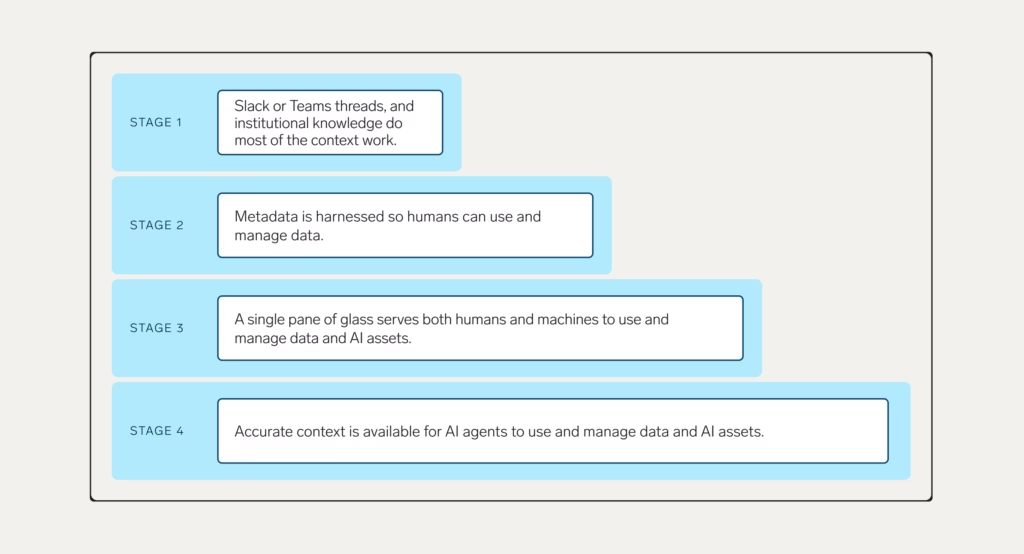
The 2026 State of Context Management Report frames organizational maturity in four stages. It’s a useful lens for evaluating where a data catalog sits today and what comes next.
- Stage 1: Spreadsheets, Slack or Teams threads, and institutional knowledge do most of the context work.
- Stage 2: Metadata is harnessed so humans can use and manage data.
- Stage 3: A single pane of glass serves both humans and machines to use and manage data and AI assets.
- Stage 4: Accurate context is available for AI agents to use and manage data and AI assets.
Two notable takeaways from the report:
- Most organizations sit at Stage 2 or Stage 3. Traditional catalogs get teams to Stage 2. Modern catalog features are what carry a team through Stage 3 and open the door to Stage 4.
- Stage 4 is where confidence outpaces reality most sharply. 39% of organizations self-report at Stage 4, but the same report shows 87% still cite data readiness as their biggest AI blocker, 61% frequently delay AI initiatives due to lack of trusted data, and 66% report that AI models in their organizations generate biased or misleading insights due to insufficient context. Most Stage 4 self-assessments are aspirational.
What a modern data catalog actually does
Every data catalog serves the same basic purpose. It organizes technical metadata so people (and now machines) can find, understand, evaluate, and trust data. At the minimum, that means a central inventory, discoverable assets, quality signals, and enough context to know where data came from and where it’s going. (If you want the full primer, our What is a data catalog piece covers it.)
Traditional data catalogs emerged in the 1990s as IT-centric tools. Where they fall short today is well-documented:
- Manual enrichment kept metadata perpetually behind reality
- Static, batch-refreshed inventories couldn’t support operational decisions
- Interfaces served technical users well and left everyone else, including AI systems, working around the tool
- Governance, observability, and data discovery were treated as separate purchases, stitched together with integrations that never quite behaved
Modern data catalogs remove those constraints and reframe metadata management as an active workflow. They capture metadata in real time, unify what used to live in separate tools, extend cleanly to organization-specific needs, and treat AI agents as first-class consumers rather than an afterthought.
The five modern data catalog features that matter for AI readiness
Each of the features below closes a specific gap between a catalog that works and one that gets teams AI-ready.
1. Real-time, active metadata (including shift-left capture)
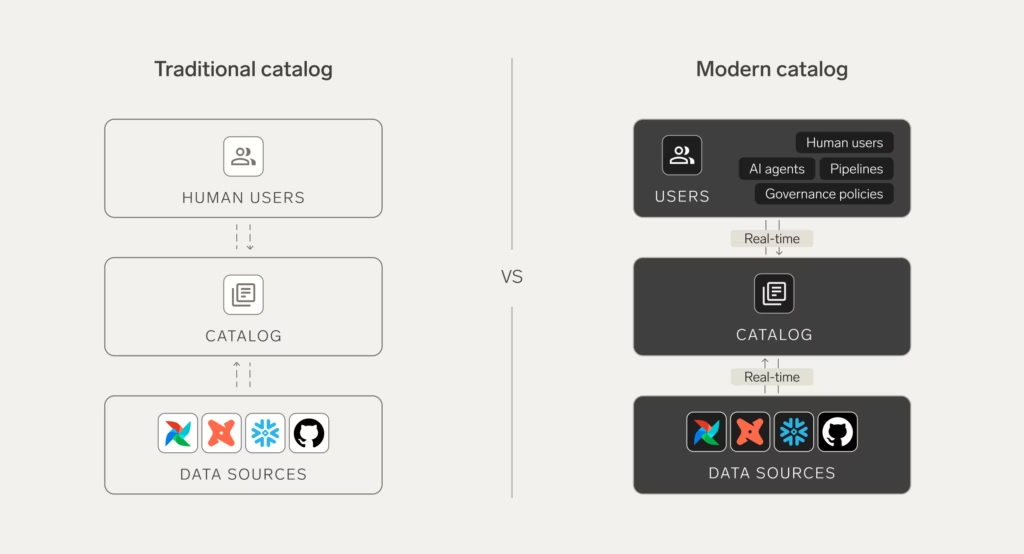
The first shift is from metadata that describes what the data looked like last night to metadata that reflects what it looks like right now.
A modern catalog captures changes as they happen across data sources like Airflow, dbt, Snowflake, GitHub, and Kafka. Instead of periodic refreshes that leave gaps, it streams metadata into a live graph that downstream systems can query, act on, and trust.
Two things become possible with this shift.
- Metadata gets emitted at the source, where the data actually lives. Shift-left patterns like schema annotations and data contracts let developers declare ownership, PII status, domains, and quality expectations right alongside the code that creates the data. Business context stays aligned with technical schemas without a separate documentation cycle.
- The catalog starts to participate in operational decisions instead of sitting alongside them. Pipelines can check data quality and lineage before processing. Circuit breakers can halt bad data before it reaches downstream models. Data access controls can adjust in real time based on current classification. AI systems can validate training data compliance before a run.
None of this works on a nightly refresh cycle. It requires an architecture designed for continuous ingestion, efficient processing, and immediate availability of updated context.
2. Full stack lineage with column-level detail
The second shift is from lineage that tells you a dependency exists to lineage that tells you exactly how, at column-level detail, across the full data lifecycle.
Most catalogs will show you that Table A feeds Dashboard B. That’s necessary but not sufficient for the work AI-ready teams actually need to do. What matters is knowing which columns in Table A feed which values in Dashboard B, what transformations were applied between them, who consumes the result, and what breaks if you change any of it.
Column-level lineage is what makes that possible. It’s what turns lineage from a passive diagram into an active tool for impact analysis, debugging, PII tracking, and schema refactoring.
- At Stage 3, teams typically use column-level lineage for human workflows. Engineers assessing the blast radius of a schema change. Stewards tracking sensitive fields. Analysts debugging a broken dashboard.
- At Stage 4, the same lineage graph becomes the substrate for AI agent trust decisions. An agent asked to build a report needs to know where the values came from, whether the pipeline is healthy, and whether the source data is authorized for the use case. Which table holds the answer is only the starting point. Column-level lineage is how the agent gets the rest.
Modern catalogs extend lineage across the machine learning lifecycle too. Training datasets, feature stores, model versions, and deployment configurations connect into the same graph, so teams can trace a model prediction back to the columns that fed the features that trained the model. That kind of provenance is what governance for AI actually looks like in practice.
3. Unified discovery, observability, and governance on one metadata foundation
The third shift is from stitching separate tools for discovery, observability, and governance to running them on one shared metadata graph.
Point solutions are one of the top-cited obstacles to scaling AI agents. Per the 2026 State of Context Management Report, 43% of teams cite tool integration complexity and 41% cite data fragmentation as blockers to production AI. Gartner projects 80% of data and analytics governance initiatives will fail by 2027. The tooling pattern is familiar. A catalog for discovery, an observability tool for freshness and quality, a separate governance platform for policy, and integrations that never quite reconcile.
A modern data catalog collapses those into a single operational layer.
An iPhone moment for data catalogs
One way to think about the shift: a smartphone unified the phone, camera, and navigation device into one package because keeping them separate no longer made sense. The same logic is playing out for discovery, observability, and governance.
When data lineage, quality signals, ownership, and policy all live on the same graph, workflows compose in ways they never could as separate tools:
- Governance policies apply automatically based on detected sensitivity
- Quality issues surface their downstream impact through lineage
- Data users and AI agents receive asset recommendations that are already governance-compliant
- Quality investments align with usage patterns because usage and quality are in the same view
Pinterest is a working example of what this unified layer unlocks. Its data platform team built the semantic backbone of its enterprise data analytics agents on DataHub, using unified context to power its top AI agent and drive roughly 10x the usage of the second-most-used agent within just two months.
Stitching this together from separate tools is possible. Creating an enterprise context layer with it stitched together is much harder.
4. A common language for every user, including AI agents
Five years ago, “modernizing” a data catalog usually meant bringing business users into a tool built for engineers. That work still matters. Business analysts, data scientists, application developers, governance teams, and stewards each need different views of the same underlying context, with the terminology and interaction patterns that fit their role.
Modern catalogs handle that through role-based interfaces, contextual help, customizable dashboards, and workflow tools that let different personas collaborate on shared assets. They also push context out to the tools people already work in, whether Slack, Teams, browser extensions, or agent plug-ins, so users don’t have to log into the catalog UI to get answers.
DataHub’s Business Glossary is one example. Business metadata like terminology, plain-language data definitions, and ownership sits alongside physical data assets, so teams can trace a KPI from the executive dashboard back to the source columns.
What’s new is that AI agents have joined the roster of consumers. They read the same metadata graph the humans do, and they need it structured for machine consumption too. That means semantic context (what does this data mean, not just what does it store), machine-readable relationships (what depends on what, at column granularity), and machine-readable authorization (what is this agent allowed to do with this asset).
A modern catalog serves both audiences from the same foundation. The definitions the humans read are the definitions the agents query. The lineage the stewards use for impact analysis is the lineage the agents use for trust decisions. There is one graph, and everything runs on it.
Natural language interfaces are what make this shared foundation feel usable to both groups. A business analyst asking “which dashboard tracks quarterly revenue by segment” in Slack should get the same underlying context an agent gets when it queries the catalog through an API. DataHub’s Ask DataHub is one implementation of that pattern, exposing the same governed context graph through natural language in Slack, Teams, and the UI for humans, and through MCP and semantic APIs for agents.
5. Agent-ready APIs and interfaces (developer-first, MCP-native)
The fifth shift extends the API surface that made modern catalogs developer-friendly into one that also serves AI agents.
Developer-first API design is still a hard requirement. Modern catalogs offer robust REST and GraphQL APIs with strong typing, change subscriptions, analytics access, and versioning that supports long-term integration stability. They ship well-documented Python and Java SDKs that abstract away low-level API details. They include a CLI experience that lets developers query and manipulate metadata without a UI.
Where the surface has extended is in how AI agents consume the same catalog. The Model Context Protocol (MCP) is emerging as the standard for exposing metadata to AI agents through natural language interfaces. A modern catalog supports MCP alongside its REST, GraphQL, and CLI surfaces, so agents can discover, understand, and act on catalog context through the same open standard other systems use. That means an agent built on LangChain, one built on Google ADK, and one calling model APIs directly can all retrieve context from the same platform without custom integration work.
Two capabilities matter especially for agents:
- Semantic understanding: Agents need to interpret data meaning, not just retrieve records. That requires the catalog to expose relationships, definitions, and business context in machine-readable form.
- Authorization: Agents that can act on data need to operate within governance boundaries. Modern catalogs provide authorization frameworks that let agents perform actions with appropriate controls, plus explanation capabilities so humans can audit what agents did and why.
This is the surface that turns a data catalog from a tool humans consult into infrastructure AI agents rely on.
Evaluating your current data catalog
Whether you’re auditing what you have or scoping what you need, the questions below map to the five features above. Answering “no” or “sort of” to any of them points to where the modern catalog gap actually sits in your organization.
- Does your catalog reflect metadata changes as they happen, or on a nightly batch?
- Can you trace lineage at the column level, across data pipelines and the machine learning lifecycle?
- Are discovery, observability, and governance running on one metadata foundation, or stitched together from separate tools?
- Does your catalog serve business users, engineers, and AI agents from the same underlying context?
- Can AI agents query, understand, and act on your metadata through open standards like the Model Context Protocol?
What comes after a modern data catalog?
For most teams, a modern data catalog is a destination in itself. The five features above are enough to close the gap between “we have a catalog” and “our AI agents can act on our data safely.”
For teams at the leading edge, the catalog becomes the foundation of something larger. A context platform.
A context platform extends the catalog by unifying structured metadata with unstructured knowledge (documentation, wikis, PDFs, query logs) into one context store AI agents can query. It layers an intelligent knowledge graph that connects data assets to business concepts, teams, and products. It adds an agent registry that makes AI applications discoverable, governable, and observable in the same way data assets are.
At Stage 4, the practical questions shift. Teams stop asking whether the right table is findable and start asking whether an AI agent can autonomously build the pipeline that produces the right dataset from an analyst’s natural-language request, within governance, without a human in the loop. Lineage accuracy stops being the goal. The goal becomes whether the context grounding an agent’s answer is trusted, current, and authorized for the use case. Asset ownership matters less than knowing which agents are running against which assets right now and what they’re doing with them.
Those questions are hard to answer without the context platform layer sitting on top of a modern catalog. If a modern data catalog is what serves your Stage 3 practitioners well and prepares them for Stage 4, a context platform is what operates at Stage 4 and beyond, where AI agents are the primary consumers.
The features covered in this piece are the on-ramp. Get them right, and the road to the context platform is much shorter.
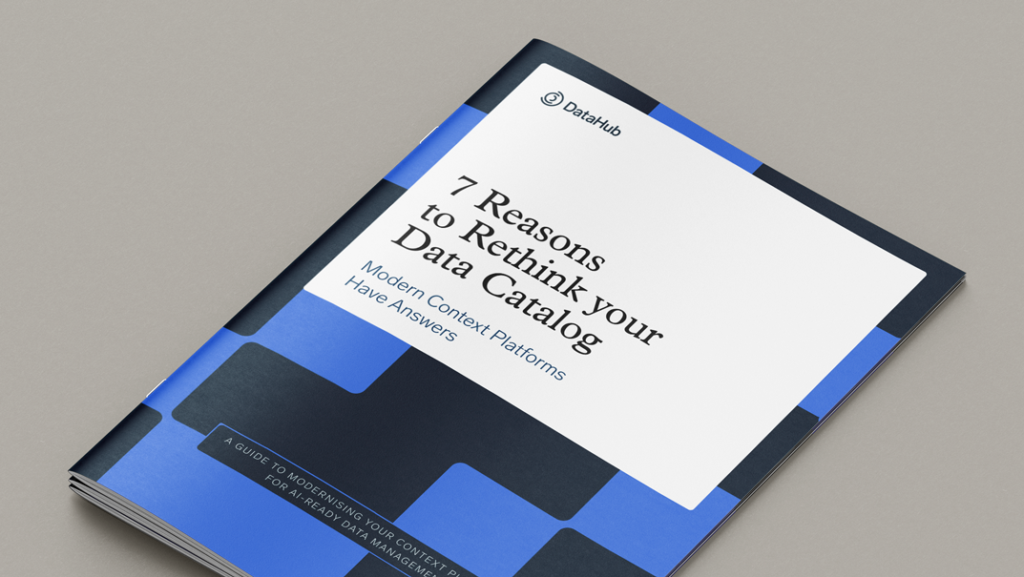
For a deeper walkthrough of what a modern metadata platform needs to deliver, and a practical framework for evaluating platforms in the market, download our guide “7 Reasons to Rethink your Data Catalog”.
FAQs
What are the essential features of a modern data catalog?
What are the essential features of a modern data catalog?
The five features that separate a modern data catalog from a traditional one are real-time active metadata with shift-left capture, full lineage with column-level detail across the data and machine learning lifecycles, unified discovery, observability, and governance on one metadata foundation, a common language that serves both humans and AI agents, and agent-ready APIs including the Model Context Protocol.
How is a modern data catalog different from a traditional one?
How is a modern data catalog different from a traditional one?
Traditional data catalogs were passive, batch-refreshed inventories that users consulted occasionally. They served a narrow audience of technical users, treated discovery, observability, and governance as separate tools, and were not designed for machine consumption. Modern data catalogs are active infrastructure that participates in data workflows in real time, unifies previously separate tools on one metadata graph, and serves AI agents through open standards alongside humans.
What are the benefits of a data catalog?
What are the benefits of a data catalog?
Modern data catalogs deliver benefits beyond what traditional enterprise data catalogs provided. Business and technical teams get self-service data discovery, so time to insight shrinks. Data engineers get real-time metadata and column-level lineage for faster debugging and safer schema changes. Governance teams get automated policy enforcement built into the same graph as discovery. AI teams get catalog context their agents can act on.
How does a modern data catalog support AI agents?
How does a modern data catalog support AI agents?
Modern data catalogs support AI agents in four main ways. Native support for AI and machine learning assets like models, feature stores, and training datasets. Agent-ready APIs and interfaces, including the Model Context Protocol. Semantic context so agents can understand data meaning rather than just retrieve records. And authorization frameworks that let agents act on data within governance boundaries.
What is column-level lineage?
What is column-level lineage?
Column-level lineage traces how individual columns are derived across systems and transformations, not just table-to-table dependencies. It shows exactly which upstream columns feed which downstream values, what transformations were applied, and what breaks if any of them change. Column-level lineage is what makes proactive impact analysis, reactive debugging, PII tracking, and schema refactoring practical at enterprise scale.
Do I need to replace my current data catalog to modernize?
Do I need to replace my current data catalog to modernize?
It depends on the architecture. Some capabilities, like a real-time metadata streaming layer or a unified operational graph, are difficult to retrofit onto a batch-oriented catalog and typically require a platform change. Others, like richer lineage detail, agent-ready APIs, or improved business glossary tooling, can often be layered on. The evaluation questions above are a starting point for scoping which side of the line your current catalog sits on.
What’s the difference between a modern data catalog and a context platform?
What’s the difference between a modern data catalog and a context platform?
A modern data catalog is metadata infrastructure designed to make data AI-ready. Real-time, unified, and accessible to both humans and AI agents. A context platform is the broader infrastructure layer that unifies structured metadata with unstructured knowledge (documentation, wikis, PDFs), adds an intelligent knowledge graph, and includes an agent registry for governing AI applications. The modern data catalog is the foundation the context platform sits on. Per the 2026 State of Context Management Report, most organizations today have a catalog but have not yet built out the full context platform layer, which is where the gap to Stage 4 maturity sits. DataHub delivers both from one architecture: the modern data catalog surface teams need at Stage 3 and the broader context platform capability that unlocks Stage 4.
Does DataHub support all 5 modern data catalog features?
Does DataHub support all 5 modern data catalog features?
Yes. DataHub captures metadata in real time through streaming ingestion from tools like Airflow, dbt, Snowflake, and GitHub. It provides column-level lineage across data pipelines and the machine learning lifecycle. It unifies discovery, observability, and governance on a shared metadata graph rather than running them as separate tools. It serves diverse personas through role-based interfaces, a Business Glossary, and the Metadata 360 framework that connects business and technical context. And it exposes metadata to AI agents through REST, GraphQL, Python and Java SDKs, a CLI, and MCP server. See the product overview for the full picture.
How does DataHub handle real-time metadata updates?
How does DataHub handle real-time metadata updates?
DataHub‘s event-based architecture continuously syncs metadata from 100+ data systems and documentation sources as changes happen. Updates propagate into the metadata graph in real time, which supports operational use cases like pipeline circuit-breaking, quality gates before model training, Slack notifications on metadata changes, and just-in-time access decisions based on current classification.
Does DataHub support the Model Context Protocol (MCP)?
Does DataHub support the Model Context Protocol (MCP)?
Yes. DataHub exposes a production MCP server that lets AI tools like Claude, Cursor, and Windsurf connect directly to your context graph. Agents can search catalog assets, retrieve lineage and quality context, and act on catalog metadata through the same open standard other AI systems use. DataHub also ships the Agent Context Kit with SDKs and integrations for agent platforms like Snowflake Cortex, LangChain, and Google ADK.
What AI and ML assets can DataHub catalog?
What AI and ML assets can DataHub catalog?
DataHub catalogs machine learning models and their versions, training, validation, and test datasets, feature definitions and feature stores, model performance metrics and monitoring data, model cards documenting intended use and limitations, experiment tracking information, and deployment configurations. All are first-class entities with specialized attributes, and lineage extends across the full machine learning lifecycle so teams can trace model behavior back to source data.
How is DataHub different from a traditional data catalog?
How is DataHub different from a traditional data catalog?
Traditional data catalogs typically stack discovery, observability, and governance as separate tools and treat metadata as periodically refreshed reference material. DataHub is architected as a context platform, not just a catalog. It unifies discovery, observability, and governance on a shared metadata graph, captures metadata in real time through its event-based architecture, extends context to unstructured knowledge like documentation and query logs, and treats AI agents as first-class consumers through open standards like MCP. That combination is what makes DataHub a foundation for context management as an organizational capability, not just a discovery tool. It’s also what enables use cases traditional catalogs cannot support, from real-time policy enforcement to autonomous agent operation within governance boundaries.