


The Best Context Management Platforms for AI Agents in 2026
TL;DR
- A context management platform, or context platform, is the infrastructure that delivers trusted, governed context to AI agents at query time. It is not the same as managing a language model’s context window.
- DataHub Cloud ranks first as a purpose-built enterprise context platform, serving trusted context to AI agents across your entire stack. Atlan, Collibra, Alation, Microsoft Purview, and Informatica are data catalogs extending toward context. Snowflake Horizon and Databricks Unity Catalog serve context inside their own estates. Glean covers unstructured enterprise search.
- 91% of organizations plan to build or buy a context platform within the next 12 months, according to the State of Context Management 2026 Report.
- The right choice depends on how much of your context work spans multiple platforms. Single-warehouse teams can start with native tools. Cross-platform estates need a dedicated context platform.
AI agents fail in production when they lack trusted context about enterprise data. They do not know what a metric means, where it came from, or whether it can be trusted, so they guess, and they guess with confidence. A context platform solves that problem. It is the context platform infrastructure that ingests, validates, and serves governed context to agents at query time, so an agent answers from validated meaning instead of inference.
This matters now because the market has moved. 91% of organizations plan to build or buy a context platform within the next 12 months, yet 61% still delay AI initiatives due to a lack of trusted data (State of Context Management 2026 Report). The question is no longer whether you need one. It is which one fits your stack.
Below are the leading options in 2026, grouped by what they actually are, from purpose-built context platforms to data catalogs reaching toward context, warehouse-native tools, an adjacent enterprise search platform, and open-source foundations.
What is a context management platform?
Quick definition: What is a context management platform?
A context management platform is the infrastructure layer between AI agents and enterprise data. It ingests structured metadata and unstructured organizational knowledge, interprets what that data means, and serves the result to agents and humans on demand through interfaces like the Model Context Protocol (MCP), APIs, and search. Context management is the capability. A context platform is the infrastructure that delivers it.
Context platform vs data catalog: what’s the difference?
A data catalog manages metadata. It captures:
- What a data asset is
- Where it lives
- Who owns it
- How it moves
That is essential for running a data platform, and every tool in this list manages metadata to some degree.
A context platform adds a semantic layer on top:
- What the data means
- How it maps to business concepts
- How those relationships hold up when an agent acts on them
It then serves that meaning to agents at runtime.
The short version: a data catalog is a mostly static inventory you need to run your data platform, and an active context platform is what you need to run AI reliably. Several tools below started as catalogs and are extending upward toward context, which is why the distinction shapes the ranking.
How to evaluate a context platform
The criteria below track the design principles DataHub uses to assess whether a context platform is built for enterprise AI at scale. They form a useful buyer’s checklist regardless of which vendor you choose.
Breadth of ingestion across structured and unstructured sources
Your agents will not respect the boundaries your tools do. A single question can need context from a warehouse, a BI tool, and an internal wiki at once, and the moment a platform cannot reach one of those sources, the agent fills the gap with inference. That is precisely where confident, wrong answers come from.
So, judge every platform on whether it ingests from your entire estate, structured and unstructured, rather than one vendor’s ecosystem or whatever subset was convenient to support.
A metadata and semantic foundation
Semantic meaning is only as trustworthy as the foundation beneath it. Telling an agent that a column means monthly recurring revenue is worthless if the data is stale, failing quality checks, or outside the agent’s access.
The strongest platforms build the substance of context first, unifying technical and operational metadata (lineage, quality, ownership, and freshness) with the semantic definitions that become your source of truth. Look for lineage, impact analysis, and data contracts connected in one context store, not scattered across tools you have to reconcile by hand.
Expert-validated context
Auto-generated context gets you moving, but no one should let an agent act on definitions no human has checked. Ask whether domain experts can review, approve, and resolve context before it reaches an agent, and whether that sign-off is tracked: who approved it, when, and with what confidence.
The platforms that treat expert judgment as an input to trusted context, rather than a bottleneck to engineer away, are the ones whose metric definitions stay accurate long after go-live.
Freshness and scale, handled by event-driven architecture
Context has a half-life. The moment documentation is written, the business starts changing around it, and an agent working from last quarter’s definition will answer with last quarter’s truth.
A capable platform resolves that drift continuously and keeps pace with agent workloads, which hit harder and more concurrently than any human catalog use. Event-driven architecture, propagating each change as it happens instead of waiting for the next batch refresh, is what closes the gap between reality and what your agents believe.
Shareability across agents and frameworks
Context that only one tool can reach is context the rest of your agents will reinvent, inconsistently. If your definition of an active customer lives inside a single warehouse, every agent outside it is either guessing or rebuilding work that already exists.
A real context platform serves one governed source of meaning to every agent and framework, so Claude, a custom agent, and a warehouse-native agent all answer from the same definition rather than three subtly different ones.
Activation beyond MCP: skills, APIs, and SDKs
An MCP server is the price of entry in 2026, not a differentiator. What separates platforms is how much further they let you go: prebuilt skills for the tasks agents perform over and over, and full API and SDK access so your engineers build on the platform instead of around its edges.
The easier that context is to activate inside the tools your teams already use, the more of it actually gets used, which is the only version of this that pays off.
Provenance, versioning, and auditability
When an agent makes a decision, you need to know what it was working from. Every piece of context it consumes should carry provenance: its source, when it was last validated, and who approved it. For regulated teams this is not housekeeping. It is the difference between demonstrating that an agent acted on authorized, compliant data and merely hoping it did.
Versioning earns its place the same way, letting you reconstruct exactly what an agent saw at the moment something went wrong.
Open and standards-driven
You are making a multi-year infrastructure bet in a market that reinvents itself every few months. A platform built on open standards and emerging protocols keeps that bet safe, staying interoperable as agent frameworks, models, and governance rules churn beneath it. One built on proprietary interfaces and closed models quietly becomes the thing you have to work around, usually right when you can least afford to.
Best context management platforms at a glance
The table below sorts the field by what each tool actually is, since that shapes how far its context reaches. Use it to shortlist quickly, then read the full entries for the platforms that fit your stack.
| Platform | Category | Best for | Key strength | Watch-out |
| DataHub Cloud | Enterprise context platform | Complete cross-platform agent context | Cross-platform metadata and lineage foundation plus semantic meaning extraction and native context validation | Standalone context module is newer and in private beta as of July, 2026. |
| Atlan | Catalog extending toward context | Business-user-friendly simple data environments | Polished UX and AI-assisted documentation | Architectural limitations on scalability, extensibility, and secure enterprise operations. No quality monitoring. Context bootstrapped from metadata more than query behavior |
| Collibra | Catalog extending toward context | Governance-first regulated enterprises | Deep stewardship and human-oriented policy workflows | Heavyweight, can require dedicated governance staff. Unproven context management capabilities. |
| Alation | Catalog extending toward context | Analyst adoption and discovery | Strong search and analyst experience | Lineage and connector depth flagged by some customers. Unproven context management capabilities. |
| Microsoft Purview | Catalog extending toward context | Microsoft and Azure estates | Native fit with Azure and Fabric | Coverage and depth drop outside the Microsoft boundary |
| Informatica | Catalog extending toward context | Large regulated enterprises with MDM | Broad connector and data-management footprint | Complex, lengthy implementations, and recent agent-facing delivery |
| Snowflake Horizon | Warehouse-native context | Snowflake-centric estates | Governed semantic context inside Snowflake | Context scoped to Snowflake, cross-system reach in early preview |
| Databricks Unity Catalog | Warehouse-native context | Databricks-centric estates | Genie Ontology grounds agents in Databricks meaning | Bounded to Databricks and connected apps |
| Glean | Enterprise search (adjacent) | Unstructured knowledge search | Strong search across docs, chat, and tickets | No native text-to-SQL, relays structured queries to other engines |
| DataHub Core | Open source | Engineering-led teams | Free, extensible metadata graph with column-level lineage | Self-hosted, requires engineering investment |
| OpenMetadata | Open source | Teams wanting an open catalog | Clean UI and integrated lineage | Mixed licensing, smaller ecosystem than commercial leaders |
The best context management platforms in 2026
The 11 tools below fall into five groups, and the group matters as much as the rank:
- Purpose-built enterprise context platform
- Established data catalogs extending toward context
- Those that serve context natively inside a single warehouse
- Adjacent enterprise search tool that solves a related but different problem
- Open-source foundations you run yourself
We’ve reviewed them by how completely each delivers trusted context across a full enterprise stack, so read the category first and the number second.
Enterprise context platform
1. DataHub Cloud
The enterprise context platform, built on a mature catalog and lineage foundation
What it is
DataHub Cloud is a managed context platform built on the DataHub open-source metadata graph, the same foundation running at Apple, Netflix, and Visa with a community of more than 15,000 members and 3,000 organizations. It brings a mature data catalog, column-level lineage, observability, and governance as its base, then adds a semantic layer and serves the result to agents.
Four capability areas carry it:
- Context Ingestion pulls structured and unstructured context from more than 100 sources through an event-driven pipeline.
- Context Intelligence auto-generates semantic context from real query history, BI dashboards, and documentation, which solves the cold-start problem.
- Context Hub gives domain experts a workspace to review, test, approve, and resolve context before agents see it.
- Context Activation serves that context through an MCP server, prebuilt skills, and full API and SDK access.
Who it’s for
Enterprises with hybrid, multi-platform estates that are moving data agents into production and need context that spans the whole stack, not one warehouse.
Pros
- Cross-platform metadata and lineage foundation that no single-vendor tool matches, tracing trusted lineage from pipeline to prompt across warehouses, lakes, BI, and documentation.
- Context generated from how analysts actually query data, then validated by domain experts before agents consume it.
- Native evaluations that trace a wrong agent answer back to the context that caused it, in the same platform.
- A Remote Executor deployment model where credentials never leave your VPC, with support for air-gapped environments.
Cons
- The standalone context module is newer than the underlying catalog and is currently in private beta.
- As infrastructure you build on, it rewards teams with engineering maturity more than teams wanting a turnkey catalog UI and nothing else.
Pricing
DataHub Cloud is custom-priced. The context capabilities are currently in private beta on an application basis.
When to choose
You run more than one data platform and need trusted agent context across all of them, with expert validation and auditability.
Third-party validation backs the foundation. IDC interviewed five enterprises using DataHub Cloud and reported teams finding data 91% faster, 119% more machine learning models reaching production, and a 24% lower project failure rate (IDC Business Value of DataHub Cloud, March 2026).
Ask DataHub has genuinely shifted how our people discover and understand data. Instead of needing to know the exact table name or the right terminology, anyone can just describe what they’re looking for in plain language and get pointed to the right assets.
Lynne C.Head of Data Enablement, Xero
Data catalogs extending toward context
2. Atlan
Modern catalog with strong business-user UX
What it is
Atlan is a proprietary, AI-native data catalog that connects modern stacks like Snowflake, Databricks, dbt, and Tableau into a unified metadata graph, positioned increasingly as a context layer that data teams and agents query as a shared source of truth.
Who it’s for
Teams that prioritize a polished user experience and broad business-user adoption on a modern cloud stack.
Pros
- Strong, well-designed UX and collaboration workflows that drive non-technical adoption.
- AI-assisted documentation and a large certified-connector ecosystem.
- Active-metadata approach that keeps catalog entries current.
Cons
- Fully proprietary, with no open-source option and pricing that scales with users and connectors.
- Context is bootstrapped largely from existing metadata and schema rather than mined from query execution history, so the semantic signal leans on what has already been documented.
- No event-driven architecture
- Poor scalability and extensibility
- No remote ingestion – big issue in data-sensitive environments
Pricing
Custom, quote-based subscription.
When to choose
Business-user adoption and design polish are your top priorities and your stack is simple and modestly sized.
3. Collibra
Governance-first catalog for regulated enterprises
What it is
Collibra is an established enterprise data governance and catalog platform known for formal stewardship, policy management, and approval workflows, common in banking, insurance, and healthcare.
Who it’s for
Large regulated organizations where governance, not agent enablement, is the primary driver.
Pros
- Benchmark stewardship, workflow, and policy-management capabilities.
- Mature operating model for regulated, compliance-heavy environments.
Cons
- Can feel heavyweight, and often needs dedicated governance staff and ongoing stewardship to deliver value rather than becoming underused overhead.
- Fully proprietary, with data lineage historically packaged as a separate commercial module.
- Extending it beyond out-of-the-box templates typically means proprietary BPMN 2.0 modeling and Groovy scripting, so custom automation is an engineering effort rather than configuration.
- Its agent-facing context is governance-first, centered on registering, scoring, and controlling what agents do and can access, more than mining and validating semantic meaning from how your data is actually queried.
Pricing
Custom, quote-based, with a modular structure.
When to choose
You are a regulated enterprise and formal governance and stewardship come before agent readiness.
4. Alation
Catalog built around discovery and analyst adoption
What it is
Alation helped define the modern data catalog, with a strong search experience and collaborative documentation aimed at analyst and business-user adoption.
Who it’s for
Organizations whose main goal is getting analysts and business users to actually use the catalog.
Pros
- Well-regarded search and discovery experience.
- High analyst adoption and collaborative documentation.
Cons
- Some customers report lineage depth and cross-system stability as pain points.
- Fully proprietary, with connector and API coverage gaps flagged by teams with complex stacks.
Pricing
Custom, quote-based, tiered.
When to choose
Analyst-facing discovery is the priority and your governance and cross-platform-context needs are lighter.
5. Microsoft Purview
Catalog and governance for Microsoft and Azure estates
What it is
Microsoft Purview is a governance and compliance platform with catalog capabilities, tightly integrated with Azure, Fabric, and the broader Microsoft ecosystem.
Who it’s for
Organizations running primarily on Azure and Microsoft data services.
Pros
- Native integration with Azure Data Factory, Synapse, Fabric, and Power BI.
- Strong fit for compliance and governance inside the Microsoft estate.
Cons
- Coverage and lineage depth drop sharply outside Microsoft and Azure, where cross-platform work becomes manual.
- Its AI governance story centers on controlling what agents can access rather than what they reason from.
Pricing
Consumption-based within Azure, alongside Microsoft 365 licensing for some capabilities.
When to choose
Your estate is Microsoft-centric and most of your data lives in Azure.
6. Informatica
Mature metadata management and MDM for large regulated enterprises
What it is
Informatica, now part of Salesforce, offers the Intelligent Data Management Cloud (IDMC), a broad platform spanning data integration, quality, governance, cataloging, and master data management (MDM), with its CLAIRE AI engine automating metadata enrichment and lineage inference. At Informatica World 2026 it introduced headless data management that exposes governed services to agents via MCP.
Who it’s for
Large regulated enterprises that want catalog, quality, integration, and MDM managed as one program, often already using Informatica for data integration
Pros
- Broad connector and data-management footprint of any tool here, spanning integration, quality, MDM, and cataloging.
- A long-standing Gartner Magic Quadrant leader for metadata management, data integration, and data quality.
- CLAIRE automates metadata enrichment, quality rules, and lineage inference at scale.
Cons
- Known for complex, lengthy implementations and high total cost of ownership, especially for teams that only need cataloging.
- Its agent-facing context delivery is recent: headless IDMC over MCP is in private preview, with general availability planned for summer 2026, per Informatica.
Pricing
Consumption-based (capacity units), custom quoted.
When to choose
You need broad connector coverage and are running quality, integration, MDM, and cataloging as a single enterprise program.
Warehouse-native context
7. Snowflake Horizon
Context for Snowflake-native estates
What it is
Snowflake Horizon is Snowflake’s catalog and governance layer. At Snowflake Summit 2026 it added Horizon Context, a governed semantic layer, and Cortex Sense, a runtime context engine that enriches Snowflake’s own agents (CoWork and CoCo) with business meaning.
Who it’s for
Organizations whose data and agents live primarily inside Snowflake.
Pros
- Governed semantic context that lives inside the query engine and is enforced at runtime.
- Strong measured impact for Snowflake-native agents. Snowflake reported Cortex Sense lifting agent accuracy from roughly 24% to 86% on its internal benchmark.
Cons
- Context and its accuracy gains are scoped to Snowflake and its agents. Cross-system reach is early: Horizon Context launched with five external metadata connectors in private preview, and a business glossary is on the roadmap for the second half of 2026.
- Meaning built for Snowflake’s agents is not automatically available to agents running elsewhere.
Pricing
Included with the Snowflake platform on a consumption basis. Horizon Context capabilities are in private preview.
When to choose
Your estate is Snowflake-centric and most agent workloads run on Snowflake’s own surfaces.
8. Databricks Unity Catalog
Context for Databricks-native estates
What it is
Unity Catalog is Databricks’ governance and catalog layer. At Data + AI Summit 2026 it added Unity Catalog Semantics (glossary, domains, and metrics) feeding Genie Ontology, a continuously learned context layer that grounds Databricks’ Genie agents.
Who it’s for
Organizations building agents primarily on the Databricks lakehouse.
Pros
- Genie Ontology gives agents a live, learned model of business meaning drawn from Databricks data and connected apps.
- Its semantic layer is open source and MCP-addressable, so definitions are portable rather than locked in, per Databricks.
Cons
- Genie Ontology is bounded to Databricks and its connected apps, so enterprises running well beyond the lakehouse still need cross-platform context.
- Some pieces are still maturing: the business glossary was in preview at launch.
Pricing
Included with the Databricks platform. Several semantic capabilities are in preview.
When to choose
Your data and agents are Databricks-centric and you want context grounded in the lakehouse.
Adjacent: enterprise search
9. Glean
Enterprise search over unstructured knowledge
What it is
Glean is a Work AI platform that lets employees search and ask questions across company apps like Slack, Drive, Jira, and email in plain language, using a permissions-aware enterprise knowledge graph. It belongs on this list as an adjacent option, because it solves a related but different problem from a context platform.
Who it’s for
Teams that want natural-language search over unstructured knowledge across their workplace tools.
Pros
- Strong search and RAG across documents, chats, and tickets, with permission-aware answers.
- More than 100 connectors for unstructured and semi-structured sources.
Cons
- It does not index structured warehouse data and has no text-to-SQL of its own. For structured questions it relays to Snowflake Cortex Analyst or Databricks Genie and returns their answer, per Glean.
- It indexes what people wrote, so it does not validate what your structured data means or resolve conflicting metric definitions.
Pricing
Custom, per-user subscription.
When to choose
Your priority is unstructured knowledge search. It pairs well with a context platform rather than replacing one.
Open source
10. DataHub Core
The open-source foundation
What it is
DataHub Core is the free, self-hosted, Apache 2.0 metadata platform that DataHub Cloud is built on, originally developed at LinkedIn. It provides a rich metadata graph, column-level lineage, business glossary, domains, and fine-grained ownership. It is the open-source foundation, and DataHub Cloud is the managed product that adds the context capabilities, expert validation, MCP delivery, and SLAs on top. The two aren’t the same tool since open-source awareness often overshadows the managed context platform.
Who it’s for
Engineering-led teams with the capacity to self-host and extend a metadata platform.
Pros
- Free and fully open source, with a large community and no proprietary ceiling on extensibility.
- A production-hardened metadata graph with column-level lineage across complex stacks.
Cons
- Self-hosted, so you own deployment, scaling, and maintenance.
- The managed context capabilities, validation workflows, and SLAs live in DataHub Cloud, not Core.
Pricing
Free and open source. You carry the infrastructure and engineering cost.
When to choose
You have engineering capacity, want to avoid vendor lock-in, and are comfortable operating the platform yourself.
11. OpenMetadata (Collate)
Open-source catalog alternative
What it is
OpenMetadata is an open-source metadata platform with a clean UI and integrated lineage and governance. Collate is its commercial managed offering.
Who it’s for
Teams that want an open-source catalog and are willing to invest engineering effort to operationalize it.
Pros
- Modern UI with integrated lineage and governance.
- Active open-source project with a growing connector set.
Cons
- Mixed licensing: the backend is Apache 2.0, while the UI and ingestion framework use the Collate Community License, so review the terms before building on it.
- Smaller ecosystem than the commercial leaders.
Pricing
Free and open source under mixed licensing. Collate, the managed version, is custom-priced.
When to choose
You want an open-source catalog with a modern UI and have the engineering capacity to run it.
Which context platform is right for you?
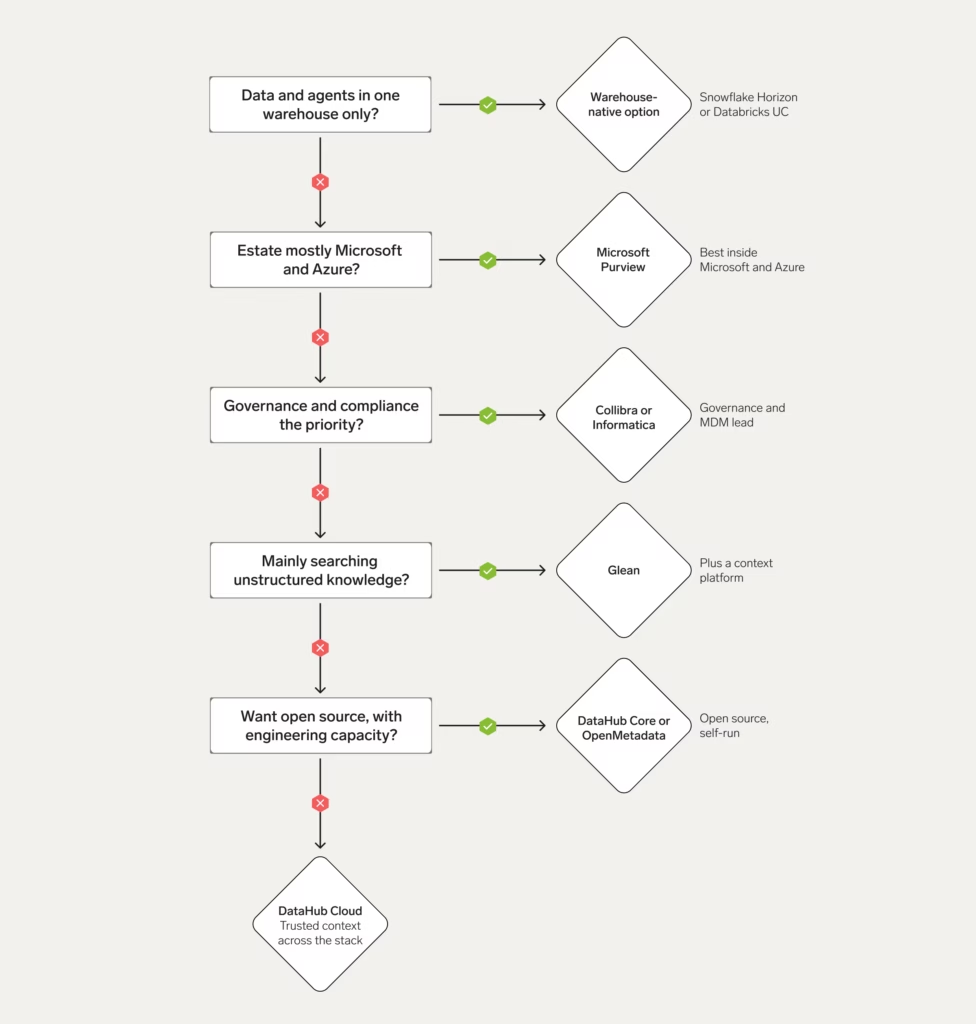
Fit comes down to one question more than any other: how much of your context work spans multiple platforms? If your data and your agents live in one place, a native tool will carry you a long way. The more your stack fragments across warehouses, BI tools, and documentation, the more you need a layer that sits above all of it. Budget, the investments you have already made, and how regulated you are shape the rest.
Use this as a starting point, then pressure-test the shortlist against your own estate.
- Cross-platform or multi-warehouse agent context: A dedicated context platform like DataHub Cloud, which is built to serve one governed source of context to every agent.
- Governance-first regulated enterprise: Collibra or Informatica, where formal stewardship and MDM lead.
- Microsoft-centric estate: Microsoft Purview.
- Single-warehouse only: The native option (Snowflake Horizon or Databricks Unity Catalog), with the caveat that native context is scoped to that platform.
- Engineering-led or open-source preference: DataHub Core or OpenMetadata.
- Unstructured knowledge search: Glean, alongside a context platform rather than instead of one.
A data catalog tells you what data you have. A context platform tells your agents what it means, and serves that meaning wherever they work. Most tools in this list do the first job well. The gap is in the second, and it widens the moment your agents need to reason across more than one platform. If your context work is genuinely cross-platform, a purpose-built context platform is the foundation worth building on.
If you’re still narrowing the field, the 10 Principles of an Enterprise Context Platform Guide turns the criteria in this article into a full evaluation framework, including the questions worth putting to every vendor before you commit.
FAQs
What is the best context management platform for AI agents?
What is the best context management platform for AI agents?
There is no single best platform for every team. For complete cross-platform agent context, a purpose-built context platform like DataHub Cloud fits best, because it serves one governed source of context to every agent. Warehouse-centric teams may do well with Snowflake Horizon or Databricks Unity Catalog, and governance-first enterprises often choose Collibra or Informatica. Match the tool to how much of your stack an agent needs to reason across.
Is a context platform the same as a data catalog?
Is a context platform the same as a data catalog?
No. A data catalog manages metadata: what a data asset is, where it lives, and who owns it. A context platform adds a semantic layer on top, capturing what the data means and how it maps to business concepts, then serves that meaning to AI agents at query time. You need a catalog to run your data platform and a context platform to run AI reliably.
How is context management different from managing an LLM’s context window?
How is context management different from managing an LLM’s context window?
They are unrelated. A context window is the fixed amount of information a language model can process at once, a model-level constraint. Context management is an organizational capability: unifying metadata and business knowledge about your data and serving it to agents so they answer accurately. One is about token capacity, the other about trusted meaning.
Why does Model Context Protocol (MCP) support matter for a context platform?
Why does Model Context Protocol (MCP) support matter for a context platform?
Model Context Protocol (MCP) is the open standard that lets AI agents query a context platform directly. With MCP support, agents like Claude, Cursor, or a custom LangChain agent pull current definitions, lineage, and ownership at query time rather than working from stale or hard-coded context. It is how trusted context reaches the agent, so treat it as a baseline requirement and then look at what a platform offers beyond it, such as prebuilt skills and full API and SDK access.
Do I need a context platform if I already use Snowflake or Databricks?
Do I need a context platform if I already use Snowflake or Databricks?
If your data and agents live almost entirely inside one warehouse, its native context tooling may be enough to start. The limit shows up when you cross platforms. Snowflake Horizon serves context to Snowflake’s agents, and Databricks Genie Ontology grounds Databricks’ agents, but neither automatically serves context to agents running elsewhere. Multi-platform estates need a context platform that spans them.
What is the difference between DataHub Cloud and DataHub open source?
What is the difference between DataHub Cloud and DataHub open source?
DataHub Core is the free, self-hosted, open-source metadata platform: a metadata graph, column-level lineage, glossary, and ownership that you deploy and run yourself. DataHub Cloud is the managed product built on that foundation. It adds the context capabilities (Context Ingestion, Context Intelligence, Context Hub, and Context Activation, including MCP delivery), expert validation workflows, enterprise security, AI-powered automations, and SLAs. Core is the foundation. Cloud is the enterprise context platform on top of it.
Are there open-source context management platforms?
Are there open-source context management platforms?
Yes. DataHub Core and OpenMetadata are both open-source metadata platforms that provide the catalog and lineage foundation context builds on. Both require engineering capacity to deploy and operate, and the managed context capabilities, validation, and support typically live in their commercial offerings (DataHub Cloud and Collate, respectively).
How much does a context platform cost?
How much does a context platform cost?
Most enterprise options are custom, quote-based. Warehouse-native tools like Snowflake Horizon and Databricks Unity Catalog are included with those platforms on a consumption basis. Open-source options are free, minus the infrastructure and engineering cost of running them. DataHub Cloud is custom-priced, with its context capabilities currently available through a private beta.