


The Five Common Context Problems Data Teams Face (and How to Solve Them)
TL;DR
- Data teams face five common context problems when putting AI into production: discovery (agents can’t find available context), trust (no way to trace decisions back to source data), freshness (context lags behind data), governance (policies built for humans, not agents), and context fragmentation (every team building its own context stack).
- These failures live at the platform layer, not inside the agent. Better prompts and bigger context windows don’t fix them, which is why 83% of IT and data leaders in the 2026 State of Context Management Report say agentic AI cannot reach production without a context platform.
- A context platform solves all five together: one shared, governed layer of definitions, lineage, freshness signals, policies, and retrieval that every AI application queries instead of rebuilding from scratch.
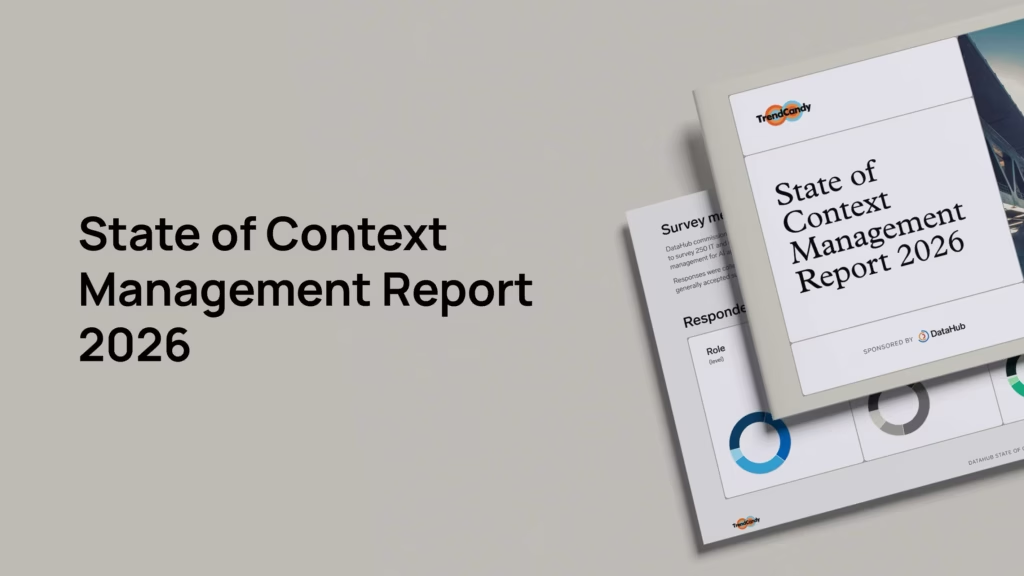
90% of organizations describe their data as AI-ready. 87% of those same organizations say data readiness is the biggest impediment to putting AI into production. Those numbers come from the same survey, the same respondents, and they sit side by side in the 2026 State of Context Management Report.
That contradiction is the context problem. It isn’t one failure but five distinct ones, and none of them live inside the agent. They live below it, in the infrastructure that’s supposed to supply context in the first place.
Shirshanka Das, DataHub’s co-founder and CTO, has been surfacing these patterns in field conversations for years. The report confirmed that they’re universal. Here’s what the five look like, and what it takes to solve them.
Why context problems live at the platform layer, not the agent layer
Most conversations about why AI fails in production circle the agent: Better prompts, better models, bigger context windows, smarter frameworks. Those are agent-layer fixes for what are, in almost every case, platform-layer problems.
The patterns are consistent:
- An agent can’t find the right definition of “customer,” not because the model is weak but because the definition lives in a Notion page the agent never saw
- An agent produces a recommendation that no one can audit, not because the agent is opaque but because the underlying lineage was never captured
- An agent reasons from stale metadata, not because the context window was too short but because the platform below it didn’t push a freshness update.
These failures persist across every LLM, every framework, and every agent architecture. Swap the model and you get the same wrong answer with different phrasing. The only fix that survives that swap is the one that lives below the agent: A context platform that supplies definitions, lineage, freshness signals, policies, and shared retrieval, and does so as a governed layer that every agent queries the same way.
Quick definition: What is a context platform?
A context platform is the infrastructure layer that supplies AI agents with the definitions, lineage, freshness signals, policies, and shared retrieval they need to produce reliable outputs. Context management is the capability. A context platform is the infrastructure that delivers it at enterprise scale.
The data backs this up. 82% of IT and data leaders in the State of Context Management Report agree that prompt engineering alone is no longer sufficient to power AI at scale. 83% agree that agentic AI cannot reach production value without a context platform. What’s shifted in the past twelve months is the recognition that the context gap is an infrastructure problem, not a prompt problem.
The five common context problems at a glance
They show up as five distinct failure modes: discovery, trust, freshness, governance, and context fragmentation.
| Problem | What fails | Business impact | Capability that solves it |
| Discovery | The agent can’t find the context that exists | Wrong definitions, confident hallucinations | Unified context platform with semantic search and business glossary |
| Trust | No way to trace an agent decision back to source data | Compliance failures, unauditable AI outputs | Full-stack lineage, versioning, and audit trail |
| Freshness | The context layer lags behind the data layer | Agents reason from stale maps of changed territory | Event-driven metadata capture and freshness assertions |
| Governance | Policy enforcement designed for humans, not agents | Unauthorized data access at machine speed | Fine-grained access control at the metadata layer |
| Context fragmentation | Every team building its own context stack | Contradictory agent answers across departments | Shared context graph via MCP and APIs |
Each of the five breaks differently, but they share a root cause: Context is stuck at the application layer when it needs to operate as shared infrastructure. Here’s how each one plays out, and what solving it looks like.
1. Discovery, or the agent can’t find the context that exists
An agent trying to answer a real business question runs into the same wall every time. The warehouse has the raw data, but not the knowledge to interpret it. Data quality issues are one problem; missing context is a separate one.That knowledge lives in glossaries, documentation, dbt metric definitions, BI semantic models, runbooks in Notion, and PDFs attached to Jira tickets.
Agents don’t ask for clarification from business stakeholders. They pick a definition and proceed, confidently. Human users hit the same wall in a different form: interviewing engineers to learn what a table contains, reading pipeline code to trace where numbers came from, and tracking down owners to confirm a dataset is trustworthy.
57% of organizations in the State of Context Management Report say it’s challenging or very challenging to identify authoritative sources of truth for their data. 66% report AI models in their organizations generating biased or misleading insights due to low maturity of data infrastructure in providing sufficient context. Agents inherit the first problem and create the second.
DataHub solves the discovery problem on two fronts: Making existing catalog context findable, and ingesting the definitional context that lives outside the catalog.
- On findability, the Business Glossary defines canonical business terms and links them to the tables and columns that implement them, so agents can’t combine incompatible definitions across departments.
- Semantic Search chunks and embeds catalog content so agents can retrieve based on intent rather than keyword match.
On ingestion, DataHub pulls definitional context from where it actually lives: Unstructured sources like Notion, Confluence, and PDFs through unstructured and semantic context integration, metrics defined in dbt, and semantic models defined in BI tools. That content is delivered to agents through semantic search for intent-based retrieval, through the Agent Context Kit for frameworks like Snowflake Cortex, LangChain, and MCP/Claude, and through Ask DataHub Plugins for multi-tool workflows across GitHub, dbt, Snowflake, and DataHub in a single conversation.
The result: Agents stop guessing at definitions and start reasoning from the same business context your analysts use.
2. Trust, or when an agent makes a recommendation, can you trace it?
The second problem starts where the first one ends. Suppose the agent gave a flawed recommendation. Which context did it draw on? Which version of that context? Which pipeline produced the source numbers? For most enterprises, that question has no answer.
53% of organizations in the State of Context Management Report say they frequently face compliance issues from lack of data provenance. When a regulator asks how an AI agent arrived at a lending decision, “we’re not sure which data it used” isn’t an answer. It’s a compliance failure.
DataHub’s full-stack lineage spans datasets, transformations, dashboards, individual columns, ML models, and feature stores, so any agent recommendation or model output can be traced back to every source table, pipeline step, and model version that produced it. That’s table stakes.
What’s less appreciated is versioning. Trust isn’t just about which data an agent used, it’s about which version of that data it used at the time. When a definition changes, a schema shifts, or a metric is recalculated, versioning lets compliance teams reconstruct the exact state of the data that drove a decision, not just the asset as it exists today.
Lineage and versioning sit alongside an audit trail that captures every access event and data contracts that formalize schema, data validation, and quality guarantees at each stage. Together, those pieces give compliance teams a complete provenance trail on demand.
The result: A regulator asking how an agent arrived at a decision doesn’t get hedging. They get a graph: Every data source, every transformation, and every quality assertion that contributed to the output.
3. Freshness, or if your warehouse updates at 2am, when does your agent know?
Most enterprises have gotten good at keeping the data layer fresh. The context layer is another story.
Agents retrieve documentation and metadata at query time. If that documentation hasn’t been updated since last quarter, the agent is reasoning with a stale map over a changed territory.
Definitions drift. Schemas evolve. A metric gets recalculated and nobody updates the glossary entry. A dbt model gets deprecated and replaced with one that has a different grain, and the agent keeps pulling from the old reference. The agent still answers, it just answers based on a policy that no longer applies. The failure is invisible until someone spot-checks the output against a live source, which in most enterprises happens rarely or never.
DataHub’s ingestion framework supports both event-driven metadata capture and scheduled syncs from hundreds of sources, which keeps the context layer synchronized with the actual data environment rather than frozen at last week’s snapshot.
Freshness Assertions, part of DataHub’s data quality and data contracts capabilities, let teams define explicit SLAs for how recently a dataset must have been updated, automatically raising Freshness incidents when data staleness violates those SLAs.
The result: When your warehouse refreshes at 2am, DataHub captures the updated lineage, schema changes, and quality signals quickly. Agents query a live map of reality, not a stale one.
4. Governance, or who can access what when agents are hitting dozens of sources?
Traditional governance was designed for a specific operational reality. Humans querying data during working hours, with periodic access reviews and quarterly audits. Agents break every part of that assumption.
An agent operating at machine speed can hit dozens of data sources in a single user-initiated task. Each of those sources may have different access policies, different classification levels, and different rules for how the underlying data can be combined. Governance that depends on human-speed review can’t keep up.
61% of organizations in the State of Context Management Report say they frequently delay AI initiatives due to lack of trusted and reliable data. Governance uncertainty is a major contributor. When teams can’t guarantee that an agent won’t access data it shouldn’t, they slow rollouts down, trading operational efficiency for caution.
DataHub’s fine-grained access control and metadata policy engine let organizations define who, or which service account or AI agent, can interact with specific datasets, columns, business terms, or sensitivity-classified fields.
When an agent queries a dozen sources autonomously, every request passes through the same policy engine that governs human access. A customer-support agent that isn’t authorized to see PII-tagged columns can’t accidentally surface them in a summary. An analyst agent running data analysis for a specific business domain can’t reach into another team’s sensitive data.
The result: Governance becomes operational, embedded in the infrastructure, and continuous, rather than a quarterly checkpoint that agents have long since outpaced.
5. Context fragmentation, or every team building the same context stack in isolation
The fifth problem is the one that motivates all the others.
Every enterprise we talk to is rebuilding the same context capabilities inside every AI application: RAG pipelines, prompt templates, conversation memory, and structured outputs for specific workflows. Each team starts from scratch. The technical debt compounds, and the resulting agents give contradictory answers to the same question because they’re drawing from different knowledge bases.
57% of organizations in the State of Context Management Report duplicate AI efforts across departments because there’s no unified context graph. When your customer-facing agent and your internal analyst agent both need to know what “revenue” means or which customer segments are canonical, they should get the same governed answer. In most enterprises today, they don’t.
DataHub’s context platform functions as a shared context layer: A single, versioned, API-accessible repository of business definitions, lineage, quality signals, ownership metadata, and policies.
Every AI application in the enterprise queries it instead of rebuilding from scratch. Rather than each team maintaining its own RAG pipeline over its own siloed documentation, every agent draws from the same governed DataHub context graph via the MCP server or REST and GraphQL APIs.
The result: When the customer-facing agent and the internal analyst agent both ask what “revenue” means, they get the identical, governed answer from the same source. Independent context pipelines collapse into one shared infrastructure. Agents stop contradicting each other because they’re reasoning from the same context graph.
Those five problems share a root cause
Data teams don’t experience these five problems one at a time. Discovery, trust, freshness, governance, and fragmentation show up together, and they share a root cause: Context is stuck at the application layer when it needs to operate as shared infrastructure. Solving any one of them in isolation produces local wins and leaves the rest open. Solving them together requires a context platform.
That’s not a theoretical claim. An IDC study of DataHub Cloud customers published in March 2026 measured the business outcomes across their AI and data projects and found 119% more AI/ML models successfully reaching production, a 24% lower AI/ML project failure rate, and a 91% reduction in time to discover trustworthy data (from 50 minutes down to 5). Those results come from data teams that stopped treating context as a per-application concern and started treating it as shared infrastructure, a core piece of their data strategy.
Context won’t solve itself. But it doesn’t require five separate initiatives either. It requires one platform that supplies the definitions, lineage, freshness signals, policies, and shared retrieval your agents need, governed the same way you’d govern any other critical system.
Ready to supply your agents with the context they need to reach production? Join a live group demo to see how you can do it with DataHub Cloud. Or, explore the 2026 State of Context Management Report.
FAQs
What are the most common context problems data teams face when building AI agents?
What are the most common context problems data teams face when building AI agents?
The five most common context problems are:
1. Discovery: Agents can’t find the context that exists
2. Trust: No way to trace an agent decision back to source data
3. Freshness: The context layer lags behind the data layer
4. Governance: Policies built for humans don’t scale to agents
5. Context fragmentation: Every team building its own context stack
All five live at the platform layer rather than inside the agent, which is why better prompts and bigger context windows don’t fix them.
What is a context platform, and how is it different from a data catalog?
What is a context platform, and how is it different from a data catalog?
A context platform is the infrastructure layer that supplies definitions, lineage, freshness signals, policies, and shared retrieval to AI agents across an enterprise. A data catalog is one capability inside that broader platform, focused on cataloging data assets for humans. Context platforms extend that foundation to serve AI agents and other data tools directly, with semantic search, ingestion of definitional context from sources outside the warehouse, versioning for audit, and APIs like MCP that agents can query.
Why do AI agents fail in production even when the underlying data is clean?
Why do AI agents fail in production even when the underlying data is clean?
Clean data answers “what is the value in this column?” Context answers “what does this value mean in the current business?” Agents need both, and most data professionals have invested in the first without investing in the second. Definitions drift, ownership changes, metrics get recalculated, and none of it reaches the agent unless the platform below the agent surfaces it.
What’s the difference between clean data and context?
What’s the difference between clean data and context?
Clean data, the output of data engineering pipelines, is accurate, complete, and formatted. Context is what the data means: Which definition is canonical, who owns it, how it’s calculated, when it was last updated, and under which policies it can be used. Clean data is necessary but not sufficient for production AI. Context is the layer that turns accurate numbers into reliable answers.
How does data lineage support AI agent trust and compliance?
How does data lineage support AI agent trust and compliance?
Full-stack lineage traces an agent’s output back through every dashboard, transformation, column, and source table that contributed to it. Combined with versioning, which captures the state of each asset at the time the agent used it, lineage lets compliance teams reconstruct any agent decision in full detail. Without lineage, AI outputs are opaque. With it, they’re auditable.
Can prompt engineering solve the context problem on its own?
Can prompt engineering solve the context problem on its own?
No. Prompts are static, and business context changes constantly. A prompt written in January doesn’t know that the revenue recognition policy changed in March, or that a metric was recertified last week. 82% of IT and data leaders in the 2026 State of Context Management Report agree that prompt engineering alone is no longer sufficient to power AI at scale. The fix has to sit in the infrastructure, not in the prompt.
What does context fragmentation mean, and why does it cause contradictory agent answers?
What does context fragmentation mean, and why does it cause contradictory agent answers?
Context fragmentation, as DataHub defines it, is the enterprise-wide duplication of context pipelines across teams. Think of it as data silos reemerging at the context layer. When every team builds its own RAG pipeline over its own documentation, the resulting agents draw from different knowledge bases and give different answers to the same question. A shared context graph, queried by every agent through the same APIs, collapses those duplicated pipelines into one governed layer and enforces data consistency by ensuring agents reason from the same source of truth.