
What is Metadata Management? A Guide for Enterprise Data Leaders
The metadata management strategy that handled 50 data sources reasonably well usually becomes a liability at 300. That’s because what worked when your data team could manually document critical pipelines fails when you’re ingesting terabytes daily across cloud warehouses, streaming platforms, ML feature stores, and legacy systems that refuse to die.
This isn’t just about scale for scale’s sake.
Enterprise data leaders face a convergence of pressures that traditional catalogs weren’t built to handle:
- AI systems that need validated training data with full lineage
- Regulatory compliance frameworks that demand continuous governance rather than periodic audits
- Decentralized data architectures where no single team controls the full picture
The old playbook of periodic metadata collection, manual documentation, and separate tools for discovery and governance creates exactly the gaps that cause production incidents and failed AI deployments.
Modern metadata management represents a fundamental shift in data management architecture: Rather than passive inventories consulted occasionally, platforms like DataHub function as operational infrastructure that participate actively in data workflows. They provide real-time context to both humans making decisions and AI systems operating autonomously.
Metadata management: Definitions and modern requirements
Quick definition: Metadata management
Metadata management is the discipline of capturing, organizing, and operationalizing information about data assets to make them discoverable, trustworthy, and production-ready across the enterprise.
At enterprise scale, an effective metadata management solution creates a unified view of what data exists, where it comes from, how it transforms, who owns it, what it means in business terms, and how it’s actually being used.
The evolution matters. Early metadata catalogs served as inventories—think card catalogs for data warehouses. They helped data engineers find tables and understand schemas. Modern metadata management operates as infrastructure that enables automation, enforces governance in real-time, and provides the context layer that makes agentic AI systems possible.
Types of data captured by metadata management
Effective metadata management captures four distinct types of information:
- Technical metadata describes the structure and location of data elements, e.g., schemas, formats, partitioning strategies, and storage locations. This is what most traditional catalogs focused on exclusively.
- Business metadata translates technical reality into business meaning, and includes glossary terms, ownership assignments, business rules, and certified definitions. This bridges the gap between how data is stored and what it actually represents.
- Operational metadata tracks the runtime characteristics of data systems, such as job execution times, data volumes, error rates, and performance metrics. This is what lets you move from “what is this data” to “is this data healthy right now.”
- Usage metadata captures how data is actually being consumed, e.g., who’s querying what, which dashboards depend on which tables, access patterns, and user ratings. This turns metadata from documentation into intelligence about data value and risk.
Why traditional approaches to metadata management fail at enterprise scale
Data catalogs have long been the primary tool for metadata management, serving as centralized inventories where organizations document their data assets. But as metadata management requirements evolved from simple discovery to operational infrastructure, traditional catalog architectures revealed fundamental limitations.
To be blunt, traditional data catalogs were designed for a world that no longer exists. They assumed data would live primarily in relational databases, be queried mainly through SQL, and change at predictable intervals when engineers ran batch jobs. They were built for humans to occasionally look things up, not for systems to continuously validate and enforce policy. Specifically, they’re:
Built for batch, breaking under real-time
Most traditional catalogs ingest metadata on schedules—nightly, weekly, or when someone remembers to trigger a scan. This worked fine when data warehouses updated overnight. It fails catastrophically when Kafka topics stream millions of events per second, when feature stores update continuously, or when ML models retrain on fresh data hourly.
By the time the catalog reflects reality, that reality has changed. Data engineers can’t troubleshoot pipeline failures with stale lineage information. Governance teams can’t enforce policies on data they don’t know exists yet.
Designed for SQL discovery, failing for AI/ML workflows
Traditional catalogs excel at one thing: Helping analysts find the right table to query. They struggle with everything AI systems need.
- Where’s the lineage connecting this training dataset back through feature engineering to raw events?
- Which models consumed this data, and what was their performance?
- What transformations were applied, and do they introduce bias?
- Has this data been validated against our AI readiness criteria?
These aren’t edge cases anymore. They’re the questions blocking AI from moving beyond pilots into production.
Optimized for human queries, can’t support autonomous systems
When a data scientist searches for customer data, a traditional catalog returns results they can browse. When an AI agent needs to validate that a proposed dataset meets governance requirements before starting a training job, that same catalog has no programmatic interface for policy checks, no way to trigger workflows, no mechanism to record the decision.
The architecture assumes every interaction involves a human sitting at a keyboard, not systems orchestrating data operations autonomously.
Siloed by design
Perhaps most fundamentally, traditional approaches treat discovery, governance, and observability as separate concerns requiring separate tools:
- You search for data in the catalog
- You check quality in your observability platform
- You verify compliance in your data governance tool
Each system has its own metadata, its own lineage graph, its own understanding of what data means. When a quality issue impacts a compliance-critical dashboard, no single system can connect those dots. Teams waste hours manually tracing dependencies across fragmented tools, and they still miss the full picture.
“The fragmentation across discovery, governance, and observability tools isn’t just inconvenient—it’s architecturally incompatible with modern data operations. We designed DataHub around a unified metadata graph specifically because context-aware governance is impossible when lineage lives in one system, quality metrics in another, and business definitions in a third. Real governance requires everything connected in real-time.” – Maggie Hays, Founding Product Manager, DataHub
Implementing metadata management: What actually matters
Even the most architecturally sound metadata management tools deliver no value if implementation fails. Successful deployments follow patterns that respect organizational reality rather than idealized rollout plans.
1. Start with high-value use cases, not comprehensive coverage
When managing metadata, the impulse to catalog everything before declaring success kills momentum. Instead, identify specific pain points where better metadata delivers immediate, measurable value:
- Accelerating incident response through automated lineage for root cause analysis: With comprehensive lineage, diagnosis happens in minutes.
- Enabling self-service analytics for a specific business unit: A well-implemented catalog with strong business metadata lets them find and understand data independently.
- Establishing AI readiness for production ML deployment: Solving this bottleneck typically unblocks multiple stalled AI initiatives simultaneously.
Each use case builds capability that supports the next. Lineage captured for incident response serves AI readiness. Business glossaries created for self-service enable better governance. Start narrow, prove value, expand deliberately.
2. Executive sponsorship and data steward empowerment
Metadata management fails when treated as a tool rollout rather than organizational change. Two factors predict success more reliably than any technical consideration:
- Executive sponsorship that establishes metadata management as strategic infrastructure, not IT overhead. This means budgets that survive quarterly scrutiny, mandates that drive adoption across business units, and visible leadership commitment.
- Empowered data stewards who own business metadata and have organizational authority to enforce standards. Metadata platforms don’t magically populate themselves with accurate business context. Someone must either define or correct auto-generated glossary terms, certify datasets, identify critical data elements, establish ownership, and maintain quality.
The platform can automate technical metadata capture, but business meaning, ownership, and governance policy still require human judgment and organizational authority.
3. Metrics that matter
Avoid vanity metrics like “number of assets cataloged.” Focus on metrics that reflect business value:
- Time-to-trust measures how long it takes a data consumer to go from discovering a dataset to confidently using it in production.
- Incident resolution speed measures mean time to resolution for data quality issues and pipeline failures. Strong metadata management should dramatically accelerate root cause analysis and improve data quality.
- AI deployment velocity tracks time from model development to production deployment. Metadata management should reduce this through automated compliance validation and lineage verification.
What modern AI-native metadata platforms deliver
Modern active metadata platforms like DataHub are built on different assumptions: That metadata velocity matters as much as data velocity, that AI workloads are first-class citizens alongside analytics, and that unifying discovery, governance, and observability creates capabilities impossible with fragmented tools.
Event-driven architecture for real-time operations
DataHub processes metadata through an event-driven architecture where every change generates events that flow through the system in real-time. This isn’t just faster batch processing; it’s a fundamentally different model.
When a data engineer creates a new dataset in Snowflake, DataHub captures that event within seconds. Governance policies evaluate the new asset immediately. If it contains PII based on automated classification, data access controls apply before anyone queries it—automatically, in production, without human intervention.
This real-time model supports both human decision-making and automated pipelines. Data scientists see current quality metrics and usage patterns, not last week’s snapshot. ML training pipelines validate lineage and compliance programmatically before starting expensive jobs. AI agents query current metadata state, make decisions, and record actions—all through APIs designed for machine consumption.
Unified graph for discovery, governance, and observability
DataHub‘s metadata graph connects data assets, transformation logic, ML models, dashboards, and the people who own them in a single, queryable structure. This unification delivers what fragmented tools cannot: Context-aware governance and true cross-platform lineage.
Discovery, governance, and observability aren’t separate problems. They’re interdependent concerns that only work well together. When data users search for customer data, they need to see immediately whether it meets quality thresholds and complies with retention policies. When a quality issue occurs, you need to understand impact on downstream dashboards and whether compliance is affected. Separate tools can’t answer these questions without manual correlation.
DataHub tracks lineage from Kafka events through Spark transformations to Snowflake tables to Looker dashboards to data science tools like SageMaker. When an upstream schema changes, impact analysis shows every affected asset across the entire ecosystem, not just within a single platform’s silo.
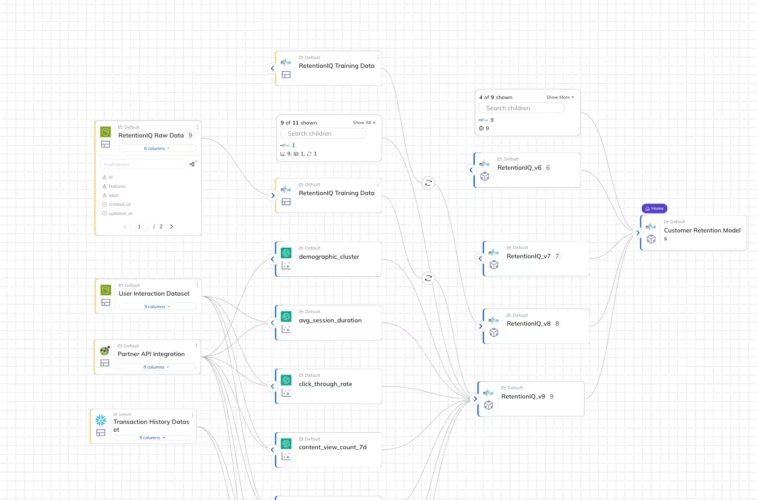
This cross-platform visibility enables governance policies that understand context: Mark a source table as containing PII, and DataHub applies appropriate controls to derived datasets automatically through lineage propagation—no manual tagging required.
AI-native from the ground up
Modern metadata management treats AI and ML as first-class citizens—not just traditional ML models, but the entire AI ecosystem including LLMs, agents, prompts, and unstructured data. This means native support for AI-specific assets, automated metadata enrichment, and architecture designed for both human and AI agent interaction.
DataHub catalogs the full spectrum of AI artifacts:
- ML models with training configurations, feature definitions, and hyperparameters
- Prompts and prompt templates used across LLM applications
- AI agents and tools that operate autonomously within your data ecosystem
- Unstructured data like documents, images, and embeddings that fuel GenAI applications
- Vector databases and feature stores that serve real-time AI systems
But cataloging assets alone isn’t enough. DataHub maintains the critical relationships and context that AI governance requires:
- Data-to-model lineage tracks exactly which datasets were consumed by which AI models, enabling impact analysis when data sources change and compliance validation for AI audits. When regulators ask “what data trained this model?”, you have definitive answers, not approximations.
- Version history captures temporal relationships between data versions and model training runs. DataHub records which version of your customer dataset trained v2.3 of your recommendation model, which features were active, and what the data quality metrics were at that exact point in time. This matters when model performance degrades and you need to understand whether data drift or model changes are responsible.
- Performance tracking retains model and agent performance metrics over time, creating context for future decisions. When you’re evaluating whether to retrain a model or deciding which agent performs best for specific tasks, DataHub provides historical performance data alongside the metadata about what data and configurations produced those results.
This comprehensive tracking extends to AI agents operating autonomously. As agents discover datasets, validate compliance, and execute transformations, DataHub records their actions, the metadata they consulted, and the outcomes they produced. This creates audit trails essential for both debugging agent behavior and maintaining governance over increasingly autonomous systems.
AI capabilities enhance metadata management itself. DataHub uses machine learning for automated classification—detecting PII, financial data, and other sensitive information without manual tagging. Natural language processing generates documentation by analyzing transformation logic and popular queries.
“Manual metadata management doesn’t scale when you’re cataloging millions of assets across hundreds of systems. AI-powered classification, automated documentation generation, and intelligent anomaly detection aren’t nice-to-have features—they’re the only way to maintain metadata quality at enterprise scale without an army of data stewards.” – John Joyce, Co-Founder, DataHub
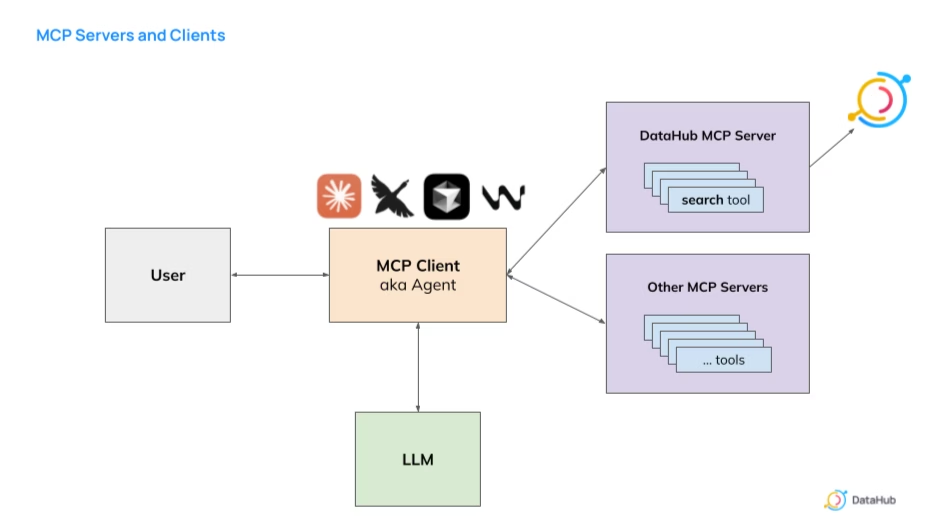
Critically, DataHub‘s architecture supports AI agent interaction as peer users, not just subjects being cataloged. As organizations deploy AI assistants and autonomous data agents, these systems need programmatic access to metadata with appropriate context. DataHub’s APIs enable AI agents to discover data, validate compliance, check quality, understand lineage, and record their actions. The platform implements emerging standards like Model Context Protocol (MCP) through a hosted MCP Server that allows AI systems to query metadata effectively and contribute metadata back to the system.
Extensibility without customization debt
Every enterprise has unique requirements: Industry-specific data classifications, proprietary business metrics, custom quality definitions.
Traditional catalogs force a choice between rigid structures or deep customization that becomes technical debt. However, DataHub’s schema-first design provides a third option. The platform’s metadata model is fully extensible without breaking core functionality or complicating upgrades. This extensibility flows through the entire platform: Custom metadata appears in search results, integrates with lineage visualization, participates in governance policies, and surfaces through APIs.
The API-first architecture means DataHub integrates deeply with existing workflows. With 100+ pre-built connectors and a flexible connector framework, most integration happens through configuration rather than code. What makes this sustainable is DataHub’s open-source foundation: 14,000+ community members, proven deployment at Apple, Netflix, and LinkedIn, and evolution through collective innovation rather than vendor roadmap dependency.
Custom extensions remain compatible with core platform evolution because they use the same extension mechanisms the community relies on. The platform adapts to your organization’s unique needs without creating a maintenance burden that eventually forces migration.
See DataHub in action
Is your metadata management solution future-proof?
Modern platforms like DataHub deliver capabilities that may seem advanced today but are fast becoming must-have requirements. The question is whether you’re building toward those requirements now or setting yourself up for a painful migration later.
Ask yourself the following questions:
Can your platform support autonomous AI agents?
Detection answers the urgent question every data team faces: “How do we know when sAI agents are already handling routine data tasks in production environments—discovering datasets, validating compliance, checking quality thresholds, executing transformations. Within two years, most enterprises will run hundreds of these agents operating with minimal human oversight.
Your metadata platform either enables this or blocks it. Ask yourself:
- Can AI agents query your metadata programmatically to make decisions?
- Can they validate governance requirements before acting?
- Can they record their actions for audit trails?
- Do your APIs provide the context agents need, or are they designed exclusively for human interfaces?
If your current platform requires human-in-the-loop for these workflows, you’re not ready. DataHub’s event-driven architecture and comprehensive APIs were designed specifically for autonomous systems that need to discover, validate, and act on metadata at machine speed.
Can you scale to trillions of metadata events?
Current metadata platforms handle billions of records and thousands of users. The next generation must process trillions of metadata events generated by streaming platforms, real-time pipelines, and autonomous agents making continuous decisions.
The architectural patterns that enable this scale (event-driven processing, disaggregated storage, efficient graph queries) aren’t features you can tack on later. They’re foundational design decisions. Platforms built for periodic batch processing will hit hard limits as metadata velocity increases.
If your metadata platform runs scheduled scans rather than processing events in real-time, you’re already seeing the constraints. That gap will only widen.
Will your metadata architecture survive the next platform shift?
Data architectures change faster than metadata platforms. The lakehouse you’re building today will integrate with systems that don’t exist yet. Emerging standards like Model Context Protocol (MCP) will define how AI systems interact with metadata.
Proprietary metadata formats and closed ecosystems become anchors when the data landscape shifts. Open-source foundations, extensible metadata models, and standards-based integration determine whether you adapt quickly or face disruptive migration.
DataHub’s open-source architecture with 14,000+ community members means the platform evolves with industry standards rather than vendor roadmaps. Custom extensions remain compatible because they use the same mechanisms the community relies on.
Can you avoid the next migration?
Migrating metadata platforms is extraordinarily difficult. Unlike swapping BI tools where visualizations can be recreated, metadata embeds deeply into operational workflows, governance processes, and organizational practices. The lineage graphs, business glossaries, data models, quality definitions, and ownership models you build represent significant organizational investment that doesn’t transfer easily.
Traditional catalogs and modern platforms may look similar in demos focused on search and discovery. The difference appears when you need real-time lineage for production AI, comprehensive APIs for agent integration, or flexible metadata models for emerging use cases—requirements that seem optional today but become blockers tomorrow.
Choose a platform without these capabilities, and you’ll face either a costly migration in three years or constraints that limit your AI ambitions. Choose architecture designed for requirements you don’t have yet, and you build foundation instead of technical debt.
DataHub was architected for a future where metadata operates at machine scale, supports autonomous agents, and adapts to platforms that don’t exist yet. The platform handles today’s needs while providing foundation for tomorrow’s requirements. That’s the difference between building infrastructure and accruing technical debt.
Product tour: See DataHub in action
Ready to future-proof your metadata management?
DataHub transforms enterprise metadata management with AI-powered discovery, intelligent observability, and automated governance.

Explore DataHub Cloud
Take a self-guided product tour to see DataHub Cloud in action.

Join the DataHub open source community
Join our 14,000+ community members to collaborate with the data practitioners who are shaping the future of data and AI.
FAQs
Recommended Next Reads
-

Article
Product Demos
-

Article
Modern Metadata Platforms