


Data Governance: Building Production-Ready Foundations for AI and Analytics
Most AI initiatives fail between pilot and production. That’s not because the models don’t work, but because the data underneath them can’t be trusted. Organizations successfully demo impressive AI prototypes but struggle to deploy them confidently to production. The culprit: Data they can’t trust, lineage they can’t trace, and data governance processes that can’t keep pace with production requirements.
Traditional data governance frameworks fail at production scale. Manual documentation goes stale the moment pipelines change. Fragmented tools create data silos where catalog, quality monitoring, and lineage don’t talk to each other. Point solutions optimized for human discovery can’t handle the billions of metadata events that AI systems generate.
“The organizations who’ve figured out that governance is a valuable infrastructure component are leapfrogging those that still treat it as a compliance exercise. Governance enables teams to move faster with confidence. The question isn’t whether to govern, it’s how to scale governance to your AI needs.”
– Stephen Goldbaum, Field CTO, Financial Services, DataHub
What is data governance?
For data engineers and platform teams, governance determines whether you can deploy AI models with confidence, provide compliance-related information in minutes instead of days, scale operations without proportionally scaling headcount, and enable self-service data access without creating security holes.
Modern governance differs fundamentally from traditional approaches. Traditional governance relies on quarterly audits, manual documentation, and treating data quality as an afterthought using fragmented tools. Modern governance implements continuous monitoring, automated validation, quality by design, and unified platforms where metadata flows between discovery, observability, and governance workflows.
Four benefits of data governance
Beyond preventing compliance failures, effective governance creates three core capabilities that determine whether your data platform succeeds or becomes a bottleneck:
- Quality and reliability: Data contracts establish explicit agreements between producers and consumers. Automated validation runs continuously. ML-based anomaly detection adapts to patterns without manual threshold tuning.
- Visibility and context: Clear ownership assigns accountability. Lineage traces data flows across platforms. Business glossaries connect technical assets to business meaning. Documentation stays current through automation.
- Access and data security: Self-service with embedded guardrails enables speed without sacrificing control. Audit trails maintain compliance visibility. Programmatic policies enforce standards at scale.
- Efficiency and scale: Policies defined once apply on every metadata change. Classifications and documentation inherit downstream automatically. Compliance status updates in real time instead of being reassembled each quarter.
Why does data governance matter for data platform teams?
Data governance directly impacts your ability to ship reliable data products and maintain production systems. Here’s where the absence of governance creates tangible problems for platform teams:
The AI readiness gap
Your organization wants to move AI from pilot to production, but production AI has fundamentally different requirements than proof-of-concept demos:
- Models need trustworthy training data with documented provenance
- Feature pipelines need continuous validation
- Compliance teams need proof that sensitive data didn’t leak into training sets
- Access controls must govern who can view or use AI-generated outputs and predictions
Without governance, you risk deploying models on questionable data where anomalies go unexplained and compliance exposure grows. With governance infrastructure in place, automated validation runs continuously, lineage traces from raw data through feature engineering to model outputs, and data contracts guarantee quality between producers and consumers.
The result: Organizations with mature governance deploy AI from pilot to production significantly faster because they’ve eliminated the trust gap that creates deployment delays.
The data trust and collaboration problem
Data teams want to move fast, but without governance, every dataset becomes a question mark:
- Is this the authoritative customer table or one of twelve outdated copies?
- Does it contain PII that requires special handling?
- Who owns it, and is it actually maintained?
Without clear answers, teams default to the safest option: they don’t use the data at all, or they spend days tracking down institutional knowledge before they trust it enough to build on.
This creates organizational friction:
- Analysts can’t self-serve because they don’t know what’s safe to use
- Engineers duplicate datasets because they can’t find or trust existing ones
- Data teams become bottlenecks as everyone routes questions through the same few people who “just know”
- Cross-team collaboration stalls when ownership and data quality standards aren’t clear
Governance infrastructure eliminates these trust gaps:
- Clear ownership assigns accountability for every dataset
- Automated quality monitoring provides confidence signals that data meets standards
- Business glossaries connect technical assets to business meaning so teams know they’re using the right data
- Access policies embedded in the catalog surface immediately—teams know what they can use before requesting access.
The result: Organizations with mature governance enable true self-service. Teams find, understand, and use data confidently without manual verification or routing every question through institutional knowledge holders. Collaboration accelerates because trust is built into the infrastructure, not dependent on knowing the right person to ask.
The compliance burden
Compliance regulations like GDPR, CCPA, and BCBS 239 evolve constantly. And industry-specific requirements often change faster than documentation can keep pace. Without governance infrastructure, compliance becomes a quarterly fire drill where teams scramble to manually document data flows, verify access controls, and prepare for audits.
Manual compliance tracing devastates productivity. When auditors ask “show me every dataset containing customer financial data” or “prove which data sources feed your credit risk models,” data teams drop everything to manually trace critical data elements across systems.
Without automated lineage, identifying which datasets AI models actually consume requires detective work—querying logs, interviewing engineers, and piecing together institutional knowledge. These fire drills pull engineers away from essential work for days or weeks while exposing the organization to compliance risk if the manual tracing misses something.
This episodic approach creates gaps:
- Point-in-time snapshots miss what’s actually happening in production between audits
- Manual documentation goes stale the moment pipelines change
With continuous compliance monitoring, audit-ready documentation generates automatically from live metadata. Real-time dashboards replace quarterly reports. Organizations using DataHub complete compliance audits faster because they’re monitoring continuously, not reconstructing history under deadline pressure.
The scaling challenge
Platform teams face an impossible equation: Data volumes explode, systems multiply, and compliance requirements increase—all while headcount stays flat or shrinks. Traditional governance approaches assume you’ll add people to handle the increased complexity. But that’s often not realistic.
Governance automation breaks this constraint:
- Programmatic policies enforce standards across thousands of assets without manual oversight
- AI agents monitor quality and flag issues automatically
- Lineage-based propagation classifies data once at the source and inherits classifications downstream
The same platform team manages dramatically more assets through intelligent workflows that scale independently of headcount.
Why traditional data governance tools fail these challenges
It’s a common pattern: Organizations try to scale governance through manual processes and fragmented tools. They document datasets by hand, run quarterly compliance audits, and deploy separate point solutions for cataloging, quality monitoring, and lineage tracking.
This approach breaks under production load for predictable reasons:
- Manual processes can’t maintain accuracy across thousands of rapidly changing datasets. By the time you document a table, the schema has changed and pipelines have evolved.
- Episodic audits create compliance gaps that grow between checkpoints. Quarterly reviews capture snapshots, but production data flows continuously. The time between audits is when problems actually happen.
- Fragmented tools prevent unified governance because metadata doesn’t flow between systems. Your data catalog doesn’t know about quality issues. Your quality tool doesn’t understand lineage. Your lineage tracker doesn’t inform access policies. Point solutions miss the critical relationships where upstream quality problems cascade through lineage to downstream consumers, where governance policies should apply automatically based on data classifications.
These capabilities must work together from shared metadata, not operate in isolation.
Four key components of production-ready data governance
When evaluating data governance frameworks, look for integrated capabilities that work from a unified metadata foundation. Fragmented point solutions create the gaps that cause governance to fail at scale.
1. Governance as code with continuous policy enforcement
The problem with most approaches: Governance policies live in documents, spreadsheets, and quarterly review meetings. Someone decides “all Tier 1 datasets must have owners and documentation,” but enforcement happens manually, if it happens at all. By the time you’ve audited 100 datasets to verify compliance, policies have changed, new datasets have been created, and your spreadsheet is already outdated.
This manual approach creates governance that can’t scale:
- Policies documented in wikis don’t enforce themselves
- Compliance checks happen episodically, missing what happens between audits
- Each new dataset requires manual classification and policy application
- Governance teams become bottlenecks as data volumes grow
What you need instead: Governance policies defined as code that enforce automatically and continuously as metadata changes. You write the rules once, and the system applies them everywhere without manual oversight.
Modern governance platforms enable:
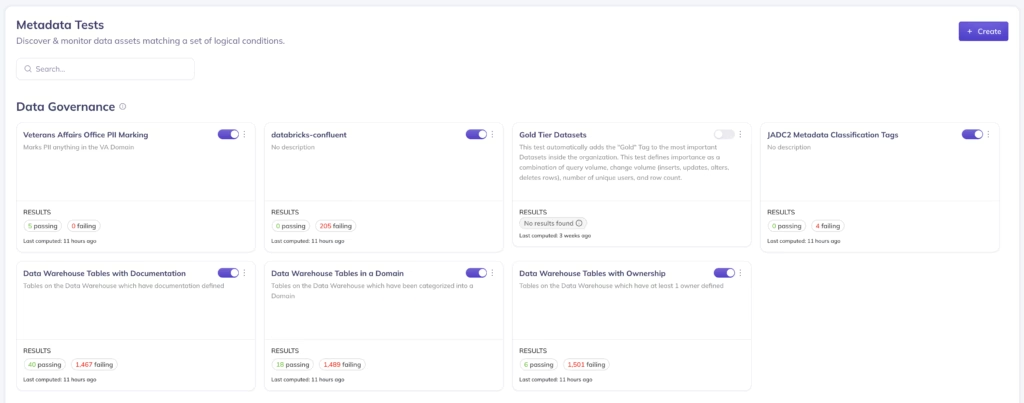
- Automated asset classification based on technical signals like usage patterns, data lineage, or schema characteristics. For example: “Automatically tag all Snowflake tables in the top 10% of query volume as ‘Tier 1’ assets.” As usage patterns shift, classifications update automatically.
- Continuous compliance monitoring where you define metadata standards and the system tracks which assets pass or fail in real-time. For example: “All Tier 1 datasets must have at least one owner, human-authored documentation, and a classification glossary term.” The platform monitors compliance continuously and surfaces violations immediately.
- Event-driven enforcement where policy actions trigger automatically when metadata changes. When a new dataset appears matching certain criteria, governance rules apply instantly—tagging it, assigning ownership, or restricting access based on data classification.
Look for systems that provide:
- Declarative policy definition where you specify conditions and actions in a structured format
- Real-time evaluation as metadata changes, not batch processing overnight
- Broad applicability across asset types (datasets, dashboards, ML models, pipelines)
- Transparent audit trails showing which policies were evaluated and what actions were taken
The difference this makes: Organizations using governance-as-code manage thousands of assets with the same governance team size that previously struggled with hundreds. Policies enforce consistently without manual intervention, and compliance posture updates in real-time rather than becoming outdated between quarterly audits.
“The winning organizations evolved from governance as a documentation exercise long ago. They’ve integrated governance into daily processes. They leverage the system to continually enforce and distribute updates across thousands of assets. When a new dataset appears or metadata changes, governance applies automatically — no manual audits, no quarterly fire drills. This is what enables a small team to manage enterprise-scale data platforms without drowning.”
Stephen GoldbaumField CTO, Financial Services
2. Access control and compliance validation through lineage
The problem with most approaches: Access policies and data classifications exist in isolation from data flows. You classify a source table as containing PII, but downstream transformations and aggregations don’t inherit those classifications automatically. When auditors ask “prove that your credit risk model only consumes approved datasets,” you’re manually tracing lineage through logs and institutional knowledge.
This fragmentation creates compliance risk:
- Sensitive data classifications don’t propagate to derived datasets
- You can’t prove which data sources actually feed production AI models
- Access controls applied to source systems don’t extend to downstream copies
- Manual lineage tracing during audits wastes engineering time and risks missing dependencies
What you need instead: Access control and compliance validation that understands how data flows through your systems. When you classify data at the source, those classifications are automatically inherited downstream. When you need to prove compliance, automated tracing shows exactly which approved datasets feed your AI models, with no manual investigation required.
Modern governance platforms enable:
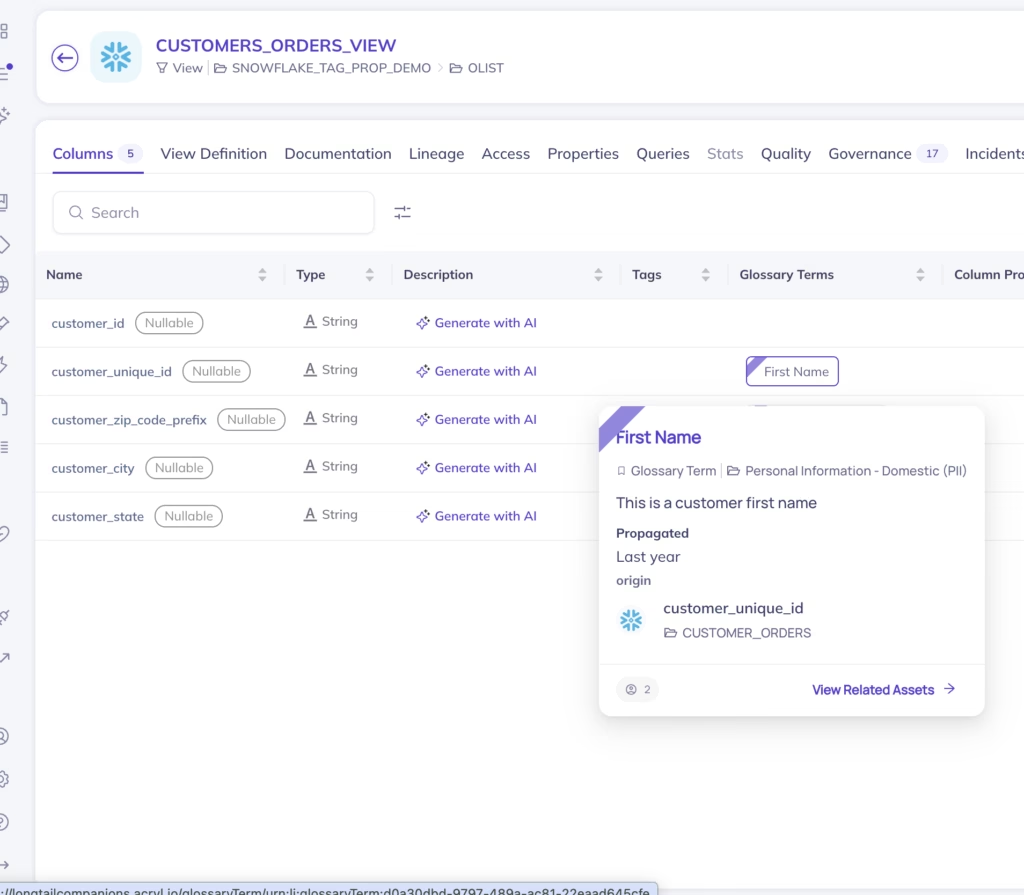
- Classification propagation: Tag a source table as “PII” or “Confidential,” and those classifications flow automatically through transformations. Downstream dashboards, reports, and ML features inherit governance policies without manual tagging.
- Compliance tracing for AI models: Answer “which datasets feed this AI model?” instantly. During audits, generate proof that sensitive data stayed within approved boundaries and that production models only consume validated, approved source datasets.
- Access policy enforcement: Implement access controls that understand data relationships. If a user can’t access a source table containing PII, they automatically can’t access downstream aggregations derived from it—even if those aggregations live in different platforms.
- Impact analysis for policy changes: Before restricting access to a dataset, understand which dashboards, models, and reports will be affected. See downstream dependencies so you can notify stakeholders before breaking their workflows.
Look for systems that provide:
- Automated lineage extraction from SQL, Python, Spark, and orchestration tools without manual mapping
- Cross-platform tracking that follows data from source systems through transformations to AI models and dashboards
- Column-level granularity to understand field-level sensitivity (e.g., “this column contains SSNs”)
- Bidirectional tracing to answer both “where does this data come from?” and “where does this data go?”
The governance impact: Lineage transforms compliance from manual reconstruction to automated verification. When auditors ask questions about data flows, you provide immediate proof. When you need to restrict sensitive data, access controls propagate automatically through every downstream use.
3. Data contracts as producer commitments
The problem with most approaches: Data quality is someone else’s problem… that is, until it breaks your pipeline. Consumers build on datasets without explicit guarantees about schema stability, freshness, or completeness. When producers make breaking changes, downstream systems fail. When data quality degrades, consumers discover it through failures in production, not through proactive validation.
This lack of accountability creates governance failures:
- No clear ownership when quality issues arise
- Consumers can’t trust data without manual verification
- Breaking changes propagate through systems before anyone catches them
- Quality standards exist in theory but aren’t enforced in practice
What you need instead: Data contracts that establish explicit producer commitments. Producers promise specific guarantees (schema stability, freshness SLAs, completeness thresholds), and those promises are verified continuously through automated assertions. Consumers build confidently because contracts are enforced, not aspirational.
Data contracts enable governance through:
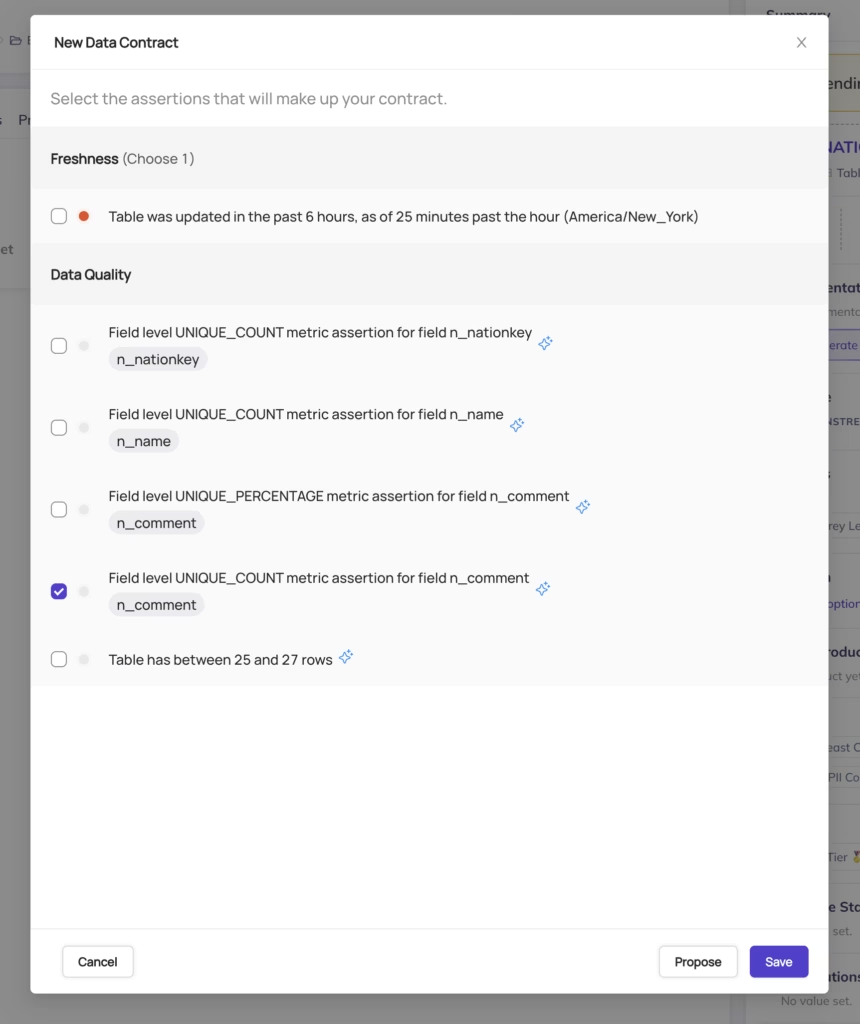
- Verifiable assertions on physical data assets, not just metadata. Contracts include schema checks (columns and types remain stable), freshness checks (data updates within SLA windows), volume checks (row counts within expected ranges), and custom column-level checks (no nulls in critical fields, values within valid ranges).
- Producer accountability: The owner of the dataset owns the contract. They commit to specific quality standards publicly, and the contract status is visible to all consumers. When contracts fail, ownership is clear.
- Consumer confidence: Teams build on datasets with explicit guarantees. If the contract passes, the data meets the committed standards. Consumers stop manually verifying quality because contracts enforce it automatically.
- Breaking change prevention: Schema changes that violate contract assertions fail before reaching production. Contracts in CI/CD pipelines catch breaking changes during deployment, not after consumers break.
Look for systems that provide:
- UI-based contract creation where you select assertions to bundle as public promises
- API-driven contract definition for programmatic creation and management
- Integration with assertion runners (dbt tests, Great Expectations) so results flow back to contract status
- Visibility on asset profiles showing contract status alongside the dataset
The governance impact: Data contracts transform data quality from a reactive firefighting exercise to proactive producer accountability. When quality standards are explicit, verifiable, and continuously monitored, governance teams can trust that policies are being met without manual verification.
4. Business glossaries and standardized terminology
The problem with most approaches: The same business concept has different names across teams. “Customer” means one thing to Marketing, another to Finance, and something else to Product. Critical metrics like “revenue” or “active users” have multiple competing definitions that nobody documented. Teams build dashboards and models using their own interpretations, creating inconsistency that undermines trust.
This terminology chaos creates governance failures:
- Misinterpretation of data because definitions aren’t standardized
- Duplicate assets created because teams can’t find existing ones under different names
- Metrics that don’t align across departments, creating conflicting reports
- Compliance risk when regulated terms like “personal data” lack consistent definitions
What you need instead: Business glossaries that establish authoritative definitions for business terms, metrics, and data concepts. These aren’t static documentation: They link bidirectionally to technical assets so teams can navigate from business concept to implementation and back.
Business glossaries enable governance through:
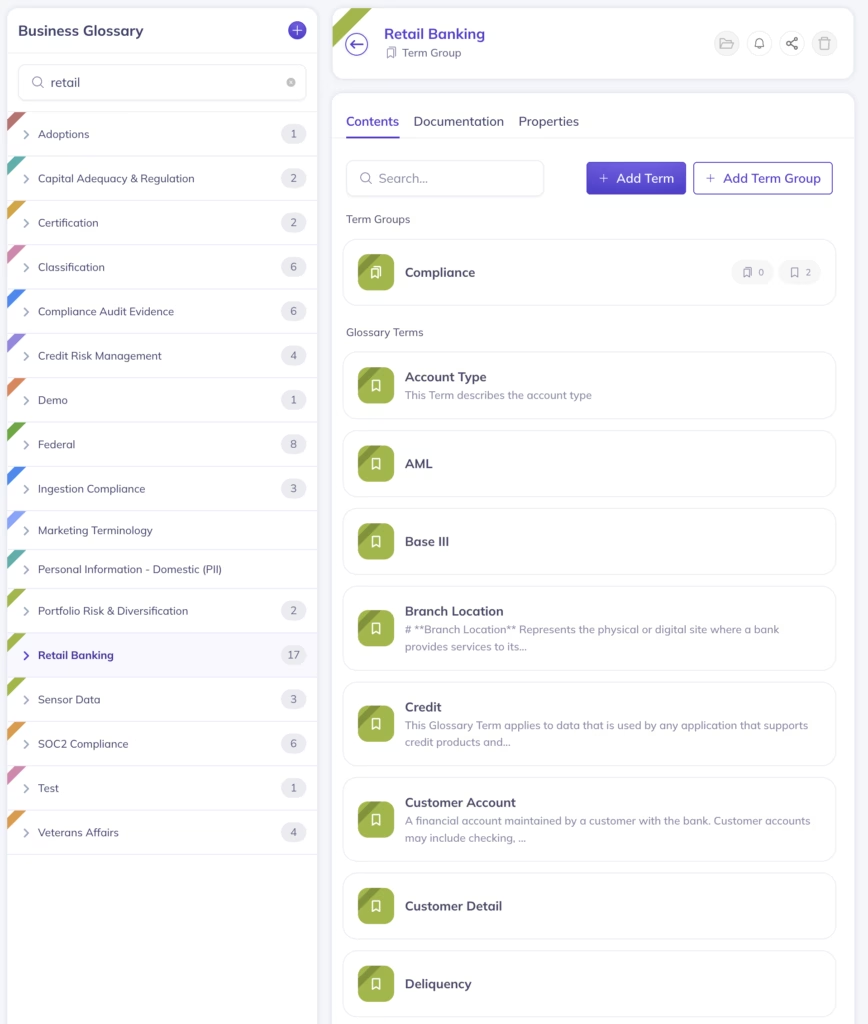
- Standardized definitions where the organization agrees on what terms mean. “Monthly Active User,” “Churn Rate,” “Revenue Recognition”—each has one authoritative definition that everyone uses. No more competing interpretations.
- Bidirectional linking between business terms and technical assets. Click on the “Customer” glossary term to see every dataset, column, dashboard, and model that implements that concept. Or start from a technical table and see which business terms it relates to.
- Hierarchical organization with term groups that reflect your business structure. Group terms by domain (Marketing, Finance, Product) or by type (Metrics, Dimensions, Classifications). Policies can require that assets in certain domains must have terms from specific groups.
- Governance policy integration where glossary terms drive access control and classification. For example: “All datasets tagged with ‘Personally Identifiable Information’ glossary term must have restricted access and require approval workflows.”
Look for systems that provide:
- Self-service glossary creation where domain owners define terms without technical overhead
- Rich term definitions, including business rules, calculation logic, and ownership
- Automatic propagation via lineage (document a source field’s meaning, and downstream uses inherit context)
- Search that understands business language (searching “customer churn” finds the right technical tables)
The governance impact: Standardized terminology prevents misuse through clarity. When everyone interprets data the same way, you eliminate a major source of governance failures—using the wrong data because you misunderstood what it represented.
How DataHub delivers production-ready data governance
Now we know exactly what production-ready governance requires:
- Governance as code with continuous policy enforcement
- Access control and compliance validation through lineage
- Data contracts as producer commitments
- Business glossaries and standardized terminology
The question becomes whether any single platform actually delivers all of this without forcing you to assemble fragmented point solutions. DataHub does—and organizations like Apple, HashiCorp, and Checkout.com prove it in production every day.
Programmatic governance that scales, not manual processes that bottleneck
DataHub’s Actions Framework (the event-driven automation engine) enforces policies as code. When metadata changes, governance rules apply automatically—no manual oversight required for thousands of assets.
Checkout.com drives real-time coverage across their data estate while scaling 42+ teams through programmatic assignment with automated notifications that keep owners informed about quality issues, access requests, and schema changes. “The most important bit of why we use DataHub’s Actions Framework is to allow us to make real-time changes as soon as an event happens.”
Lineage-based propagation means you classify sensitive data once at the source and classifications flow downstream automatically. Quality certifications propagate based on data flow. The same governance team handles dramatically more assets through automation, not headcount growth.
Built on unified metadata, not bolted-on integrations
DataHub unifies discovery, observability, and governance on a single metadata foundation. When MYOB eliminated breaking changes from multiple per week to zero while growing Snowflake usage 4x, it wasn’t through better coordination between tools—it was because real-time governance runs on shared metadata where changes trigger policy enforcement immediately.
The difference: Quality issues detected through monitoring automatically trigger lineage analysis to identify downstream impact. Tag a table as containing PII, and access controls update in real-time. Search results show both relevance and compliance status simultaneously. Document or classify upstream, and context inherits downstream via lineage.
When your catalog doesn’t know about quality issues, your quality tool doesn’t understand lineage, and your lineage doesn’t inform access policies, you’re manually transferring context between systems—introducing delays and errors. Unified metadata eliminates those gaps entirely. No sync delays, no contradictions, no manual handoffs.
Production-scale architecture, not retrofitted batch processing
Legacy catalogs were built for weekly batch updates and human search. DataHub’s event-driven stream processing handles billions of metadata events in real-time—the scale that production AI actually generates.
Zynga processes more than 35 billion records daily, ingests 66 terabytes of data, and runs 100,000+ queries and 4,000+ reports each day—production-scale governance infrastructure that would break legacy batch-oriented catalogs. The disaggregated architecture scales each layer independently (persistence, search, graph, events) so you handle massive metadata volumes without performance degradation.
AI-powered automation, not just AI-assisted search
Ask DataHub provides conversational debugging through natural language: “What datasets contain customer PII?” or “Why did this metric spike yesterday?” The AI agent uses cross-platform lineage and rich metadata to answer with full context.
One financial services customer now resolves metric anomalies in minutes instead of hours using AI-powered debugging with cross-platform lineage that pinpoints upstream quality issues without manual investigation.
The automation enables platform teams to maintain governance standards without scaling headcount as data volumes grow—managing dramatically more assets with the same team size.
Enterprise-grade with open-source foundations
DataHub is the #1 open-source AI data catalog with 14,000+ community members and 3,000+ organizations using DataHub Core in production. The battle-tested APIs and extensible architecture come with enterprise deployment options: cloud, on-premises, or hybrid. SOC 2 and HIPAA compliance satisfy regulatory requirements. In-VPC remote execution agents collect metadata from sensitive environments without data leaving your firewall.
“Our open-source foundations give you freedom from vendor lock-in while enterprise features deliver the production support you need. You benefit from community innovation and shared best practices across thousands of deployments, but you’re not on your own when issues arise. It’s the best of both worlds—extensibility without risk.”
Maggie HaysFounding Product Manager, DataHub
Measurable impact in production environments
The results DataHub customers achieve aren’t projections—they’re measured outcomes:*
- 60-70% reduction in access request time through self-service workflows with embedded approvals
- 100% asset ownership coverage via programmatic assignment at scale
- 30-40% faster compliance audits through continuous monitoring versus episodic reviews
*Results from individual DataHub customers
Product tour: See DataHub in action
Join a demo to see how DataHub unifies discovery, observability, and governance on a single platform.
Ready to scale data governance without slowing down?
DataHub delivers automated workflows and continuous enforcement that scale governance across your data ecosystem without creating bottlenecks.
FAQs
What’s the difference between data governance and data management?
What’s the difference between data governance and data management?
- Data management is the overarching practice of collecting, storing, processing, and using data throughout the data lifecycle
- Data governance is a subset focused specifically on policies, standards, and processes that ensure data quality, data security, and compliance
Think of data management as the entire discipline of handling data, while governance establishes the rules and frameworks that guide how that data is managed. Governance answers who owns data, how quality is maintained, who can access what, and how compliance is ensured.
How is modern data governance different from traditional approaches?
How is modern data governance different from traditional approaches?
Traditional governance relies on periodic audits, manual documentation, and treating quality as an afterthought. It uses fragmented point solutions and reactive processes. A modern and effective data governance program implements:
- Continuous monitoring with automated validation
- Real-time enforcement through data contracts
- Unified platforms where metadata flows between discovery, observability, and governance
A robust data governance strategy provides operational infrastructure that runs in production, not just compliance paperwork created quarterly. Modern approaches use AI for anomaly detection, programmatic policies that scale without manual oversight, and self-service workflows with embedded guardrails.
What are the key roles in a data governance team?
What are the key roles in a data governance team?
- Chief Data Officers provide executive oversight and secure funding for governance initiatives
- Data owners have accountability for specific data domains across business units, making decisions about policies and standards for their areas
- Data stewards handle daily management of data domains, implementing policies and ensuring quality
- Data governance committees establish policies and resolve escalated issues
- Governance teams provide centralized coordination and tool management
For engineers specifically, you’ll interact most with data stewards who implement technical controls and data owners who make decisions about access and quality standards for datasets you work with.
How do you implement a data governance strategy without slowing down data teams?
How do you implement a data governance strategy without slowing down data teams?
Embed governance in existing workflows rather than making it a separate approval gate.
- Enable self-service access requests with intelligent routing—teams request access through UI, owners approve in Slack, and full audit trails maintain regulatory compliance without bottlenecks
- Automate policy enforcement programmatically so rules apply automatically as metadata changes
- Use data contracts where producers make explicit guarantees and consumers trust without manual verification
- Implement governance as code with CI/CD integration to catch issues before deployment
The goal is making compliance invisible to practitioners while maintaining full control and visibility for governance teams.
What is a data catalog and how does it relate to data governance?
What is a data catalog and how does it relate to data governance?
A data catalog is a centralized repository of metadata about your data assets—what data exists, where it lives, what it means, who owns it, and how it’s used. It’s foundational infrastructure for governance because you can’t govern what you can’t see.
The catalog provides the visibility layer that enables discovery, lineage tracking, quality monitoring, and access control. Modern catalogs go beyond static inventories to include real-time metadata, automated documentation, and integration with observability and governance workflows. The catalog becomes the single source of truth that governance policies operate against.
How does data governance support AI and machine learning initiatives?
How does data governance support AI and machine learning initiatives?
AI requires trustworthy, well-documented data with clear provenance. Governance provides the foundation through continuous quality validation that catches issues before they impact model training, lineage tracking that traces from raw data through feature engineering to model outputs, and compliance controls that ensure sensitive data doesn’t leak into training sets.
Governance enables confident deployment from pilot to production by maintaining data contracts, automating quality checks, and providing audit trails. Organizations with strong governance deploy AI three to four times faster because they trust their data foundation and can prove compliance.
What are data contracts and why do they matter?
What are data contracts and why do they matter?
Data contracts are explicit agreements between data producers and consumers about quality expectations, schema definitions, and freshness guarantees. Producers commit to specific service levels—”this table will update hourly with complete records and no null values in critical columns”—and consumers build pipelines based on those guarantees.
Contracts are defined as code and validated automatically. They matter because they prevent breaking changes from reaching production, establish clear ownership and accountability, enable consumer confidence without manual verification, and surface quality issues at the source. Teams using data contracts eliminate breaking changes that previously disrupted downstream systems multiple times per week.
How do you measure the success of a data governance program?
How do you measure the success of a data governance program?
Measure outcomes that matter to practitioners and business stakeholders, not vanity metrics:
Governance maturity:
- Asset ownership coverage (100% coverage means clear accountability)
- Compliance audit preparation time (time reductions show automation working)
- Data team confidence in data quality (via surveys)
Business impact:
- Reduced risk of compliance failure?
- AI deployment velocity from pilot to production
- Data team productivity improvements
Operational efficiency:
- Time saved in data discovery and access requests (reductions indicate better self-service)
- Breaking changes prevented before production deployment
Good governance enables speed and trust simultaneously—metrics should reflect both dimensions.